Armorer’s Bench Assorted-Bore Cleaning Swab Kit - Wood Handle
5 sold in last 24 hours
These aren’t drugstore Q-tips—they’re armorer’s tools. The Armorer’s Bench Assorted-Bore Cleaning Swab Kit uses low-lint cotton on rigid wood handles in multiple diameters and lengths, so you can chase carbon in rails, lugs, ports, and chambers without leaving fibers behind. Long 8" heads probe deep, short 3" sticks give you fast, controlled work around tight geometry. For anyone who treats gun cleaning like gunsmithing, this is how you put solvent exactly where it belongs—and nowhere else.
Precision Cleaning Tools for the Same People Who Obsess Over Tolerances
An automatic knife collector who cares about action timing and lockup usually cares about their guns the same way—tight tolerances, controlled lubrication, zero grit where it doesn’t belong. That’s exactly where the Armorer’s Bench Assorted-Bore Cleaning Swab Kit - Wood Handle earns its keep. It’s 325 pieces of low-lint, rigid-handled control, built for the same kind of detail work you do on a tuned automatic knife or a fitted slide.
Why a Serious Bench Needs More Than Generic Swabs
Generic cotton swabs are fine for bathroom cabinets. On an armorer’s bench, they’re a liability. They shed, they bend, and they smear solvent without telling you what’s actually happening on the metal. This assorted kit fixes all of that with three simple design choices: low-lint cotton, wood handles, and purpose-driven diameters and lengths.
The low-lint heads mean you’re not trading carbon and fouling for stray fibers wrapped around a firing pin or hiding in a slide rail. The wood handles stay rigid enough that when you push into an extractor claw or lug recess, you feel the resistance instead of watching a plastic stem bow and lie to you. And the size breakdown is engineered—not guessed—to match real-world gun cleaning, auto detailing, and electronics work.
Dialed-In Sizes: Every Diameter Has a Job
This isn’t a random mix. It’s a working spread of heads that map to specific tasks on firearms and other precision gear:
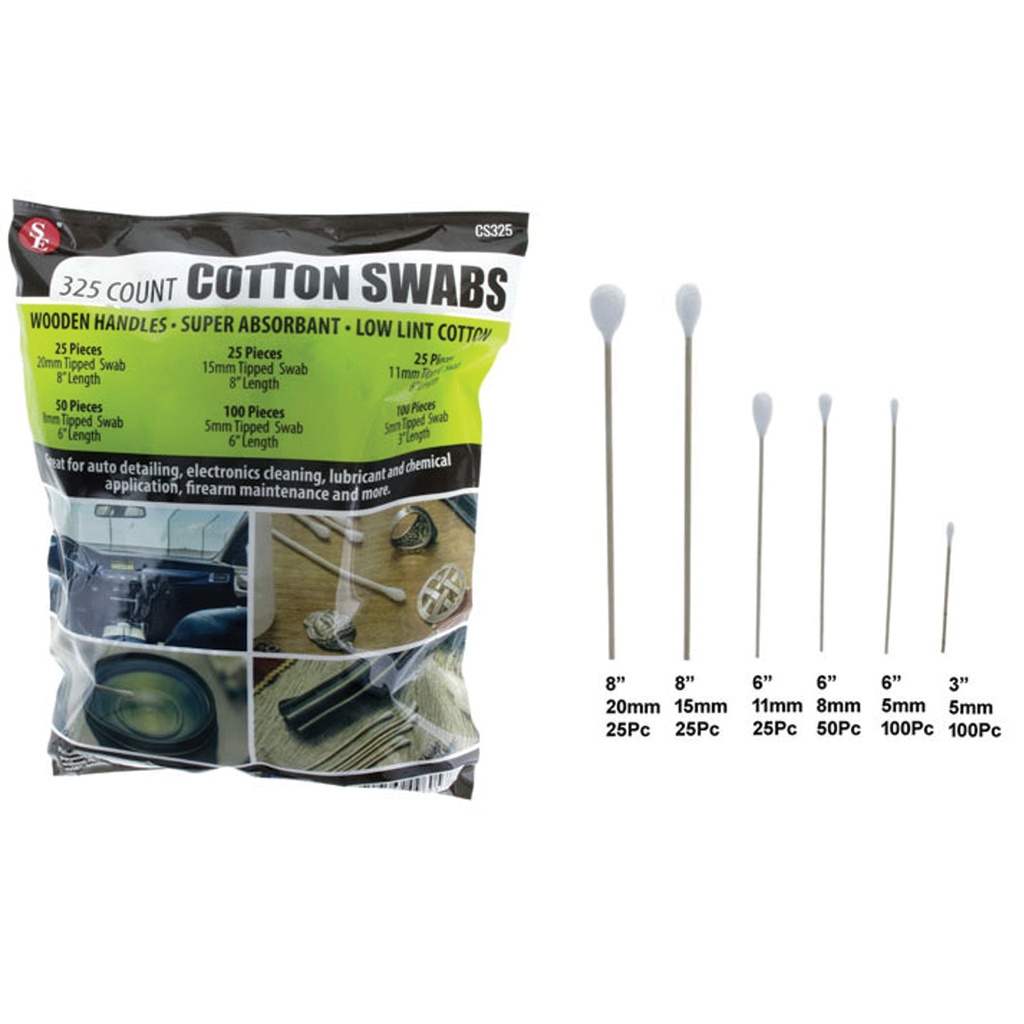
- 20 mm heads on 8" shafts (25 pcs) – Big surface coverage for broad wipe-downs: bolt bodies, carrier exteriors, mag wells, dust covers, and even automotive interior detail work.
- 15 mm heads on 8" shafts (25 pcs) – When you need reach and coverage, but not a full mop. Think slide interiors on larger pistols, shotgun receivers, and around buffer tube threads.
- 11 mm heads on 6" shafts (25 pcs) – The all-rounder. Perfect for rails, trigger housings, gas system interfaces, and anywhere you want targeted pressure with clear feedback.
- 8 mm heads on 6" shafts (50 pcs) – Small enough for tighter channels and ports; ideal for extractor slots, ejector pockets, and tight corners in knife handles or OTF channels if you maintain your own gear.
- 5 mm heads on 6" shafts (100 pcs) – Precision tips for tiny cavities. Think firing pin channels once stripped, optics mounts, screws, and control surfaces on electronics.
- 5 mm heads on 3" shafts (100 pcs) – Short, fast, high-control detailing. When you want fingertip-level feel without excess length getting in the way.
If you’ve ever tried to clean carbon out of a slide lug recess with a fat pharmacy swab, you already know why this breakdown matters.
Mechanical Control: Feel the Surface, Not the Handle
Low-Lint Cotton for Clean, Honest Feedback
On a tuned automatic knife, you feel the difference between a dry pivot and a properly lubed one in the way the blade walks and talks through the action. Cleaning should give you the same honest feedback. Low-lint cotton lets you feel roughness, fouling, or machining marks instead of glazing over them with fibers.
As you work through slides, chambers, or small parts, the cotton conforms slightly to the geometry but doesn’t explode into fuzz. When the swab comes out dirty, you know it’s carbon and residue, not your tool disintegrating on contact.
Rigid Wood Handles: Real Reach, Real Pressure
Wood handles do something plastic doesn’t: transmit force and feel without flex drama. Push into a chamber shoulder, around a feed ramp, or into the corner of an extractor groove and you’ll feel the exact amount of resistance. That means controlled pressure—enough to move fouling, not enough to gouge anything.
The longer 8" lengths get you into barrels from the breach end, into deep receiver cavities, or behind frames and panels in automotive and electronics work. The 3" sticks are your close-quarters tools when you want nothing between your fingers and the workpiece.
From Gun Cleaning to Shop Detail: Built for the Way Enthusiasts Actually Work
Yes, the category is gun cleaning kits, but the people who buy like an armorer rarely stop at one hobby. The same precision that keeps a duty pistol trustworthy also keeps an automatic knife’s action free of pocket grit and an optic’s mounting hardware free of oil slicks.
- Firearm maintenance: Slides, rails, locking lugs, gas blocks, bolt faces, mag feed lips, extractor channels, and firing pin channels once disassembled.
- Automatic knife care: Along pivot hardware, around button cutouts, in OTF tracks (dry, no lint), and inside handle cavities once opened.
- Electronics and optics: Contact surfaces, housings, retention screws, and tight corners where Q-tips are too fat and rags are too blunt.
- Auto detailing: Vents, switchgear, emblem edges, stitching channels, and other spots where precision beats a big, soggy rag.
One kit lives on the bench, and it pays rent across every precision tool you care about.
Why This Belongs Next to Your Automatic Knives and Gun Cleaning Gear
Collectors of automatic knives and serious shooters share a habit: they maintain their own equipment. When you’re already hand-picking steels, actions, and finishes, it makes no sense to clean with disposable, imprecise tools.
The Armorer’s Bench Assorted-Bore Cleaning Swab Kit - Wood Handle gives you a simple edge: clear control over solvent placement, fouling removal, and last-pass inspection. No gimmick, no moving parts—just correct geometry and the right materials. It’s the same logic that separates a good automatic knife from a gas-station clicker: construction, not hype.
What Buyers Ask Before Purchasing an Automatic Knife
Are automatic knives legal?
Under U.S. federal law, automatic knives (often called switchblades in statutes) are regulated mainly by the Federal Switchblade Act, which focuses on interstate commerce and shipment—not simple ownership. Many automatic knife owners can legally buy and possess them, but shipping across state lines, importing, or mailing them can trigger federal rules. Real complexity shows up at the state and local level: some states allow automatic knives with few restrictions, some limit blade length or carry method, and a few still prohibit them outright. Before you buy or carry an automatic knife, check your specific state and local laws—what’s legal to own at home may not be legal to carry concealed or across state lines.
What’s the difference between an automatic knife, OTF, and a switchblade?
Mechanically, an automatic knife is any knife whose blade opens from a closed position by pressing a button, switch, or similar control in the handle, with the blade driven open by an internal spring. A side-opening automatic swings open like a conventional folder, just powered by a spring. An OTF (out-the-front) knife drives the blade along the handle’s axis, exiting and retracting through a slot in the front—single-action OTFs auto-deploy and manual-retract, while double-action OTFs deploy and retract under spring power. The term switchblade is usually the legal and cultural catch-all used in statutes for automatic knives, but enthusiasts use it more narrowly; in practice, most laws treat “switchblade” and “automatic knife” as the same category even though OTFs are a distinct mechanical subset.
What makes this automatic knife worth buying?
When you’re evaluating an automatic knife for sale, focus on three things: action consistency, lock integrity, and materials. A good automatic fires the same every press—no partial deployments, no hesitation—because the spring is properly tuned and the track or pivot is machined cleanly. Lockup should be secure with minimal play; side-to-side or vertical slop is a red flag in both side-openers and OTFs. Finally, blade steel and handle construction should match your use: a well-heat-treated mid-to-high-grade stainless or tool steel, solid pivot hardware, and a handle that can survive repeated recoil from the action. The same mentality that makes you reach for proper armorer’s swabs on the bench should drive your automatic knife purchase: you’re buying execution, not just aesthetics.
Built for the Enthusiast Who Actually Maintains Their Gear
If you’re the kind of buyer who compares double-action OTF mechanisms or knows why a certain steel belongs on an EDC automatic, you already understand why tools like this matter. The Armorer’s Bench Assorted-Bore Cleaning Swab Kit - Wood Handle doesn’t try to be clever—it just gives you precise, low-lint control over every surface that keeps your guns, optics, and automatic knives running like they should.
That’s the difference between owning gear and maintaining a collection.