Backstage Riff Spring-Assisted EDC Knife - Sunburst Guitar
10 sold in last 24 hours
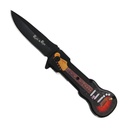
A spring-assisted knife built for the guy who knows the difference between a decent gig and a real show. The Backstage Riff snaps open with a positive, guitar-pick-fast deployment off the flipper tab, locking up on a liner lock behind a matte black drop-point blade. The sunburst electric guitar handle isn’t just novelty—it’s solid metal, pocket clip-equipped, and ready for real EDC cuts between sets, in the shop, or on the road.
Automatic Knives for Sale vs. Assisted Opening: Where This Backstage Riff Fits
If you’re hunting for an automatic knife for sale and you landed here, let’s start with mechanical honesty. The Backstage Riff is not a button-fired automatic knife or OTF switchblade. It’s a spring-assisted opening knife: a folding EDC that requires you to start the motion with the flipper tab, then the internal torsion spring takes over and drives the blade open with authority.
That matters, both for how it carries and how it fits into your collection. You get the fast, satisfying snap that automatic knife buyers love, but with the user-started action of an assisted folder—often a cleaner legal fit in more jurisdictions and a bit more control in the hand.
Automatic Knife for Sale Alternatives: Why This Assisted Riff Still Scratches the Itch
When people search for an automatic knife for sale, they’re usually chasing one thing: instant, positive deployment. This Backstage Riff delivers that feel. The flipper tab is tuned so that once you break the detent, the spring-assisted mechanism whips the 3.25-inch matte black drop-point blade fully open and into a solid liner lock with a single, clean sound—like a well-struck chord.
Is it technically an automatic? No. Mechanically, an automatic knife self-deploys from a button or hidden release. This is a spring-assisted folding knife. But from a user experience standpoint, the difference in speed is negligible for most EDC tasks. What you gain is a more low-profile, guitar-themed piece that rides like a standard folder but behaves like it’s been tuned by somebody who actually cares about action.
Mechanics That Matter: Action, Lockup, and Everyday Use
Any serious buyer wants to know what’s happening under the hood. Here’s the mechanical breakdown.
Spring-Assisted Deployment You Can Count On
The Backstage Riff uses a torsion spring paired with a flipper tab. You initiate the opening with light pressure on the tab; once you pass the detent, the spring handles the rest. The benefit over a pure manual flipper is consistency—opening on a bad angle, with gloves, or with a less-than-perfect grip is still easy. The assist keeps things predictable.
Unlike double action automatic knives, which have to split their engineering between opening and retraction, this knife focuses all its spring tension on a single job: clean, decisive opening. Closing is manual, via the liner lock, which means fewer internal parts, simpler maintenance, and less to go wrong if you actually carry it.
Blade, Steel, and Real Cutting Performance
The blade is a 3.25-inch plain-edge drop point in black-finished steel—an honest working profile. While the exact steel grade isn’t billboarded, think of this as reliable utility steel: easy to touch up, tough enough for box duty, light cord, tape, and general gig-bag chores. The matte black finish helps cut glare and visually ties in with the rock-and-roll aesthetic.
The drop point geometry gives you a centered tip that’s strong enough for everyday puncture tasks without getting needle-fragile. The straight primary edge with a slight belly makes it predictable on a cutting mat, in a warehouse, or breaking down cases of merch after a show.
Automatic Knives for Sale Don’t Usually Look Like This
Most automatic knives for sale chase the same two aesthetics: tactical blacked-out or sterile modern. The Backstage Riff takes a different route entirely—music first, still functional.
Sunburst Guitar Handle: Collector Detail with Actual Structure
The handle is shaped and printed like a sunburst electric guitar: body, neck, fretboard detail, and headstock running down the spine. This isn’t a cheap sticker on plastic. You’re looking at a metal handle with a glossy finish, Torx hardware, and a cutout to expose the liner lock bar. It feels like a real tool in hand, not a hollow novelty prop.
The contouring gives you more than just a picture. The "guitar body" end fills the palm, while the "neck" gives your fingers a natural index point leading toward the flipper tab. It’s a surprising amount of ergonomic sense from a themed knife.
Carry Reality: Clip, Length, and Pocket Presence
Closed, you’re at about 4.75 inches, with an overall open length of 8.25 inches. That puts it squarely in full-size EDC territory—enough blade to get work done, short enough to vanish along a pocket seam. The black metal pocket clip keeps the guitar graphic tight to the pocket line and offers standard tip-down carry.
A lanyard hole at the base of the "guitar" lets you add a fob or cord if you want faster retrieval out of a crowded pocket or bag—useful on stage, on the job, or while traveling with too many cables and tools in the mix.
Legal Context: Where an Assisted Knife Sits Beside an Automatic Knife for Sale
Any time you look at automatic knives for sale, you have to think about legality. Under U.S. federal law, true automatic knives (including many switchblades and some OTFs) are restricted in interstate commerce with carve-outs for military, law enforcement, and certain uses. States then stack their own rules on top of that.
This Backstage Riff is a spring-assisted folding knife, not a button-fired automatic or OTF switchblade. You must manually start the blade with the flipper; the spring only assists once you’ve initiated the motion. In many states, that distinction makes a real legal difference, and assisted openers are treated more like standard folding knives.
That said, local and state laws vary widely. Some jurisdictions lump assisted and automatic together; others don’t. Before you buy or carry any knife—automatic, assisted, OTF, or switchblade—check your current state and local laws, not just federal guidelines. Laws change, and the responsibility sits with the carrier.
What Buyers Ask Before Purchasing an Automatic Knife
Are automatic knives legal?
On the federal level in the U.S., automatic knives (often called switchblades) are regulated by the Federal Switchblade Act. It restricts interstate commerce in true automatics, with exemptions for military, law enforcement, and certain occupational uses. However, the bigger factor for most buyers is state and local law.
Some states allow automatic knives and OTFs broadly, some limit blade length or carry type, and others ban them outright. Spring-assisted knives like this Backstage Riff are often treated as standard folders because you must initiate opening manually, but not everywhere. Always verify your current state and local laws before buying, carrying, or shipping an automatic knife, OTF, or assisted opener. Nothing here is legal advice—just the framework serious buyers pay attention to.
What’s the difference between an automatic knife, OTF, and a switchblade?
Mechanically, an automatic knife is any folder that opens from a closed position to fully locked with a single push of a button, lever, or hidden release. Your thumb does not have to move the blade; the internal spring does all the work once you hit the control.
"Switchblade" is the traditional and legal term often used interchangeably with automatic knife—think side-opening autos that swing out from the handle. OTF (out-the-front) knives are a subtype of automatic where the blade travels straight out the front of the handle, either single-action (auto out, manual in) or double-action (auto out, auto back in off the same slider). The Backstage Riff is none of these—it’s a spring-assisted folder. You start the blade with the flipper; the spring simply finishes the move.
What makes this automatic-style assisted knife worth buying?
Three things: the action, the theme, and the usability. First, the spring-assisted deployment gives you automatic-adjacent speed without full-auto complexity. Second, the sunburst electric guitar handle and "Rock & Roll" blade etch make it a standout music-themed piece in any EDC or novelty collection—this isn’t another black slab with a generic skull. Third, it’s built with real-world use in mind: metal handle, liner lock, pocket clip, workable drop-point blade and a size that actually carries.
If you’re the kind of buyer who appreciates action quality but also wants a knife that tells a story—something you can hand to another musician or collector and watch them grin—this one earns its pocket time.
For Enthusiasts Who Buy More Than Just a Knife
Automatic knives for sale will always have their place: the crisp button fire, the OTF obsession, the pure mechanics. The Backstage Riff sits just beside that world—a spring-assisted EDC with enough snap to satisfy, wrapped in a design that speaks directly to guitar players, concert hounds, and rock-and-roll lifers.
If your collection already has the tactical autos and clean OTFs, this is the piece you add for personality. It’s a usable, assisted-opening EDC knife that still carries the energy of a live set every time the blade snaps open.
| Blade Length (inches) | 3.25 |
| Overall Length (inches) | 8.25 |
| Closed Length (inches) | 4.75 |
| Blade Color | Black |
| Blade Finish | Matte |
| Blade Style | Drop Point |
| Blade Edge | Plain |
| Blade Material | Steel |
| Handle Finish | Glossy |
| Handle Material | Metal |
| Theme | Guitar |
| Safety | Liner Lock |
| Pocket Clip | Yes |
| Deployment Method | Spring-assisted |
| Lock Type | Liner lock |