
Barber’s Heritage Folding Razor Knife - Pakkawood Bone
13 sold in last 24 hours
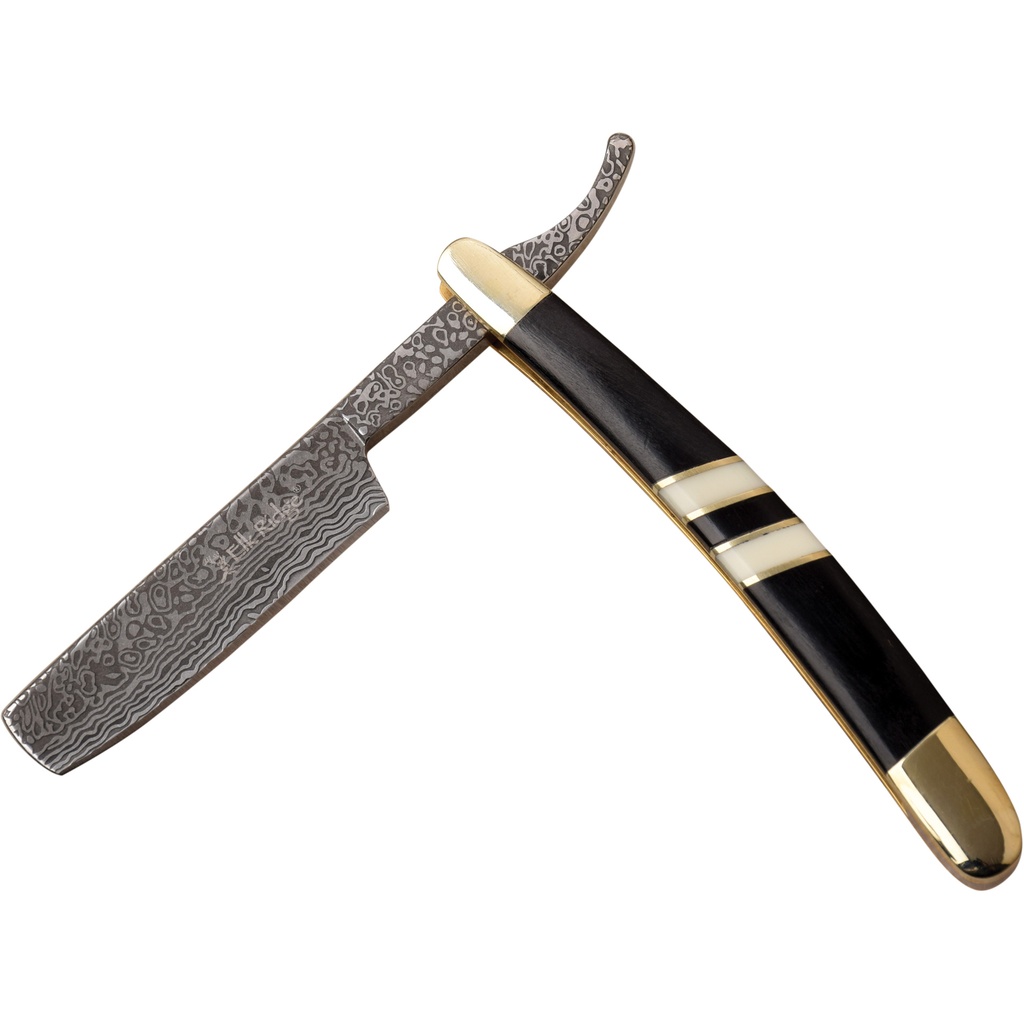
This is not an automatic knife; it’s a compact, straight-razor style folding knife built for the enthusiast who appreciates classic lines and clean mechanics. A 2.75" 3Cr13 razor blade with etched Damascus pattern folds into a 4" pakkawood handle dressed with white bone inlay and nickel silver bolsters. The manual tang hook makes deployment deliberate and controlled, more barbershop ritual than fidget toy. For the collector, it’s a pocketable gentleman’s piece with vintage barber energy at an easy entry price.
Barber’s Heritage Folding Razor Knife - Pakkawood Bone
Let’s get one thing straight up front: this is a manual folding razor-style knife, not an automatic knife, not an OTF, and not a switchblade. If you came here to buy an automatic knife, you’re in the wrong mechanism category—but if you appreciate classic barber razors translated into a compact folding knife, you’re exactly where you should be.
The Barber’s Heritage Folding Razor Knife takes the silhouette of a traditional straight razor and shrinks it into a 6.75" overall folding knife with real pocket manners. The look is pure vintage barbershop: razor-style blade, thumb hook tang, pakkawood handle, white bone inlay, and nickel silver bolsters. It carries like a gentleman’s pocket knife and displays like a small collectible.
Mechanics First: How This Razor-Style Folding Knife Operates
This knife is built around a simple, honest manual action. No springs, no assisted opening—just steel, pivot, and tang hook doing what they were designed to do. The 2.75" 3Cr13 blade is ground in a straight-razor profile with a rounded tip and straight cutting edge. The extended tang hook mirrors traditional barber razors, giving your thumb a positive, familiar point of leverage for controlled opening.
Manual Tang Hook Deployment
Because this is manual, you dictate the pace of the deployment. Thumb the tang hook out of the handle, roll the blade into position, and it settles into a secure open position via the folding joint. There’s a tactile satisfaction here that automatic knife buyers will recognize: that quiet snap when steel seats where it should. It’s not a button-actuated automatic, but the mechanical honesty is the same—the action tells you whether the build was respected.
3Cr13 Steel and Damascus-Etch Pattern
The blade steel is 3Cr13—a stainless workhorse in this price class. You’re not buying super steel here; you’re buying easy maintenance and corrosion resistance. For a razor-style folding knife that will see light cutting, package work, or simply pocket rotation, 3Cr13 makes sense. It sharpens quickly on basic stones and strops to a fine working edge. The etched Damascus pattern isn’t true pattern-welded steel—it’s a cosmetic etch—but it does its job visually, breaking up the flat plane of the blade and giving the piece a custom look at an entry-level cost.
Design Story: Straight Razor Energy in a Folding Knife
Visually, this knife doesn’t pretend to be tactical. It leans fully into gentleman’s razor territory. The 4" handle is shaped with a subtle curve that follows the natural arc of your hand, echoing the spine of a barbershop straight razor. Black pakkawood provides a dark, stable base, interrupted by white bone inlay panels that bring a clean, almost ivory-like contrast. Nickel silver bolsters bookend the handle in gold-tone polish, throwing light at both ends of the profile.
Pakkawood, Bone Inlay, and Collector Appeal
Pakkawood is a resin-stabilized wood—dense, more dimensionally stable than plain hardwood, and capable of taking a smooth, refined finish. Combined with white bone inlay, you get an old-world materials story at a budget-level buy-in. For a collector, that matters: this doesn’t look like a generic plastic-handled folder. It reads as a small gentleman’s razor knife that belongs in a display tray next to your automatics, not tossed in a junk drawer.
The bone inlay, separated by darker spacers, gives the handle rhythm—your eye tracks the pattern from bolster to bolster. That’s the sort of detail people notice at the table when you lay this out next to more expensive custom pieces. It won’t pretend to be custom, but it won’t be mistaken for gas-station fodder either.
Where This Knife Fits in an Automatic Knife Collector’s World
If your primary interest is automatic knives for sale, this razor-style folder is a different lane—but a complementary one. Automatic knife enthusiasts tend to appreciate mechanisms and history, and the straight razor is a foundational cutting tool in that story. Where your double action automatic snaps open from a button or slider, this folds out under your control, with the classic barber tang acting as your deployment interface.
Think of it as the dress watch in a collection full of dive watches. You’re not buying it for hard use; you’re buying it because it tells a particular story: barbershop ritual, vintage grooming, and the evolution of edge tools. It’s the piece you pocket on days when you don’t feel like explaining why your automatic knife fires out the front—you just want a clean, gentlemanly blade that looks right in hand.
Legal Context: Manual Folding Razor vs. Automatic Knife Laws
One of the quiet advantages of this design is legal simplicity. A true automatic knife for sale—whether side-opening or OTF—triggers a more complex legal framework in the U.S. Federal law (the Switchblade Knife Act) and many state statutes address knives that open automatically by a button, spring, or other mechanical device in the handle.
This Barber’s Heritage piece is a manually opened folding knife. There is no spring assist, no button in the handle, and no automatic deployment mechanism. That generally places it in the same legal category as standard pocket knives in most jurisdictions, which are far more widely legal to buy, own, and carry than automatic knives or true switchblades.
That said, knife law is always local. Length limits, concealed carry rules, and city ordinances can still apply. The carry advantage here is straightforward: if your area is restrictive on automatics, a manual folding razor-style knife like this often remains acceptable where a switchblade or automatic knife would not. Always verify your state and local laws before carrying any knife.
What Buyers Ask Before Purchasing an Automatic Knife
Are automatic knives legal?
In the U.S., automatic knives—often called switchblades in statutes—are regulated primarily by federal law and, more importantly, by state law. Federally, interstate commerce and import of automatic knives are restricted with narrow exceptions (such as for military or certain law enforcement uses), but federal law doesn’t outright ban personal possession.
The real complexity lives at the state and local level. Some states broadly allow automatic knives, some permit ownership but restrict carry, and others limit blade length or ban them outright. City ordinances can add another layer. That’s why many enthusiasts keep both automatics and manual folders in their rotation: you carry the automatic knife where it’s legal and default to a manual like this razor-style folder in more restrictive environments. Whatever you choose, check up-to-date knife laws for your specific state and municipality before you buy or carry.
What’s the difference between an automatic knife, OTF, and a switchblade?
Mechanically, an automatic knife is any knife that opens from a closed position by pressing a button, lever, or similar control, with a spring doing the work of deployment. "Switchblade" is the legal term often used in statutes to describe that same class of knives. In enthusiast language, most switchblades are automatic knives, and most automatic knives fit the legal definition of a switchblade.
OTF—out-the-front—refers to the blade’s path of travel, not the legality. An OTF automatic knife has a blade that extends and retracts along the handle’s long axis, usually via a sliding actuator. A side-opening automatic opens like a traditional folder but is still driven by a spring from a button or release. This Barber’s Heritage piece is neither automatic nor OTF; it’s a manual folding razor-style knife that requires you to physically swing the blade open with the tang hook, with no spring assist.
What makes this folding razor knife worth buying?
For the price and category, it hits a combination that’s hard to ignore: a recognizable straight-razor profile, Damascus-etch visual interest, stabilized pakkawood, real bone inlay, and nickel silver bolsters—all in a compact 6.75" overall package. You’re not paying for exotic steel or complex locking hardware; you’re paying for a gentleman’s aesthetic that slots neatly into a collection heavy on tactical and automatic pieces.
As a gift, it reads premium without demanding custom-knife money. As part of a collection, it fills the classic grooming/razor niche, offering contrast to the modern automatics and OTF knives on the same shelf. As an occasional carry, it’s a pocket-friendly conversation piece with low legal friction compared to an automatic knife in more restrictive jurisdictions.
For the Enthusiast Who Knows the Difference
If you live in the world of automatic knives for sale, you already understand that mechanism defines the knife. This Barber’s Heritage Folding Razor Knife doesn’t try to be something it’s not. It’s a clean, manual straight-razor style folder with honest materials and a vintage barbershop footprint. You add it to your rotation not because it fires like your favorite double action, but because it reminds you why you fell in love with edged tools in the first place: steel, edge, history, and a design that knows exactly what it is.