
Black Trial Executioner Display Axe - Chained Pommel
7 sold in last 24 hours
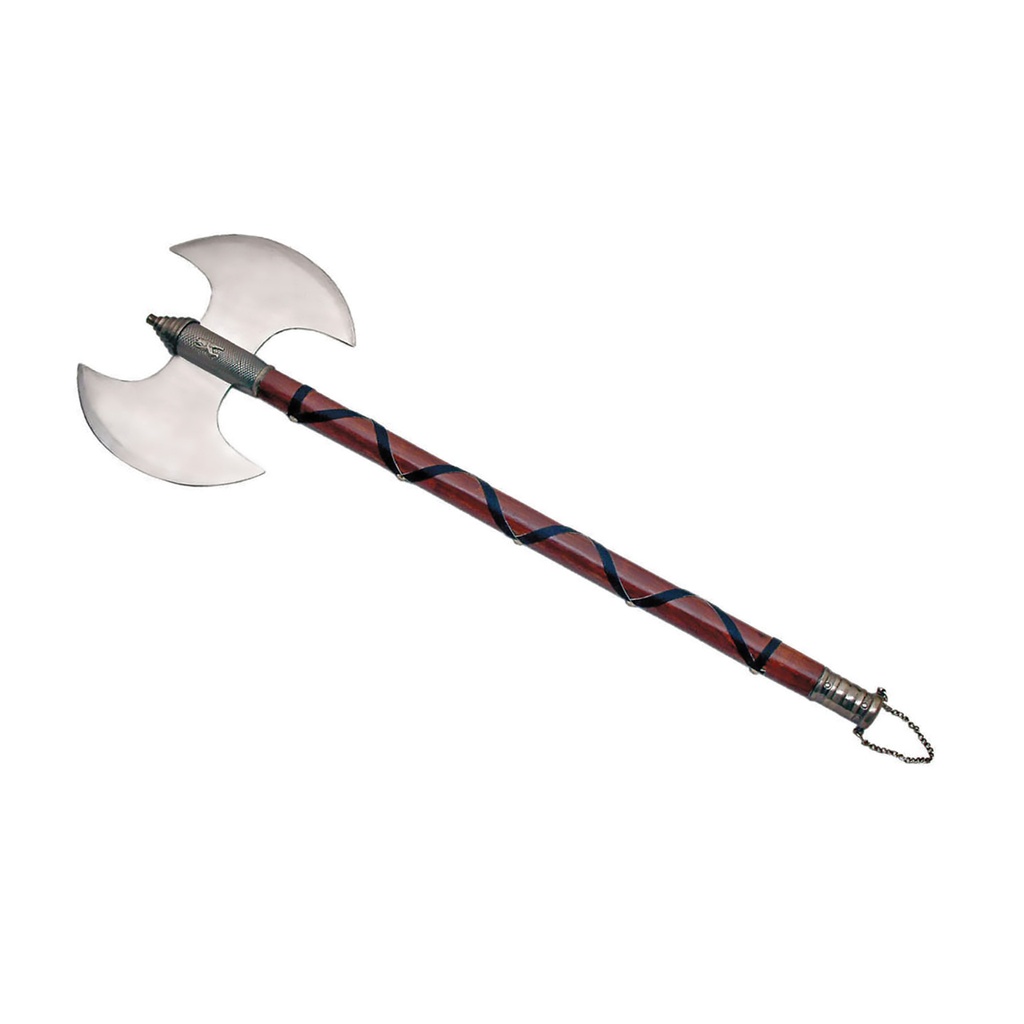
This isn’t a camp axe, it’s a statement piece. The Black Trial Executioner Display Axe pairs a dramatic double-bit blade with a straight 32" wood shaft and black spiral leather wrap for a secure, period-correct grip. The polished heads and chained pommel drive the medieval executioner theme hard, making it ideal for wall display, costumes, stage, or dungeon-style decor. For collectors and reenactors who want their gear to look like it walked off a scaffold, not a toy aisle.
Executioner Display Axe for Sale – Medieval Presence, Stage-Ready Design
The Black Trial Executioner Display Axe is built for atmosphere, not firewood. At 32 inches overall with a double-bit crescent head, polished steel finish, and a chained pommel, it hits that sweet spot between historical inspiration and theatrical, display-ready drama. If your collection leans toward medieval justice, dungeon aesthetics, and executioner lore, this is the kind of axe that reads clearly from across the room.
Why This Executioner Axe Belongs in a Serious Medieval Display
Most cheap “medieval axes” look like plastic toys the second you get within arm’s length. Here, the visual weight comes from familiar historical cues: a double-headed blade, a straight wooden shaft, and a black leather wrap that actually looks like someone planned to hold it with intent. The polished metal catches light in a way that works in a dim game room, on a convention floor, or under stage lighting, while the wooden handle keeps it grounded in the right era.
This is a ceremonial-style executioner axe, not a battlefield bearded axe or a modern tactical tool. The symmetrical double-bit profile and long, uninterrupted handle line are there to signal one thing: this piece is about the ritual, the moment, the spectacle. That makes it perfect for display walls, themed bars, haunted attractions, or costume builds where the silhouette matters as much as the materials.
Handle Construction and Balance – Wood Core, Leather Spiral Grip
The core of the axe is a straight wood shaft with a smooth finish. That matters for two reasons. First, visually, it reads correctly as a medieval pole-style weapon—no plastic texture, no gimmick shapes, just clean, cylindrical wood. Second, for handling, a straight shaft with predictable diameter feels natural in the hands whether you're posing for photos, rehearsing stage movement, or setting it into a wall rack.
Spiral Leather Wrap for Grip and Visual Flow
The black leather wrap is more than decoration. The diagonal spiral creates alternating ridges and channels your hand locks into when you slide up or down the shaft. On stage or in costume, that makes a difference: you can shift grip quickly without the axe rolling or feeling vague in the palm. Visually, the wrap also draws the eye along the length of the handle, tying the polished head to the metal pommel and chain in one continuous line.
Double-Bit Head and Polished Finish
The double-bit head uses a crescent-style profile on both sides, giving you that classic executioner outline from any angle. For display, that’s critical: hang it blade-forward, blade-up, or at a diagonal and the silhouette stays instantly recognizable. The polished finish isn’t just shine for the sake of shine—it creates high contrast against both dark walls and lighter backdrops, so the axe doesn’t visually disappear in dim or mood-lit spaces.
Chained Pommel Detail – Display Function and Thematic Attitude
At the base of the handle, a metal pommel with attached chain finishes the piece. Functionally, that chain gives you an easy anchor point for hanging the axe, integrating it into a larger wall display, or tying it into costume rigging without drilling into the wood or blade. Thematically, it leans heavy into the dungeon aesthetic—chains, confinement, and punishment—so the axe feels like part of a larger story instead of a standalone prop.
Use Cases – Where This Executioner Axe Actually Shines
This is not a working camp or splitting axe and shouldn’t be treated as such. It’s a medieval-style display and costume piece built to sell the image of an executioner’s weapon. That makes it particularly well suited for:
- Wall Displays & Decor: Game rooms, home theaters, themed bars, and dungeon-style decor layouts.
- Cosplay & Costume Builds: Executioner, headsman, dark knight, or fantasy judge characters.
- Stage & Haunted Attractions: Theater productions, haunted houses, immersive medieval or fantasy experiences.
- Photo & Video Shoots: As a visually convincing foreground prop that reads “medieval wrath” without looking like plastic.
What Buyers Ask Before Purchasing an Automatic Knife
Are automatic knives legal?
Under U.S. federal law, automatic knives—often called autos or switchblades—are regulated primarily by the Federal Switchblade Act. That law mostly targets interstate commerce and shipping, not simple possession. Federally, autos generally cannot be mailed through USPS and have specific restrictions when crossing state lines. The real deciding factor for carry is state and local law. Some states allow automatic knives with few limits, others restrict blade length, opening mechanism, or who can carry them, and a few still ban them outright. Before you buy an automatic knife or assume it’s legal to carry, you need to check the current knife laws in your state and any city you actually live in or travel through. Laws change, and the responsibility to comply is on the owner.
What’s the difference between an automatic knife, OTF, and a switchblade?
“Automatic knife” is the broad mechanical category: a blade that deploys from a closed position using a spring or stored energy, triggered by a button, lever, or similar control, without you manually moving the blade along its path. A switchblade is essentially the traditional side-opening automatic knife—think classic button-activated folders where the blade swings out from the side of the handle under spring pressure. An OTF (out-the-front) automatic is a subtype where the blade travels linearly out of the front of the handle rather than pivoting from the side. OTFs can be single-action (spring-driven one way, manually reset) or double-action (spring-driven both out and back in). All OTFs are automatic knives, but not all automatic knives are OTFs. In every case, the defining trait is spring-powered deployment from a fully closed position via a dedicated control.
What makes this executioner axe worth buying?
If you’re collecting medieval-style weapons or building out themed decor, this axe earns its place on the wall by nailing the silhouette and the details. The double-bit crescent head, straight wooden shaft, and spiral leather wrap read as convincingly medieval at a glance, while the polished metal and chained pommel push it into theatrical, display-grade territory. It looks like a headsman’s tool, not a novelty toy, and that makes it a strong anchor piece for a scaffold scene, dungeon wall, or executioner costume kit.
For Collectors Who Care About the Story Their Gear Tells
This Black Trial Executioner Display Axe isn’t pretending to be a survival tool or a modern tactical implement. It’s honest about what it is: a medieval-inspired showpiece built to project judgment, ritual, and wrath. For the enthusiast who already owns the high-end automatic knife, the customized OTF, and the historically influenced blades, an executioner’s axe like this adds a different kind of presence to the collection—big, unapologetic, and instantly readable from across the room.