
Blackout Control Triple-Wick Survival Candle - Silver Tin
12 sold in last 24 hours
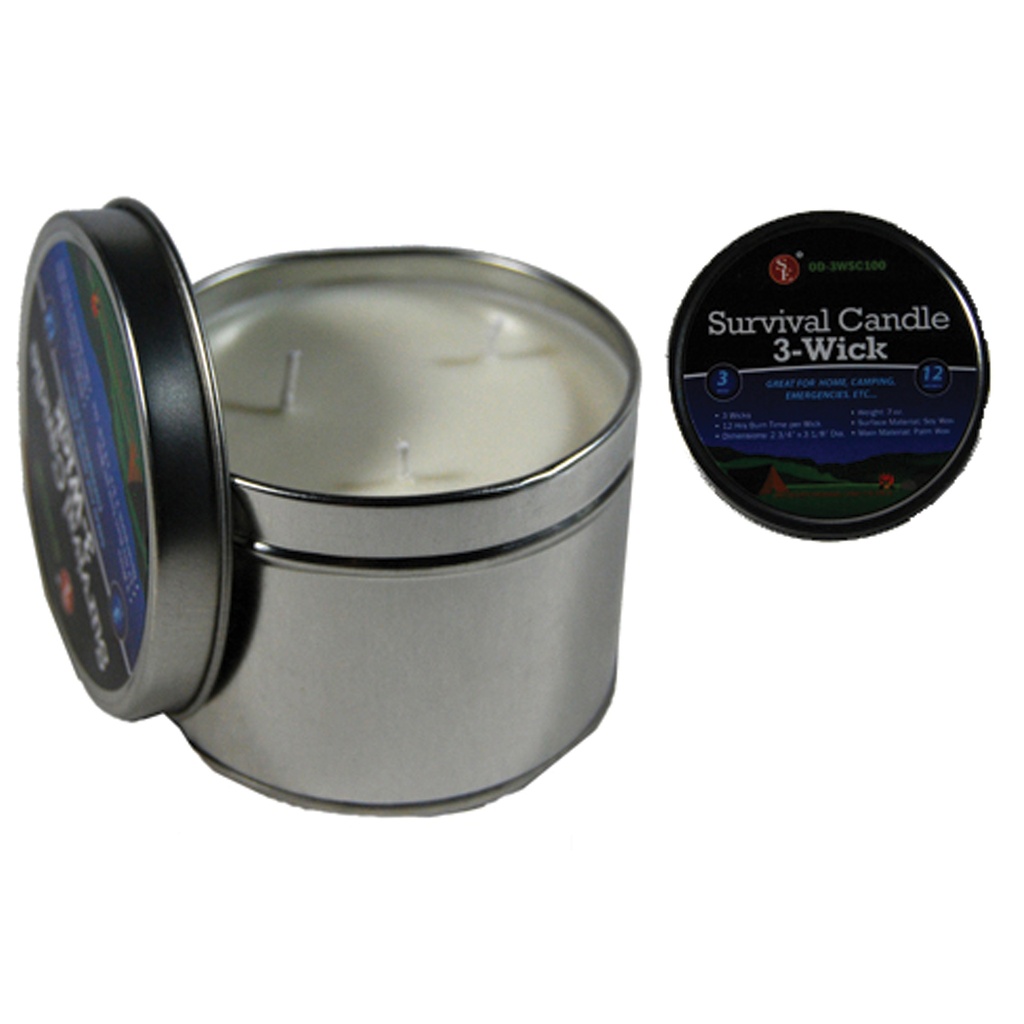
When the power dies, this survival candle earns the space in your kit. Three wicks let you choose between low-profile glow and serious light and warmth, with up to 36 hours of total burn from clean soy wax. The compact silver tin with slip-on lid rides easily in glove boxes, go-bags, and home blackout kits, staying protected until you actually need it. Simple, reliable, and built to be forgotten—right up until it’s the only light that matters.
Blackout Control Triple-Wick Survival Candle - Silver Tin
If you’re the kind of person who cares which steel is in your EDC blade and how your automatic deploys, you already know this: gear either earns its place or it doesn’t. This triple-wick survival candle is the emergency equivalent of a proven, no-drama automatic knife—quiet, compact, and absolutely there when the lights go out.
Designed Like Real Gear, Not Home Décor
This isn’t a scented jar candle pretending to be emergency equipment. The Blackout Control Triple-Wick Survival Candle - Silver Tin is built on the same principle as serious carry gear: simple mechanics, reliable performance, and no fragile nonsense.
The matte silver metal tin takes a beating in a glove box, go-bag, or camp kit. The slip-on lid keeps the triple-wick soy surface clean and ready, while the compact 2.75" x 3.125" form factor drops into side pockets and organizers the way a well-sized automatic knife disappears in a pocket sheath.
Triple-Wick Layout: Control Your Light Like You Control Your Blade
Think of the three wicks as selectable modes, the way you’d think about deployment options or blade profiles:
Single Wick: Stealth Mode and Long Runtime
Run one wick when you want just enough light to move, read, or keep morale up without broadcasting a beacon. One wick gives you up to 12 hours of burn—slow, controlled, efficient. It’s the emergency equivalent of carrying a slim, low-profile automatic knife: enough tool, zero excess.
Dual or Triple Wick: Room Light and Heat On Demand
Light two or all three wicks when you need real illumination or a bit of warmth. All three push out serious light for a small form factor, trading raw runtime for usable brightness, just like choosing a heavier-duty blade when the task demands it. Total combined wax volume supports up to 36 hours of burn time across all wicks.
Soy Wax and Indoor Use: Clean-Burning Under Stress
When the power drops, you’re usually indoors. That’s where the choice of soy wax matters. Soy burns cleaner than traditional paraffin, helping keep the air clearer in closed rooms where ventilation is already compromised. It’s the same mindset as spec’ing better steel in a blade—not for a label, but for performance where it counts.
Indoor-safe design and a contained metal tin body mean you can set this on a stable surface and trust it to do its job without fragility or drama. Extinguish easily, lid on, and it’s ready for the next outage.
Built for Kits, Bags, and Real Emergencies
Preparedness is carry logistics. Just like you don’t EDC a giant fixed blade if you actually plan to carry it, blackout gear has to fit your life to be there when you need it.
- Compact size: 2.75" diameter and 3.125" height slide into pack organizers, center consoles, and home kits.
- Durable metal tin: Handles getting knocked around with the rest of your gear.
- Slip-on lid: Protects the wicks from dust, moisture, and pocket debris until it counts.
Home, truck, cabin, or camp—this belongs wherever you’d stash a reliable automatic knife or multitool. Forget about it until things go sideways, then be very glad it’s there.
Survival Candle Mechanics That Actually Matter
We obsess over pivot tolerances and lockup on knives because details change performance. The same mindset applies here—small design choices add up in an emergency.
Three Independently Usable Wicks
You don’t have to waste burn time. Light what you need: one wick for navigation and sanity, three when you’re cooking, working, or warming hands. Because each wick is drawing from the same wax pool, you’re choosing how quickly you consume the total 36 hours of fuel, not locked into a fixed, all-or-nothing burn.
Metal Tin as Heat Shield and Transport Shell
The round metal tin isn’t just there to look "outdoorsy." It acts as a physical barrier between an active flame and whatever surface you’re on, and it protects the wax and wicks when stored. Just like a good handle scales and liners protect a blade and mechanism, this container keeps the candle intact through real use, not just shelf life.
Why Serious Gear People Add This to Their Setup
If you’ve spent time dialing in your carry—choosing the right automatic knife, the right light, the right multitool—you already understand redundancy and simplicity. A survival candle fills a different role than a flashlight or headlamp: it provides light, passive heat, and a focal point in stressful situations. No batteries, no switches, nothing to leak.
It’s there for extended blackouts, winter storms, stuck vehicles, and power failures at remote cabins. It lives with the rest of your emergency kit, quiet and low-maintenance, until the grid fails and it becomes the most valuable piece of gear on the table.
What Buyers Ask Before Purchasing an Automatic Knife
Are automatic knives legal?
In the U.S., automatic knives are regulated primarily at the state level, with a federal layer that mostly governs interstate commerce. Federally, it’s legal to own an automatic knife, but the Federal Switchblade Act restricts interstate shipment and certain commercial transfers, with exemptions for military, law enforcement, and some one-handed individuals. State laws vary drastically—some states allow carry with few limits, others allow possession but restrict concealed or open carry, and a few heavily restrict or ban automatics outright. Before you buy or carry an automatic knife, check your specific state and local laws; what’s completely acceptable in one jurisdiction can be a chargeable offense in another.
What’s the difference between an automatic knife, OTF, and a switchblade?
Mechanically, an automatic knife is any knife that opens its blade using a stored-energy mechanism (usually a spring) when you activate a button, lever, or switch on the handle—no manual blade movement required. An OTF (out-the-front) knife is a specific type of automatic where the blade travels along the axis of the handle and deploys straight out the front, rather than pivoting from the side like a traditional folder. A switchblade is essentially the legal and cultural term used—especially in law and statute—for automatic knives; in many legal texts, “switchblade” and “automatic” are referring to the same general mechanism. Not all automatics are OTF, but most OTFs are automatic. Side-opening automatics, double-action OTFs, and single-action OTFs are all subtypes within that larger automatic/switchblade category.
What makes this survival candle worth buying?
It earns space in your kit the same way a well-built automatic knife does: by combining simple, proven mechanics with dependable performance. You get a total of up to 36 hours of burn from clean soy wax, three independently usable wicks for output control, a tough metal tin that’s actually packable, and a lidded design that protects the candle between emergencies. No decorative filler, no gimmick features—just a compact, purpose-built light and heat source that’s ready for real-world failures, not just marketing photos.
Preparedness for People Who Actually Use Their Gear
The Blackout Control Triple-Wick Survival Candle - Silver Tin is the blackout equivalent of a trusted automatic: compact, tough, and dead simple to deploy when things go bad. If you’re the kind of buyer who chooses an automatic knife for its mechanism, tuning, and reliability—not because it looks cool on a shelf—this is the same philosophy applied to emergency light. Add one to your home kit, one to your vehicle, one to your go-bag, and know that when the switch flips and the power dies, you’ve already made the smart, gear-first choice.