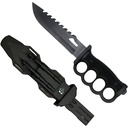
Blackout Trench-Guard Survival Fixed Blade - Matte Black
5 sold in last 24 hours
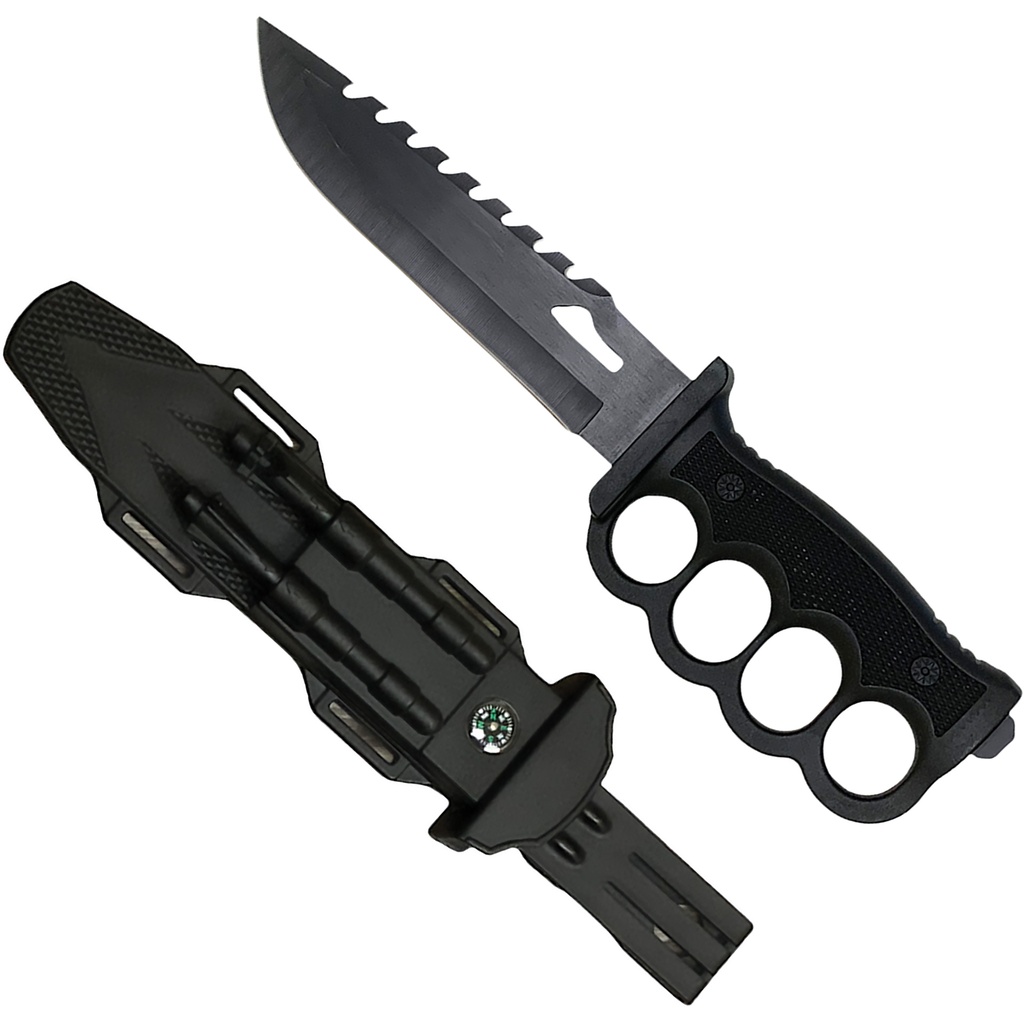
This isn’t a wall-hanger; it’s a blackout trench-guard survival fixed blade built for hard use. The full-tang, matte black clip point with partial serrations and a sawback spine gives you cutting, ripping, and notching options in one tool, while the knuckle-guard handle locks in your grip when things get sketchy. A rigid sheath with belt slots and an integrated compass keeps this knife ready on your rig, pack, or in the truck—field-oriented, no-nonsense, and made to be used, not babied.
Blackout Trench-Guard Survival Fixed Blade - Matte Black
The Blackout Trench-Guard Survival Fixed Blade is what happens when someone actually thinks through how a budget tactical-survival knife gets used in the real world. This isn’t a fantasy prop. It’s a full-tang, trench-guard fixed blade built to ride on a belt or pack, get knocked around, and still give you confident grip, usable edge geometry, and direction-finding in one package.
Why This Fixed Blade Belongs Next to Your Automatic Knife for Sale Shortlist
If you’re the kind of buyer who already scans pages looking for an automatic knife for sale, you know the rule: folders ride in the pocket, fixed blades carry the ugly jobs. Where your automatic or OTF knife handles day-to-day cutting and fast one-hand deployment, this trench-guard fixed blade is the hard-use counterpart—strapped to kit, sitting in a truck door, or lashed to a pack. The synergy matters: fast action in the pocket, full-tang leverage on your belt.
Instead of chasing another cheap switchblade clone, this piece gives you something different: a matte black, knuckle-guard fixed blade that takes the abuse your nicer automatic knives shouldn’t see. Pair it with your favorite double action automatic for EDC, and you’ve covered both speed and brute-force cutting without pretending one blade can do everything.
Mechanics of Control: Blade Geometry, Grip, and Real-World Use
This knife isn’t about action speed; it’s about mechanical control once it’s in hand. Start with the blade: a matte black clip point with a partially serrated edge near the handle and a sawback spine. The clip point gives you a fine enough tip for controlled thrusts and detail cuts, while the main plain edge handles push cuts and slicing without fighting you. The partial serrations near the handle do what they’re supposed to—chew through rope, webbing, and fibrous material when clean slicing isn’t an option.
The spine saw teeth aren’t there for decoration. They’re aggressive enough for notching, rough cutting branches, or working through light material in the field—think survival improvisation, not woodworking finesse. Full-tang steel running through the handle scales anchors the whole package, giving you rigidity and predictable flex under torque instead of that hollow, vague feeling you get from cheaper rat-tail tang setups.
Knuckle-Guard Ergonomics: Why the Handle Matters
The trench-style knuckle guard is the defining feature. Four finger holes lock your hand into the knife, which changes the leverage profile completely in close-quarters or when your grip is compromised by mud, sweat, or gloves. It’s control first, intimidation second. The textured matte black handle scales give you traction without turning into sandpaper, and the guard itself serves as both hand protection and an impact option when you don’t want to cut but still need to send a message.
Sheath System and Compass: Field-Ready, Not Shelf Candy
The rigid black sheath does what a survival-tactical sheath should: protect the edge, retain the knife, and give you mounting options. Multiple strap slots let you run it on a belt, lash it to MOLLE, or rig it to a pack strap. The sheath-mounted compass is a simple, old-school redundancy—no batteries, no pairing, just a quick cardinal-direction check when GPS or phones get stupid. The dual tubular features on the sheath face give you extra storage potential for small essentials, rounding out the "grab and go" survival profile.
Choosing This Over Another Automatic Knife for Sale
For collectors who live in the automatic space—OTF, side-opening, double action switchblades—the temptation is always to grab another mechanism. But every serious kit needs at least one fixed blade that can take hits your auto shouldn’t. This trench-guard survival knife is that piece. Matte black, full-tang, and unapologetically purpose-built, it complements your best automatic knife for EDC instead of trying to replace it.
If you buy automatic knife after automatic knife, you already know the limits: pivot strength, lock geometry, and legal gray areas as soon as you cross the wrong state line. A fixed blade like this bypasses the action mechanism entirely. No springs to fail, no buttons to gum up, no deployment lag. Pull, draw, work. That simplicity is its own kind of engineering elegance.
Legal Perspective: Where a Fixed Blade Simplifies the Equation
When people search for an automatic knife for sale, the legal question is never far behind. Automatic knives, OTFs, and switchblades live in a patchwork of state and local restrictions—blade length caps, assisted-opening versus automatic definitions, and outright bans. A non-folding, manually drawn fixed blade like this trench-guard model often sits in a different legal category.
Most jurisdictions regulate fixed blades on dimensions, carry method (open vs concealed), and intent, not on whether a spring or button deploys the edge. That doesn’t mean "anything goes"—you still need to check your local and state laws before carrying—but it does mean this knife sidesteps many of the automatic and switchblade-specific statutes that complicate OTF and button-activated folders. For buyers who already juggle automatic knife legal to carry questions, a straightforward fixed blade is a welcome bit of clarity.
What Buyers Ask Before Purchasing an Automatic Knife
Are automatic knives legal?
In the United States, federal law (the Switchblade Knife Act) restricts interstate commerce and mailing of automatic knives and switchblades, especially across state lines and into certain jurisdictions. However, possession and carry are primarily governed by state and local law. Some states allow automatic knives with few restrictions, some limit blade length or carry style, and others still ban them outright for civilians. Always check your state and municipal codes and remember that crossing a border with an automatic or OTF knife can change your legal status instantly. A fixed blade like this trench-guard model generally falls under different statutes, but you still need to confirm what is legal to carry where you live and travel.
What’s the difference between an automatic knife, OTF, and a switchblade?
Mechanically, an automatic knife is any folding knife where the blade is deployed by a button, switch, or similar control and driven open by a spring—press, and the blade snaps open under stored energy. A switchblade is the traditional legal term for that same family of button-activated automatics, usually side-opening. An OTF (out-the-front) knife is a specific subtype of automatic where the blade travels linearly out of the handle’s front instead of pivoting from the side. Many OTF knives are double action: push the slider forward to deploy, pull it back to retract, both powered by internal springs and tracks. The knife on this page is none of those—it’s a fixed blade: full-tang, no moving parts in the action, drawn from a sheath instead of deployed from a handle.
What makes this automatic knife worth buying?
If you’re already browsing automatic knives for sale, the better question is: what makes this alongside your autos worth buying? Mechanically, you get a full-tang, trench-guard fixed blade with a clip point, partial serrations, and sawback—all in a matte black package designed for low profile and real-world abuse. The knuckle-guard handle gives you locked-in retention and impact options in tight spaces, while the sheath-mounted compass and mounting options push it into genuine survival territory. It’s the knife you reach for when you don’t want to risk prying or batoning with your favorite double action automatic knife.
Built for the Buyer Who Chooses Tools on Purpose
This Blackout Trench-Guard Survival Fixed Blade isn’t trying to compete with your best automatic knife for sale on deployment speed or fidget factor. It’s the counterweight: simple, rugged steel, a trench-guard handle that doesn’t apologize for its intent, and a sheath system that admits this knife is supposed to live in the field, not a display case. If you’re the kind of enthusiast who knows why mechanism distinctions matter—automatic versus OTF versus fixed—this piece earns its space by doing the one thing that makes any blade worth owning: it shows up when conditions get ugly, and it just works.
| Blade Color | Black |
| Blade Finish | Matte |
| Blade Style | Clip Point |
| Blade Edge | Partial-Serrated |
| Blade Material | Steel |
| Handle Finish | Matte |
| Handle Material | Plastic |
| Theme | Knuckle Guard |
| Tang Type | Full Tang |
| Carry Method | Belt Carry |
| Sheath/Holster | Sheath |