Campfire Line-Stroke Fillet Knife - Faux Stag
11 sold in last 24 hours
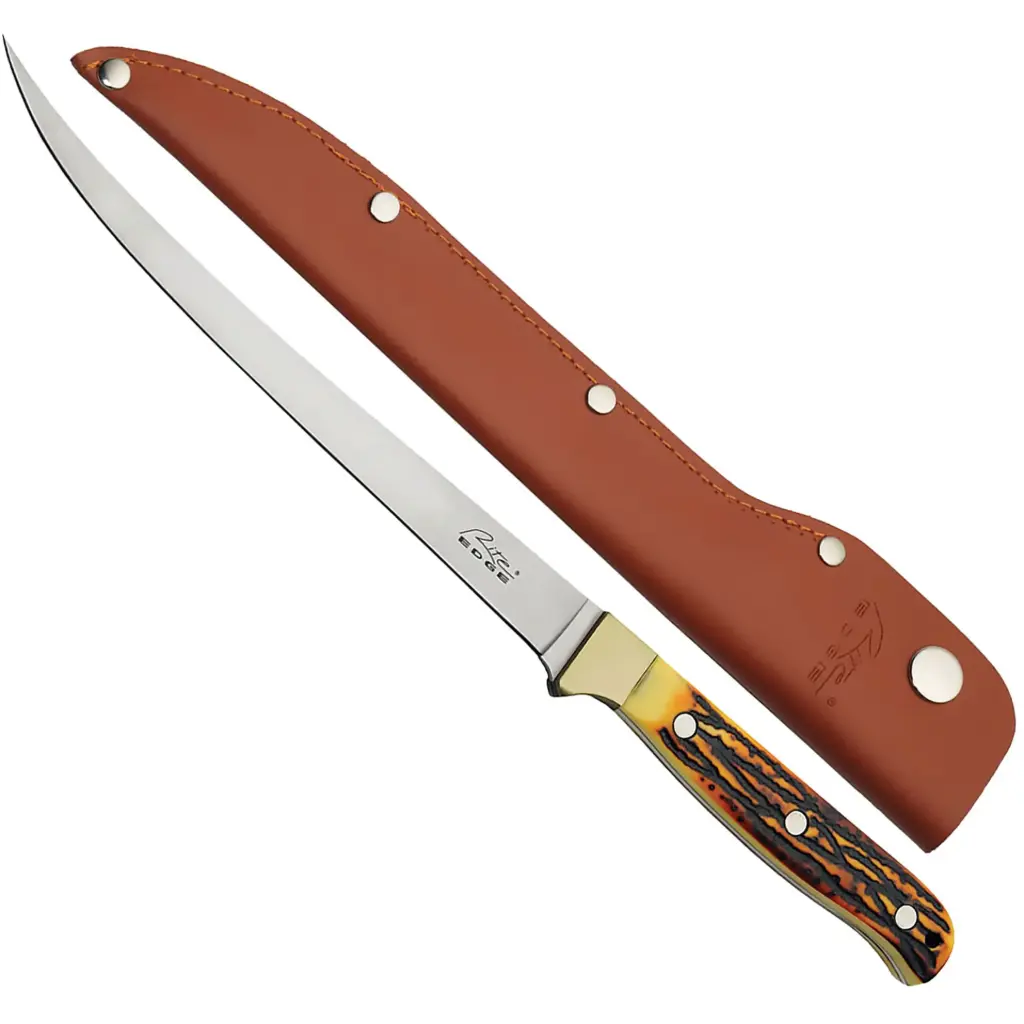
This isn’t an automatic knife—it’s a classic fillet tool dressed in hunting-camp clothes. The Campfire Line-Stroke Fillet Knife pairs a 7.5" full tang trailing-point blade with a flexible, polished profile built for clean, controlled cuts along bone and skin. A faux stag handle with brass guard and pommel locks into the hand, while the split leather sheath rides on your belt from dock to tailgate. It’s an old-school fillet knife look with the work-focused geometry serious anglers actually need.
Before You Buy an Automatic Knife: Why a Classic Fillet Still Belongs in Your Kit
If you’re the kind of buyer who types “automatic knife for sale” and actually means it, you already know the difference between a button-fired side-opener, an OTF, and every junk switchblade knockoff out there. But here’s the thing serious users and collectors all learn: your kit isn’t only about fast deployment. Sometimes, slow and precise beats instant and loud.
The Campfire Line-Stroke Fillet Knife - Faux Stag is one of those blades. It’s not an automatic knife, not an OTF, not a switchblade. It’s a classic 7.5" full tang fillet knife built for real work at the cleaning table and in camp, with the kind of geometry you just don’t get from an automatic folder. You carry your auto for EDC; you reach for this when it’s time to turn fish and game into dinner.
When You Buy an Automatic Knife, You Still Need Purpose-Built Steel on the Table
Collectors and serious users who buy automatic knives for daily carry usually share a common trait: they respect the right tool for the job. You might love a double-action automatic for fast deployment, but you don’t break down a stringer of fish with a chunky side-opening auto. Wrong tool, wrong geometry.
This fixed fillet gives you:
- A 7.5" trailing-point blade with a long, narrow, flexible profile for controlled passes along bone and skin
- Full tang construction for predictable flex and stability from heel to tip
- A classic polished finish that wipes clean easily after a messy session on the dock or tailgate
That long trailing point isn’t decorative. The upswept tip lets you stay shallow when you need to ride just above a rib cage or follow the curve of a spine, while the flex helps you keep more meat on the fillet and less discarded with the carcass. Any serious angler or hunter who also owns an automatic knife will recognize the value: autos are for access, fillets are for finish.
Automatic Knives for Sale vs. Purpose-Built Fillet: Mechanism, Steel, and Feel
Most pages trying to sell you an automatic knife for sale lead with action, deployment speed, and lockup. Valid priorities—for a pocket knife. This fillet knife plays a different game entirely, and that contrast is useful if you’re building a serious kit.
Mechanism Reality: Fixed Blade Beats Any Auto in the Cleaning Line
There’s no spring, no button, no track here. Just a full tang fixed blade. Why does that matter to someone who understands automatics?
- No moving parts to clog with scales, fat, or grit the way an OTF or side-opening automatic can
- Predictable flex coming directly from the steel and tang, not from a pivot or liner
- Immediate control—no opening stroke, no lock engagement, just blade in hand and work in front of you
If you’ve ever tried to rinse blood and fish slime out of an automatic or OTF track, you already understand why a fixed fillet lives in its own lane. This is the knife you grab when mess is guaranteed.
Handle and Ergonomics: Faux Stag with Real-World Grip
The faux stag handle isn’t just about looking like granddad’s hunting knife. The jigged texture and contouring give you traction when your hands are wet, cold, or slick with fish oil. A brass guard keeps fingers from sliding forward under pressure, and the brass pommel anchors the rear of the grip. At 4.75" of handle length, you’ve got enough real estate for a full-hand grip, even with gloves.
Where an automatic knife rises and falls on its button placement and how it feels coming out of the pocket, this fillet wins or loses on how it behaves when your hand is tired and the cutting board is a mess. Here, the fit and finish are tuned for that environment.
Carry, Sheath, and How It Lives Beside Your Automatic Knife
EDC autos ride in a pocket, on a clip, or sometimes in a dedicated sheath. This fillet is meant to live on your belt or in the truck, ready the moment the cooler drops.
- Split leather sheath with stitching and reinforcing rivets for camp abuse
- Integrated belt loop for straightforward carry from dock to cleaning station
- Lightweight build at just 3.19 oz., so it doesn’t drag on the belt or feel clumsy in hand
Think of it as the fixed-blade counterpart to your automatic: you carry the auto because you like mechanical precision and speed; you carry this because you like clean fillets and predictable control.
Legal Context: Automatic Knives, Fixed Blades, and Where This Fillet Fits
A lot of buyers land on pages about automatic knives for sale because they’re also trying to figure out what’s actually legal to carry. Automatics, OTFs, and traditional switchblades live in a more complicated legal space than a simple fixed-blade fillet like this.
Under U.S. federal law, automatic and switchblade knives are regulated primarily for interstate commerce and certain federal properties. Many states layer on their own restrictions: some limit blade length on autos, some require law-enforcement or military status, others allow automatic knives for EDC but restrict concealed carry. OTF knives can fall under the same statutes as switchblades, depending on the state’s definitions.
This fillet knife, by contrast, is a straightforward fixed blade. Most jurisdictions treat it as a tool—especially in hunting and fishing contexts. That said, state and local laws can still regulate blade length and how/where you carry any knife. If you’re the kind of buyer who researches “automatic knife legal to carry” before you click checkout, apply that same discipline here: know your local laws and carry accordingly.
What Buyers Ask Before Purchasing an Automatic Knife
Are automatic knives legal?
At the federal level in the U.S., automatic knives and traditional switchblades are regulated mainly by the Switchblade Knife Act, which focuses on interstate shipment, importation, and possession on certain federal properties. Day-to-day legality—owning, carrying, and using an automatic knife—depends on state and sometimes city or county law.
Some states fully allow automatic knives for EDC; others allow ownership but restrict carry, limit blade length, or reserve autos for law enforcement and military. A few still largely prohibit them. OTF knives are often treated the same as autos or switchblades. The only responsible approach is to check current statutes where you live and where you travel; laws do change, and “automatic knife legal to carry” has a different answer in Arizona than it does in, say, New York.
This fillet knife is not an automatic, not an OTF, and not a switchblade; it’s a fixed-blade fillet, which most jurisdictions classify as a tool, especially in outdoor use. Even so, you’re responsible for knowing your local rules.
What’s the difference between an automatic knife, OTF, and a switchblade?
Enthusiast shorthand gets sloppy, so let’s be precise:
- Automatic knife (side-opening): A folding knife whose blade is deployed by a spring when you press a button, switch, or lever in the handle. The blade swings out from the side, like a conventional folder with powered opening.
- OTF (out-the-front) automatic: The blade travels linearly out the front of the handle, usually via a thumb slide. Double-action OTFs both deploy and retract the blade under spring tension; single-action OTFs deploy under spring power but require manual retraction.
- Switchblade: In legal language, this often means any knife whose blade opens automatically by a button, spring, or similar mechanism—so most autos and many OTFs are treated as switchblades under the law.
This Campfire Line-Stroke Fillet is none of those. It’s a fixed blade with no deployment mechanism at all—by definition, not an automatic knife, not an OTF, and not a switchblade.
What makes this automatic knife worth buying?
Strictly speaking, it doesn’t—because it isn’t an automatic knife at all. But if you’re already the kind of buyer who hunts for the best automatic knife for EDC, you’ll appreciate the same things about this fillet that you appreciate in a good auto:
- Purpose-built geometry: A long, narrow, trailing-point blade tuned for filleting, not generic utility.
- Predictable performance: Full tang construction and flexible steel that behaves the same cut after cut.
- Thoughtful ergonomics: Faux stag handle, brass guard, and a weight that stays nimble in hand.
- Real-world carry: A belt-ready leather sheath that makes sense on the dock or in camp.
You buy an automatic knife for deployment. You buy this when it’s time to actually break down fish and game. Both have a place in a serious user’s kit.
For Enthusiasts Who Own Autos and Still Respect a Good Fillet Knife
If you’re here because you were looking at automatic knives for sale, you’re already our kind of buyer: you care about mechanism, fit, finish, and function. The Campfire Line-Stroke Fillet Knife - Faux Stag earns its space next to your favorite auto by doing one thing exceptionally well—turning what you caught into something worth eating.
Collect the autos. Tune the actions. Debate single-action versus double-action OTF all night if you want. But when the cooler hits the table, it’s the quiet, well-designed fixed-blade fillet that does the real work. This is that knife.
| Blade Length (inches) | 7.5 |
| Overall Length (inches) | 12.25 |
| Weight (oz.) | 3.19 |
| Blade Color | Silver |
| Blade Finish | Polished |
| Blade Style | Trailing Point |
| Blade Edge | Plain |
| Blade Material | Steel |
| Handle Finish | Glossy |
| Handle Material | Faux Stag |
| Theme | Hunting |
| Handle Length (inches) | 4.75 |
| Tang Type | Full Tang |
| Pommel/Butt Cap | Brass cap |
| Carry Method | Belt Carry |
| Sheath/Holster | Split leather sheath |