Castle Rampart Spiked Medieval Battle Axe - Wood Handle
3 sold in last 24 hours
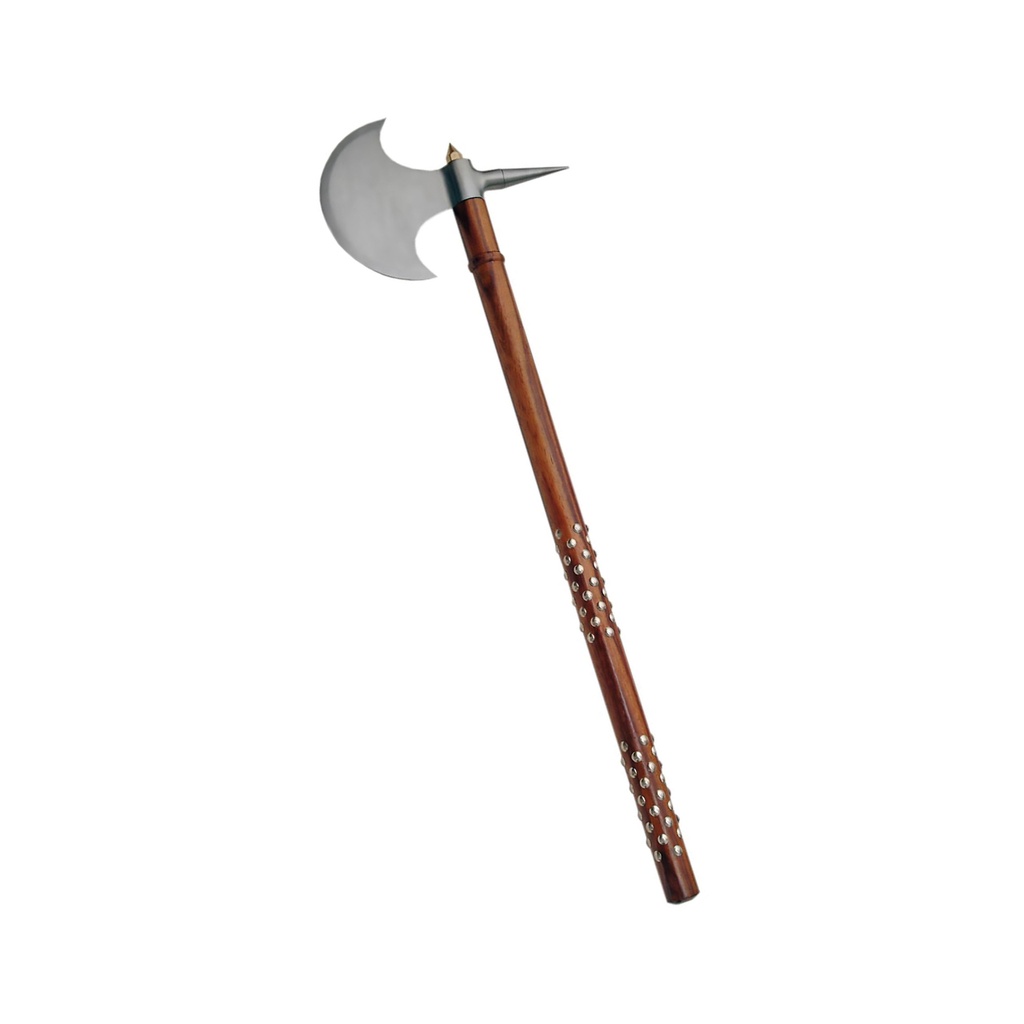
This isn’t a camp hatchet—it’s a Castle Rampart Spiked Medieval Battle Axe built for presence. The 32-inch two-handed wood handle, studded for grip and attitude, drives into a crescent steel head backed by a vicious spike. It reads like it came off a fortress wall: polished metal, warm grain, and a silhouette that owns any room. For collectors, cosplayers, and medieval display junkies, it’s a statement piece that looks like it has a story even before you hang it.
Fortress-Inspired Steel: A Medieval Battle Axe Built to Be Seen
The Castle Rampart Spiked Medieval Battle Axe - Wood Handle is unapologetically medieval. This is not a bush tool, not a tactical breaching axe, and definitely not something you tuck onto a pack and forget about. It’s a long-hafted, crescent-headed battle axe with a rear spike that looks like it belongs on a stone castle wall lit by torches. If you collect blades and polearms for their silhouette and story, this is squarely in your lane.
Crescent Head and Spike: Why This Battle Axe Silhouette Works
Mechanically, this axe is all about profile and balance rather than modern chopping geometry. The polished steel head carries a broad crescent blade on one side and a pronounced rear spike on the other. That duality is what sells the medieval feel: one edge for the cut, one point for the puncture. Even as a display piece, the shape matters. Collectors know that a medieval axe without a credible spike or beard looks like décor; add that back spike and the whole thing snaps into “war axe” territory.
The head’s polished finish throws light cleanly, which is exactly what you want on the wall or in a themed room. It catches highlights along the curve, outlines the cutting edge, and gives the spike a hard, deliberate glint. That visual clarity is why it works so well in a display cluster with swords, shields, or helms—you can read its purpose from across the room.
Steel Head with Defined Edges
The steel head is cast and shaped to emphasize the sweeping outer curve of the blade and the direct line of the spike. You’re not buying this like a high-Rockwell camp axe; you’re buying it for the historically inspired head geometry that looks right on a medieval wall or in a cosplay loadout. The edges present clean, purposeful lines that photograph well and hold their shape over time on a rack or plaque.
Two-Handed Studded Wood Handle: Medieval Presence from Grip to Pommel
The shaft is a 32-inch wood handle, stained to bring out the grain and visually warm up the steel. This isn’t a one-handed hatchet proportion—it’s a true two-handed grip length, which changes everything about its presence. Stand it in a corner, and it reads as a polearm, not a camp tool. Put it on a wall, and the length visually anchors everything around it.
Rows of metal studs run along the lower handle, doing two jobs at once. Functionally, they add texture where your hands naturally land, giving you a more secure purchase if you’re staging or posing with it. Aesthetically, they broadcast "armory" and "castle guard"—a design cue you see on reenactment gear and fantasy film props. That studded section provides a natural focal point below the head, breaking up the line of wood and tying the whole piece together.
Two-Handed Balance and Grip Zone
With its long shaft and steel head, the balance shifts forward the way you’d expect on a historical-style war axe. You feel the mass in the head, not the handle. For display, that means it hangs with the blade slightly dominant, which is exactly how collectors like it: the steel leads, the wood supports. When you pick it up, the studded portion marks the primary two-handed grip zone, giving you a natural choke point for photos, costumes, or stage work.
Collector Context: Where This Medieval Battle Axe Belongs in a Collection
This piece lives in the medieval armory lane—think swords, maces, shields, and helmets, not modern tactical gear. As a collector, you’re buying this as a visual anchor: one long vertical element with a strong head profile that frames everything around it. It pairs cleanly with European longswords, Viking-inspired blades, fantasy greatswords, and even replica shields.
For retailers, this is a narrative driver. You hang one of these and suddenly your medieval wall is a story instead of a row of steel. It’s the kind of battle axe customers point at first, even if they came in for a sword—because the spike, crescent blade, and studded wood handle immediately tell a fortress story.
What Buyers Ask Before Purchasing an Automatic Knife
Even though this product is a medieval battle axe, many buyers who collect blades are also deep into modern mechanisms—especially the automatic knife for sale market. Below are answers to the questions we hear constantly from knife enthusiasts who also pick up pieces like this axe for their wall collections.
Are automatic knives legal?
In the United States, automatic knives (the kind that deploy with a button, switch, or hidden release) sit under a mix of federal and state rules. Federally, the Switchblade Knife Act restricts interstate commerce of automatic knives but carves out exceptions for military, law enforcement, and some commercial channels. The real deciding factor is your state and local law. Some states allow you to buy automatic knife models and carry them openly or concealed; others only allow ownership at home, and a few restrict them outright.
Before you shop automatic knives for sale, you should always check your state statutes and, if you carry, your city or county rules. Look specifically for terms like “spring-assisted,” “automatic,” and “switchblade,” because the definitions and treatment can differ. That’s the framework: federal law cares about interstate shipping and certain uses, while state law dictates what you can legally own and carry.
What’s the difference between an automatic knife, OTF, and a switchblade?
Serious collectors don’t use these terms loosely. An automatic knife is any knife where the blade opens from the handle using a spring or stored energy, triggered by a button, lever, or similar control—usually sideways like a traditional folder. An OTF knife (out-the-front) is a specific subtype where the blade tracks linearly out the front of the handle. OTF automatics can be single-action (spring deploy, manual reset) or double-action (spring deploy and spring retract).
Switchblade is generally the legal and colloquial term, especially in statutes, for automatic knives that open by a button or switch in the handle. All switchblades are automatic knives, but not all automatic knives are OTFs, and not every assisted-opening knife is a switchblade. The distinctions matter when you’re evaluating mechanisms, action quality, and legality.
What makes this automatic knife worth buying?
Applied to a proper automatic knife for sale, the answer is always in the mechanism and steel. Collectors look for a decisive, repeatable deployment with minimal blade play, clean lockup, and an action that doesn’t feel mushy or over-sprung. On a good double-action OTF, the track is tight, the button stroke is consistent, and the blade doesn’t rattle. On a side-opening automatic, you want a tuned spring, a pivot that doesn’t bind, and a lock that inspires confidence.
Blade steel is the other half of the equation. Enthusiasts weigh edge retention, corrosion resistance, and toughness—whether that’s modern stainless like 154CM and S35VN or tool steels tuned for hard use. Put a well-chosen steel on a reliable mechanism and you get an automatic knife that isn’t just fun to fire; it earns a permanent slot in a rotation or display case.
How a Medieval Battle Axe Complements an Automatic Knife Collection
If you’re already hunting for the best automatic knife for EDC, you’re the kind of buyer who understands mechanical personality. This medieval battle axe scratches a different itch but taps the same mindset: appreciation for form, purpose, and presence. Where an automatic folds technology into your pocket, this axe spreads history across your wall.
In a serious collection, a piece like the Castle Rampart Spiked Medieval Battle Axe - Wood Handle acts as a visual counterpoint to modern OTF and switchblade folders. Your automatic knives for sale wish list is all about action, lockup, and steel; this axe is about silhouette, spike, and studded wood. Together, they tell a fuller story of edged weapons—from fortress walls to pocket clips.
Collector Identity: From Battle Axe Display to Automatic Knife Bench
At the end of the day, you either care about details or you don’t. The buyer who notices the crescent curve of this axe head, the way the rear spike changes its attitude, and how the studded wood handle telegraphs “castle guard” is usually the same buyer who can feel the difference between a budget auto and a tuned automatic knife from a reputable maker.
If that’s you, this medieval battle axe earns its space. It’s a fortress piece for the wall of someone who also knows how a double-action OTF should sound when it fires. Add it to the collection that already has a few carefully chosen automatic knives for sale on the shelf, and it’ll look right at home.