Crimson Talon Rapid-Action Automatic Knife - Red Blade
3 sold in last 24 hours
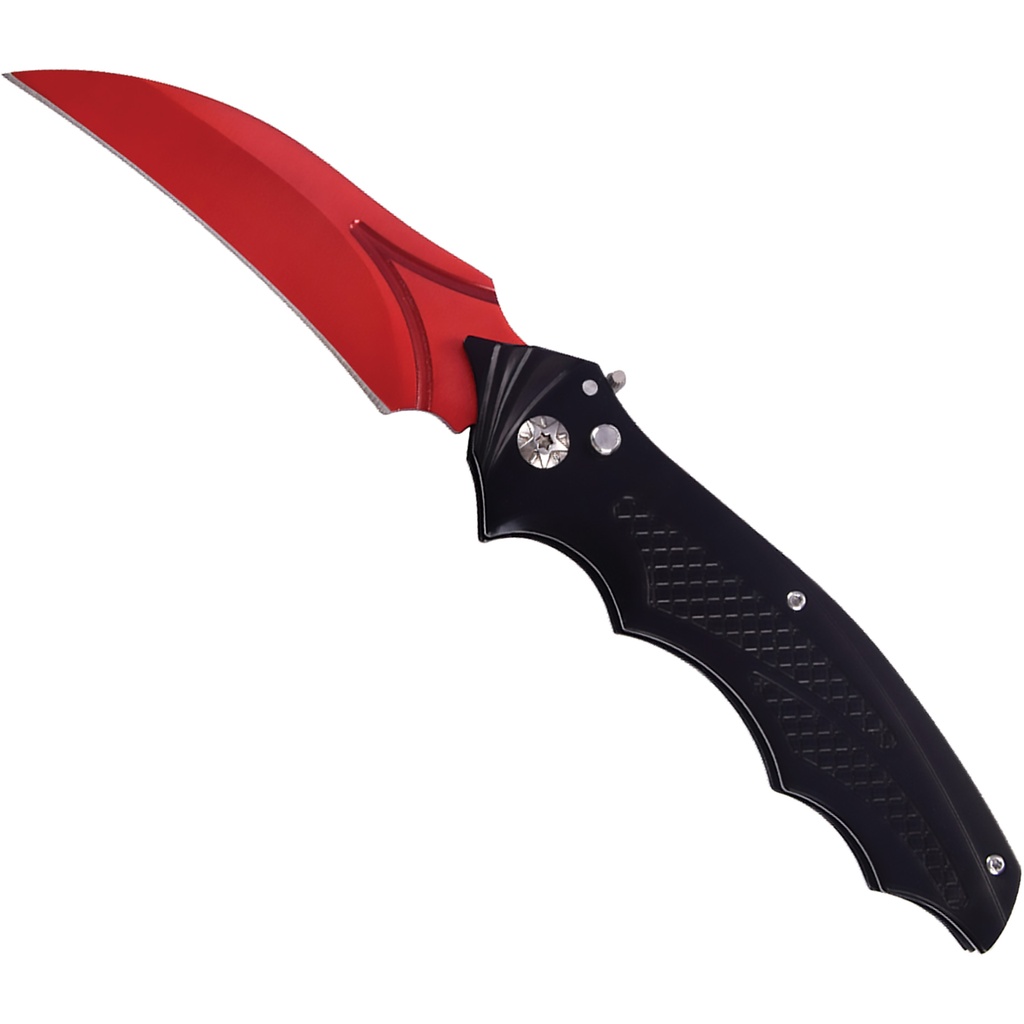
This automatic knife for sale isn’t subtle, it’s purposeful. The Crimson Talon pairs a fast push-button automatic action with a deep hawkbill profile that excels at pull-cuts, stripping, and controlled slicing. The blood-red matte blade sits in a black aluminum handle with finger grooves that actually lock your grip. It carries flat with a spine-mounted clip, but in hand it feels like a tool, not a trinket—built for buyers who care how their knife deploys and how it cuts.
Automatic Knives for Sale That Earn Their Keep, Not Just Attention
The Crimson Talon Rapid-Action Automatic Knife - Red Blade is what happens when a hawkbill work profile collides with a bold tactical aesthetic. This is an automatic knife for sale that doesn’t just look aggressive—it’s engineered for pull-cuts, stripping, and precise control where a straight blade feels clumsy. If you’re here to actually buy an automatic knife you’ll carry, not just photograph, you’re in the right place.
Why This Automatic Knife for Sale Feels Different in Hand
Mechanically, this is a classic side-opening automatic, not an OTF. Press the push-button and a coil spring drives the blade out of the handle on a fixed pivot. That matters, because a side-opening automatic like this typically gives you a stronger lockup and more confidence when you’re really torquing into material.
The hawkbill blade measures about 3.875 inches, riding in a 5.875-inch black aluminum handle. Closed, it’s a full-size automatic—big enough for gloved work, still pocketable for EDC. At 7.62 ounces, it has real presence. This isn’t a featherweight gentleman’s piece; it’s the knife you reach for when the job fights back a little.
The Hawkbill Advantage: Pull-Cut Geometry That Works
The talon-style hawkbill blade is the entire point of this design. That forward-dropping curve bites into material as you pull: pallet wrap, rope, carpet, hose, heavy plastics. Instead of slipping off the surface, the edge tracks along the curve, keeping your cut where you intended it. That’s why electricians, warehouse crews, and rescue-minded carriers gravitate to this shape—it’s honest, predictable performance.
With a plain edge and matte red finish, you get full sharpening real estate and no reflective glare. No serrations to snag, no coating shine to give anything away. Just a clean working edge on a steel blade that’s meant to be touched up and put back to work.
Push-Button Automatic Action You Can Trust
The action is simple and effective: a push-button releases the sear, the coil spring drives the blade open, and the pivot and lock geometry do the rest. Properly tuned, that means a decisive snap instead of a lazy swing. It also means you can deploy from awkward angles—overhead, under a shelf, around a post—without needing room for a thumb stud arc or flipper tab.
Combine that with the finger-grooved aluminum handle and you’ve got a knife that stays put when the blade hits resistance. The curves in the handle aren’t cosmetic; they keep your hand from sliding forward when you’re pulling hard, exactly the use case this hawkbill was built for.
Buy Automatic Knife Designs That Respect Real Carry
Plenty of automatic knives for sale look good in photos and feel wrong the minute you clip them on. The Crimson Talon is built around actual carry realities: size, balance, and a clip that doesn’t fight you.
Carry Profile and Clip Details That Matter
The spine-mounted pocket clip keeps the knife riding flat against the pocket seam, not twisting outward. That’s a small detail until you’ve carried a slab-sided brick all day. Here, the 9.625-inch overall length and curved profile disappear better than the dimensions suggest because the handle follows the natural line of the leg.
The aluminum handle keeps weight manageable while still feeling solid. Matte texturing and inlay patterning give you traction without shredding pockets. Add the lanyard hole, and you’ve got options—deep carry with a fob, or bare-bones clip-only.
Mechanics, Steel, and Action: What Enthusiasts Actually Care About
Anyone can say “high quality steel.” That’s marketing filler. What matters is how the blade behaves in the real world and how the mechanism holds up to regular use.
The steel here is a work-grade stainless tuned for easy maintenance and impact resistance rather than brittle edge retention contests. That makes sense for a hawkbill automatic: you’re going to drag this edge through dirty, abrasive materials. You want a steel that sharpens quickly on a basic stone and shrugs off minor abuse instead of chipping for the sake of an impressive spec sheet.
On the mechanism side, the push-button, coil-spring setup is a proven pattern. Fewer moving parts than most budget OTF switchblades, more robust lockup, and easier diagnosis if anything ever feels off. You feel the spring preload as you close it, you feel the snap as it fires open—those tactile cues tell you the system is healthy long before anything fails.
Collector Value: Why This Isn’t Just Another Budget Auto
Collectors notice when a knife commits to its theme. The blood-red matte blade isn’t a gimmick tacked onto a random profile; it fits the talon concept. The S-curve silhouette from tip to butt, the star-head pivot, the finger grooves, and the black-on-red contrast all echo the same predatory intent. That kind of cohesive design language is what separates a throwaway automatic from something you actually remember in a case full of black drop points.
Automatic Knives for Sale and the Law: What You Need to Know
Any time you buy an automatic knife, you should be thinking about where and how you can legally carry it. In the United States, federal law (notably the Switchblade Knife Act) mainly restricts interstate commerce and automatic knife shipment to certain locations and agencies. It doesn’t by itself tell you what you can carry in your pocket on a city street—that’s up to your state and sometimes your local ordinances.
Some states now allow automatic knives statewide, some allow possession but restrict carry, and others still treat switchblades and automatic knives quite strictly. Length limits, opening mechanisms, and intended use can all factor into local rules. Before you clip any automatic, OTF, or switchblade in your pocket, check current state and local law and remember that regulations change. When in doubt, consult official state resources or an attorney rather than relying on hearsay.
What Buyers Ask Before Purchasing an Automatic Knife
Are automatic knives legal?
In the U.S., automatic knife legality is a layered issue. Federally, the Switchblade Knife Act restricts manufacturing, import, and interstate shipment of switchblades and certain automatic knives, with exemptions for military, law enforcement, and some other uses. Day-to-day carry, however, is primarily governed by state and local law.
Some states have broadly legalized automatic knives; others allow them with blade length limits or specific carry conditions; a few still prohibit them or restrict them heavily. City and county ordinances can be more restrictive than state law. Before you buy an automatic knife or treat it as your EDC, verify the laws where you live and where you travel. This overview isn’t legal advice—always rely on up-to-date official sources.
What’s the difference between an automatic knife, OTF, and a switchblade?
“Automatic knife” is the broad mechanical category: a blade that opens by spring power when you press a button, lever, or similar control. A side-opening automatic, like the Crimson Talon, swings the blade out from the side on a pivot, much like a standard folder that happens to be spring-driven.
OTF (out-the-front) knives are a specific type of automatic where the blade travels straight out the front of the handle, usually via a sliding switch. Many double-action OTFs extend and retract under spring tension.
“Switchblade” is the older legal and cultural term, often used in statutes to describe automatic knives in general. In enthusiast conversation, we usually reserve “OTF” for the true front-deploying designs and “automatic” for side-openers like this one, but the law may use the terms differently. When you’re reading statutes, focus on the mechanism description, not just the label.
What makes this automatic knife worth buying?
Three things: geometry, action, and honesty of purpose. The hawkbill profile gives you real cutting advantage for pull-cuts and controlled slices that a straight blade can’t match. The push-button automatic action means one-handed deployment on demand in real work positions, not just at a desk. And the design doesn’t pretend to be something it’s not—it’s a bold, red-bladed working automatic with a solid aluminum handle, not a safe-queen that cries at the first pallet.
If your idea of the best automatic knife for EDC includes real-world utility, distinctive styling, and a mechanism you can understand and maintain, the Crimson Talon fits that brief.
For Enthusiasts Who Choose Their Automatic Knives on Purpose
This isn’t the automatic knife for sale you buy because it was in the front of the catalog; it’s the one you pick because you understand what a hawkbill automatic brings to the table. You care how the action feels, how the curve bites into material, how the handle locks into your grip. If that’s how you buy automatic knives, the Crimson Talon will feel like it was built with you in mind.
| Blade Length (inches) | 3.875 |
| Overall Length (inches) | 9.625 |
| Closed Length (inches) | 5.875 |
| Weight (oz.) | 7.62 |
| Blade Color | Red |
| Blade Finish | Matte |
| Blade Style | Talon |
| Blade Edge | Plain |
| Blade Material | Steel |
| Handle Finish | Matte |
| Handle Material | Aluminum |
| Button Type | Push |
| Theme | None |
| Pocket Clip | Yes |