Desert Kalashnikov Tribute Tactical Automatic Knife - Tan Combo Edge
5 sold in last 24 hours
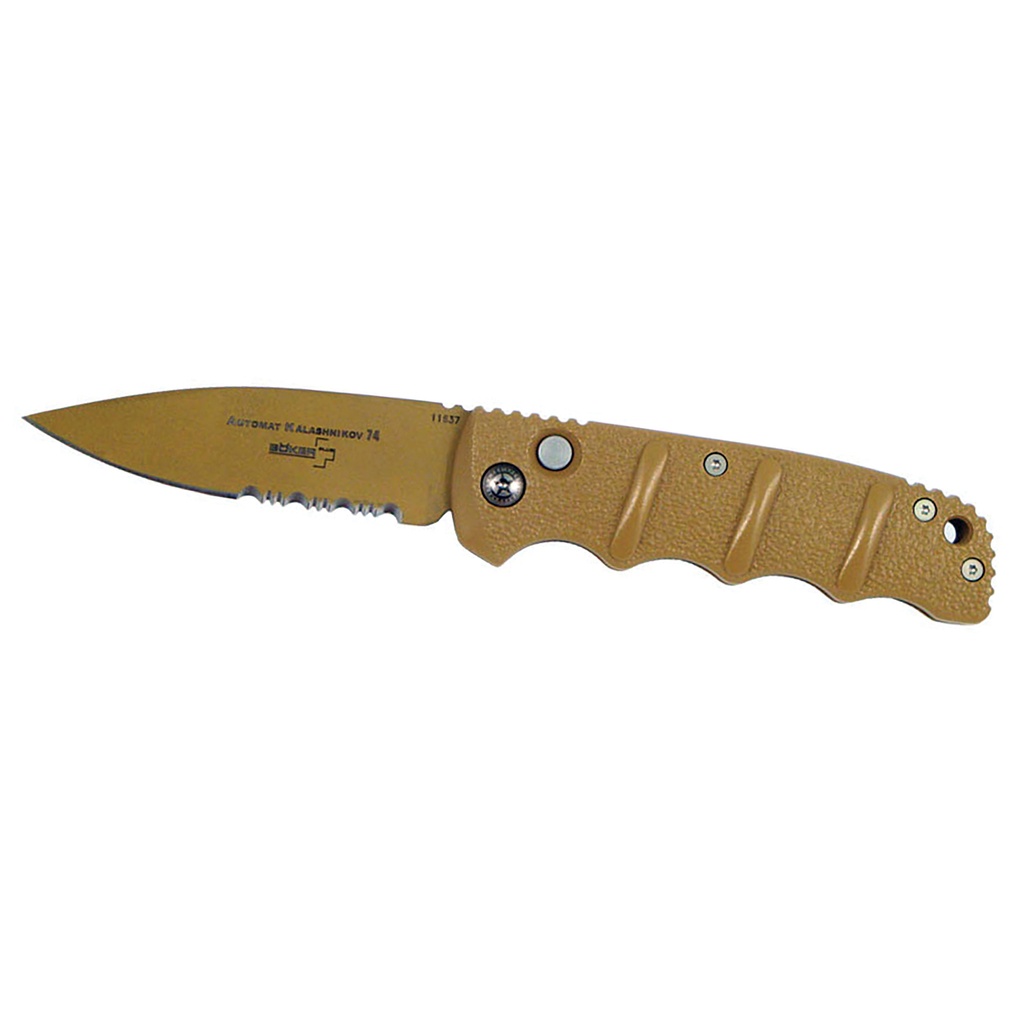
This automatic knife for sale is a desert-tuned workhorse, not a drawer queen. The Desert Kalashnikov Tribute Tactical Automatic Knife snaps open with a confident push-button action that feels like a well-tuned rifle selector. The partially serrated drop point, desert-tan finish, and grippy finger-grooved handle make it a serious automatic to buy for hard-use EDC or tactical backup. If you appreciate purposeful engineering and no-nonsense deployment, this belongs in your rotation.
Automatic Knife for Sale That Actually Earns the Kalashnikov Name
If you’re looking to buy an automatic knife that feels more like a duty tool than a desk toy, this Desert Kalashnikov Tribute Tactical Automatic Knife - Tan Combo Edge delivers. It’s built around a push-button automatic mechanism that behaves the way an enthusiast expects: decisive snap, controlled lock-up, and repeatable deployment even when your hands are cold, wet, or gloved.
Visually, it leans hard into its inspiration. The Automat Kalashnikov 74 markings, desert tan blade and handle, and no-nonsense geometry are a nod to the rifle that never quits. Mechanically, it’s a compact, tactical-focused automatic knife tuned for real-world EDC and field work.
Why This Automatic Knife for Sale Stands Out Mechanically
Mechanism is where serious buyers separate gimmicks from gear. This is a side-opening automatic, not an OTF, and certainly not a novelty switchblade. The blade rides on a pivot tuned for snappy deployment off a coil spring, triggered by a recessed push button that doubles as a button lock. That means:
- Clean break on deployment – the blade drives to lock with a single, authoritative snap.
- Secure lock-up – button lock engagement keeps the drop point anchored until you intentionally disengage.
- Positive actuation – button placement is natural under the thumb, even in a full fist grip.
The partially serrated drop point gives you a useful compromise: plain edge for push cuts and detail work, serrations for webbing, cord, and field tasks where a toothy bite matters. Spine and handle jimping at the thumb ramp help you drive into cuts without slipping, especially in a forward, thumb-up grip.
Blade Geometry and Edge Versatility
The drop point profile is deliberately conservative—no fantasy angles, just a practical tip with enough meat behind it to resist snapping under lateral stress. The combo edge is divided so you’ve got a predictable plain edge portion for controlled slicing and a serrated section closer to the handle where you can leverage maximum pressure. It’s the kind of edge layout people who actually cut things all day prefer.
Handle Design: AK-Inspired, Glove-Friendly
The textured synthetic handle is where the rifle inspiration shows up in a useful way. Three primary finger grooves and a flared pommel hook lock your hand in under recoil from the spring and under torque during hard cuts. The desert tan scales are secured with Torx fasteners, so disassembly and maintenance are straightforward for anyone who actually services their knives.
The rear lanyard hole isn’t decoration—it’s properly placed at the end of the handle, letting you run a retention lanyard without interfering with your grip or the button’s path. The jimped thumb ramp on both blade spine and handle gives you one continuous traction line, so your thumb knows exactly where to land every time you deploy.
Buying an Automatic Knife for EDC: Where This One Fits
If you want the best automatic knife for EDC in harsh, dusty, or sandy environments, a desert-tan, tactical-inspired platform like this makes sense. The color isn’t just about looks; in a desert or dry woodland setting, it reads as neutral, not a shiny target.
In hand, it hits the sweet spot for a pocketable tactical: compact enough for everyday carry, substantial enough to feel like a real tool when you bear down. While the clip side isn’t shown here, the overall silhouette and hardware layout are consistent with the Boker Kalashnikov series—known for riding well in the pocket without printing like a brick.
Action Quality: What Enthusiasts Actually Notice
Collectors and regular show-goers will appreciate how the spring tunes in over time. A well-broken-in Kalashnikov-style automatic settles into a balance of speed and control: fast enough to be satisfying, not so violent that it beats itself up. The button lock keeps closing smooth and predictable; no fighting a stiff liner, no awkward two-hand rituals. Press, rotate closed, done.
Steel, Finish, and Real-World Use
Boker’s Kalashnikov automatics are known for using solid, work-ready steels in this series—formulated to hold an edge reasonably well, sharpen without drama, and shrug off casual abuse. This isn’t a safe-queen super steel; it’s a working blade meant to be touched up on a basic stone or field sharpener and put back into circulation.
The desert tan blade finish does two useful things. First, it knocks down glare, which matters more than people admit if you’re working outdoors or around others. Second, it adds a layer of visual camouflage for minor scuffs and scratches—this is a finish that wears in, not out, and looks better with honest use.
Collector Value in a Tactical Automatic
As a collector piece, the Automat Kalashnikov 74 marking and desert configuration matter. The Kalashnikov autos have become a recognized sub-collection in the automatic world: distinct profile, unmistakable handle sculpting, and series-specific finishes. This desert tan variant slots neatly into that lineage, especially for anyone building out color or theme-based sets (urban, woodland, desert, etc.).
Legal Context: When Is This Automatic Knife Legal to Carry?
Any time you buy an automatic knife, legal context is part of the decision. Under U.S. federal law, automatic knives (often casually called switchblades) are regulated primarily in terms of interstate commerce and certain restricted locations. Federal law doesn’t outright ban ownership nationwide, but it limits how automatic knives can be shipped and to whom in some circumstances.
The real deciding factor is state and local law. Some states treat an automatic knife like any other folding knife for carry purposes. Others restrict blade length, mechanism type, or carry method. A few still prohibit possession altogether. If you’re considering this automatic knife for EDC, you need to check:
- Your state’s statutes on automatic knives or switchblades
- City or county ordinances that may be stricter than state law
- Rules for carry in government buildings, schools, and similar locations
This automatic is designed to be carried and used, but it’s your responsibility to verify that an automatic knife is legal to carry where you live and where you travel.
What Buyers Ask Before Purchasing an Automatic Knife
Are automatic knives legal?
In the U.S., automatic knives are legal in many states, restricted in others, and prohibited in a few. Federal law (the Switchblade Act) primarily regulates interstate commerce, importation, and carry in certain federal jurisdictions; it does not automatically make every automatic knife illegal to own. State and local laws are where the real variation happens: some states allow automatic knives with few or no restrictions, some impose blade length or carry limits, and some ban them outright.
Before you buy, check your state’s specific language on automatic, switchblade, or OTF knives, and verify whether there are separate rules for open carry, concealed carry, and transport in vehicles. Laws change, so rely on current statutes or reputable legal summaries, not rumor.
What’s the difference between an automatic knife, OTF, and a switchblade?
Mechanically, an automatic knife is any knife whose blade opens fully by pressing a button, lever, or similar actuator—this one is a side-opening automatic, where the blade pivots out from the handle on a hinge. An OTF (out-the-front) knife is a specific subtype of automatic where the blade travels linearly out of the front of the handle; many high-end OTFs are double action, meaning the same switch deploys and retracts the blade.
Switchblade is largely a legal and cultural term used in statutes and popular language to describe automatic knives in general, including both side-opening autos like this and OTF designs. Enthusiasts tend to use “automatic knife” and then specify side-opening or OTF to stay mechanically precise.
What makes this automatic knife worth buying?
This one earns its place with three things: proven action, purposeful ergonomics, and collectible lineage. The push-button deployment is fast and repeatable without feeling out of control. The finger-grooved, jimped handle lets you actually work with the blade, not just flick it open to impress friends. And the Automat Kalashnikov 74 heritage, combined with the desert tan combo-edge configuration, gives it a clear identity in a crowded automatic knife market.
If you’re the kind of buyer who cares how a knife feels coming out of the handle as much as how it looks in photos, this automatic will make sense the moment you hit the button.
For Enthusiasts Who Buy an Automatic Knife with Intention
This isn’t a generic automatic knife for sale thrown together to hit a price point. It’s a desert-themed Kalashnikov-series automatic tuned for people who notice action timing, thumb ramp geometry, and how a grip locks in under load. If you want to buy an automatic knife that reflects that level of intent—something you’ll actually carry, use, and be glad you chose—this Desert Kalashnikov Tribute Tactical Automatic Knife is built for your side of the display case, not the souvenir shelf.