Dixie Banner Micro EDC OTF Blade - Matte Aluminum
7 sold in last 24 hours
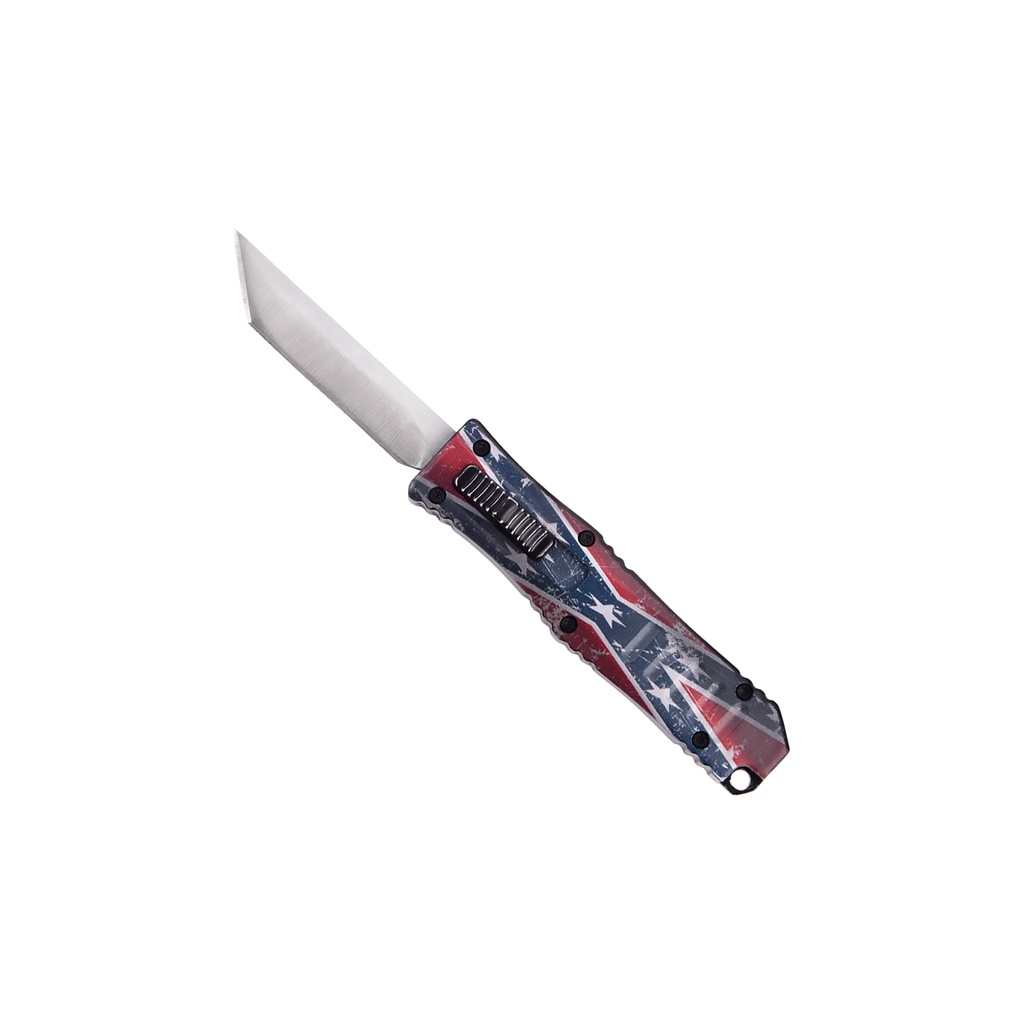
An automatic knife for sale that doesn’t waste space or motion, this micro OTF rides light but hits fast. A single-action slide drives the 1.99-inch American tanto straight out the front, giving you precise tip control in a package that barely prints. The matte aluminum handle, Dixie banner graphic, deep-carry clip, and sub-2-inch blade make it a confident small-format OTF for collectors who appreciate crisp deployment and pocket-ready discretion.
Micro Precision, Heritage Graphic: An Automatic Knife for Sale with Purpose
This is not another generic import with a lazy spring and vague "tactical" branding. The Dixie Banner Micro EDC OTF Blade - Matte Aluminum is a compact out-the-front automatic knife built around one idea: fast, controlled deployment in the smallest footprint that still feels like a real tool in the hand. At 5.5 inches overall with a 1.99-inch American tanto blade, it threads that line where a serious enthusiast can still appreciate the mechanics, even in a micro format.
For the buyer actively looking to buy an automatic knife that’s pocketable, visually bold, and mechanically honest, this one earns its keep through crisp action, thoughtful proportions, and a handle that makes its heritage statement loud and clear.
Automatic Knives for Sale: Why This Micro OTF Stands Out
Among automatic knives for sale in the compact category, most fall into two camps: flashy keychain toys, or brick-like minis with clumsy slide switches. This piece avoids both traps. It’s a true single-action OTF automatic: you thumb the side-mounted slide forward, the internal spring takes over, and the blade snaps straight out the front into lockup. To retract, you manually pull the slide back, re-seating the blade and resetting the spring for the next deployment.
That single-action system matters. It keeps the mechanism simpler and lighter than a double-action OTF, which is exactly what you want at 1.35 ounces—less mass to fight, less friction to gum up. The result is a snappy, repeatable deployment that doesn’t feel mushy or over-damped. For a micro EDC automatic, that’s the difference between a knife you actually carry and one that lives in the back of a drawer.
American Tanto Geometry Built for Real Tip Work
The 1.99-inch blade isn’t a gimmick; it’s a compact American tanto with a defined secondary point. That gives you two working zones: the primary straight edge for push cuts and the reinforced tip for precise puncture and scoring. In real daily carry use—opening taped boxes, scoring packaging, cutting cord—the short tanto format shines because the blade moves more like a scalpel than a slicer. You get control over the first half-inch of steel, which is what actually touches material most of the time.
Matte Aluminum Handle, Textured Where It Counts
Matte aluminum is the right call here. It keeps weight down, resists pocket wear, and gives the Dixie banner graphic a clean platform. The subtle scalloped edges and finger groove shaping add grip without turning the handle into a cheese grater. Under pressure, your thumb finds the slide naturally, and the flat sides seat well against the pocket clip. This isn’t a fidget toy first—it’s a compact working automatic that happens to look loud.
Mechanics That Earn Enthusiast Respect in an Automatic Knife for Sale
If you’re going to buy an automatic knife that’s this small, the action has to justify the format. The side-mounted slide is tuned for a deliberate push—not feather-light, not stubborn. That tuning matters: too light and pocket lint or an errant thumb could start it moving; too stiff and you lose the one-handed advantage that makes an OTF worthwhile.
The internal track and spring are balanced to push the blade out decisively without feeling like it’s trying to jump from your hand. The American tanto in plain-edge configuration keeps the grind straightforward and the maintenance simple. You’re not juggling serrations or ornate grinds—just functional steel in a blade profile that’s easy to bring back on a flat stone.
Single-Action OTF: Why It Makes Sense Here
Collectors love double-action OTF automatics for the party trick: push forward to fire, pull back to retract, all under spring power. In a micro build like this, single-action is actually the smarter choice. Fewer moving parts, fewer internal friction points, and a stronger drive in one direction. In practice, that means fewer failures to fully deploy and a more authoritative snap when the blade locks out.
Carry Profile: Deep, Light, and Intentionally Small
At 3.25 inches closed and just 1.35 ounces, this knife disappears in the pocket. The deep-carry clip anchors it low and secure, and the lanyard hole at the butt gives you options if you want a small pull tab for faster retrieval. For anyone who’s run full-size OTFs and gotten tired of the brick-in-pocket feel, this micro is the opposite experience: you forget it’s there until you need a clean, sharp edge right now.
Legal Context: Buying an Automatic Knife and Carrying It Smart
Any time you see an automatic knife for sale—especially an OTF or anything that could be casually called a switchblade—the next logical question is legality. In the United States, federal law mainly restricts the interstate commerce and shipping of automatic knives to certain categories, but does not set a universal carry rule. That’s done at the state and sometimes local level.
Some states now allow automatic knives, OTFs, and other switchblade-style mechanisms with few restrictions. Others limit blade length, restrict carry to one’s own property, or ban automatic deployment outright. A sub-2-inch blade like this can be advantageous in some jurisdictions that set length thresholds, but it is not a universal pass. Before you buy an automatic knife or clip this one into your pocket, you need to check your specific state and local laws and abide by them. This description is informational, not legal advice.
What Buyers Ask Before Purchasing an Automatic Knife
Are automatic knives legal?
In the U.S., automatic knives—whether side-opening, OTF, or commonly called switchblades—exist in a patchwork of regulations. Federal law focuses on interstate commerce and shipping, particularly restricting automatic knife shipment to certain end users and contexts, but it doesn’t create one national carry rule. States (and sometimes cities or counties) decide what you can own and carry day to day.
Some states now fully permit automatic knives, others allow ownership but restrict concealed or public carry, and a few still prohibit them. Blade length, opening mechanism, and intended use can all matter. A compact OTF with a sub-2-inch blade like this may fit within more permissive categories in some jurisdictions, but it can still be restricted elsewhere. Always review current statutes and, if necessary, consult a qualified attorney before you treat any automatic knife as legal to carry in your area.
What’s the difference between an automatic knife, OTF, and a switchblade?
“Automatic knife” is the broad mechanical category: any knife where a spring drives the blade open when you actuate a button, lever, or slide. That includes side-opening autos and OTF designs. “OTF” (out-the-front) is a subset where the blade travels on a linear path straight out the front of the handle—like this Dixie Banner micro—and is housed fully inside the handle when closed.
“Switchblade” is largely a legal and cultural term used in statutes and popular language to describe automatic knives, especially classic side-opening autos. In enthusiast circles, we usually talk in precise terms: automatic, OTF automatic, side-opening automatic. This piece is a single-action OTF automatic knife: you slide the control forward to fire the blade straight out the front, and manually retract it to reset.
What makes this automatic knife worth buying?
Mechanically, it’s a true OTF automatic in a micro package, not a novelty folder pretending to be something it’s not. The slide is tuned for positive engagement, the single-action drive gives you consistent deployment, and the American tanto geometry makes the short blade genuinely useful for daily cutting and scoring. The matte aluminum handle keeps it featherweight while still feeling solid in the hand.
For collectors, the Dixie banner graphic turns a compact EDC into a statement piece in the OTF segment—distinctive enough to stand out in a case, small enough to actually carry. If you’re looking to buy an automatic knife that proves you care about deployment quality and design details, not just blade length, this micro OTF earns its place in rotation.
Built for Enthusiasts Who Choose Their Automatic Knives for a Reason
The Dixie Banner Micro EDC OTF Blade - Matte Aluminum isn’t trying to be everything to everyone. It’s a specific answer to a specific question: what happens when you shrink an honest OTF automatic down to micro size without dumbing down the mechanics? You get a compact, heritage-forward piece that fires cleanly, carries quietly, and rewards the buyer who pays attention to action, geometry, and proportion.
If you see automatic knives for sale and immediately want to know how the slide feels, how the blade tracks, and how the handle sits in a real pocket, you’re the audience this knife was built for. It’s a small OTF with a real presence—and a reminder that in the automatic world, execution matters more than inches.
| Blade Length (inches) | 1.999 |
| Overall Length (inches) | 5.5 |
| Closed Length (inches) | 3.25 |
| Weight (oz.) | 1.35 |
| Blade Color | Silver |
| Blade Finish | Matte |
| Blade Style | American Tanto |
| Blade Edge | Plain |
| Blade Material | Steel |
| Handle Finish | Matte |
| Handle Material | Aluminum |
| Button Type | Slide |
| Theme | Confederate Flag |
| Double/Single Action | Single |
| Pocket Clip | Yes |