Dragon Prism Six-Point Throwing Star - Rainbow Steel
3 sold in last 24 hours
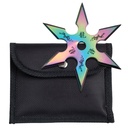
This isn’t a toy store ninja star. The Dragon Prism Six-Point Throwing Star in rainbow steel is a 4-inch, 4mm-thick shuriken built to actually fly. Precision-balanced steel, sharp tapered points, and a central cutout keep rotation clean and predictable. The rainbow finish, dragon engravings, and nylon pouch push it firmly into collector territory—equally at home on the range or on the wall. If you care how a star tracks through the air, this one earns its spot.
Dragon Prism Six-Point Throwing Star – Rainbow Steel Built to Fly
The Dragon Prism Six-Point Throwing Star is what happens when you take a classic six-point shuriken profile, give it real-world balance, and then finish it like a showpiece. At 4 inches across and 4mm thick, this rainbow steel throwing star is substantial in the hand without turning into dead weight in flight. The dragon engravings and calligraphic symbols aren’t just decoration – they frame a piece that’s meant to be thrown, then displayed.
Precision-Balanced Throwing Star for Sale – Why Balance Matters
Most cheap stars feel like stamped sheet metal with points. This one doesn’t. The 4mm thickness and six symmetrical arms give the Dragon Prism a predictable spin off the fingertips. The central circular cutout is not a gimmick; it shifts mass outward just enough to promote smooth rotation, so you get less wobble and more point-first impact when your throw is on line.
The concave inner arcs between the points trim unnecessary weight while keeping the points reinforced. That geometry matters—each point tapers to a sharp tip with enough meat behind it to resist bending under repeated target impacts. It’s the difference between a star you throw a few times for fun and one you actually bring back to the range because it flies the way you expect.
Six-Point Geometry with Practical Contact Angles
Six points on a 4-inch diameter gives you generous contact windows without turning the star into a wide, draggy plate. The arms are long enough to bite, short enough to stay quick in the air. That window between overbuilt wall-hanger and flimsy novelty is where this throwing star lands.
Rainbow Steel Finish That Works for Collectors and Retailers
The rainbow steel finish isn’t just for show, but it certainly doesn’t hurt display value. That iridescent sheen catches ambient light, bringing out the engraved dragons and symbols. On a wall or in a display case, this star reads as a modern, fantasy-leaning take on traditional ninja gear—exactly the kind of piece that gets picked up first in a retail case.
Throwing Star Mechanics: Steel, Thickness, and Real-World Use
This is a fixed steel throwing star—no moving parts to hide sloppy build quality. At 4mm thick, it’s far more rigid than ultra-thin novelty stars, which means less flex on impact and more consistent hits on soft wood targets. The darkened edges visually emphasize the points, but mechanically what matters is the gradual taper into the tips. That taper is long enough to penetrate yet stout enough not to mushroom at the first bad throw.
The steel used here is purpose-appropriate: tough enough for repeated practice, easy enough to touch up the points with a basic stone or file if you start to see rounding. This isn’t high-end knife blade steel—and it doesn’t need to be. Shuriken performance lives on toughness, repeatability, and geometry, not razor-slice edge retention.
Grip, Release, and Controlled Rotation
The combination of the central cutout and engraved surface gives the fingers something tactile to index on during the grip. You can run traditional pinch grips across opposing points or thumb-on-center holds; either way, the star doesn’t feel slick in hand. That controlled release is what keeps your rotation consistent across throws.
Collector-Grade Aesthetic with Range-Ready Practicality
Collectors care about two things with a throwing star: how it looks on the wall and how it feels in the throw. The Dragon Prism checks both. The dragon motifs and Asian-style calligraphy engraved into the face give it clear martial arts lineage. The rainbow finish leans modern, bordering on fantasy, but the underlying geometry is classic, functional shuriken.
The included black nylon pouch does what it’s supposed to: protect the star, protect your gear, and keep the edges from chewing up a bag or pocket. The snap-closure flap and stitched edges are straightforward and durable. Slide it on a belt, drop it in a range bag, or keep it in a drawer next to the rest of your martial arts kit—it carries cleanly without the usual improvised storage.
Display Presence That Actually Earns Its Space
On a pegboard, stand, or shadow box, the color gradient across each arm and the engraved details draw the eye immediately. A lot of throwing stars blur into a gray circle of points when you step back. This one holds its individuality at distance, which is exactly what you want if you’re building a visible collection instead of a drawer full of duplicates.
Legal Context: What to Know About Owning a Throwing Star
Unlike an automatic knife, which is regulated in many jurisdictions based on deployment mechanism, throwing stars live in a different legal lane—and it varies widely by region. Some states and countries treat shuriken as prohibited "martial arts weapons," others classify them like any other fixed blade or impact tool, and some have no specific mention at all.
Federally in the United States, there is no blanket prohibition on owning a throwing star like this. The legal friction usually starts at the state, county, or city level. In some areas, possession is legal at home but carry in public is restricted or banned. In others, throwing stars fall under broader "dangerous weapon" or "concealed weapon" language.
Translation: always check your local and state laws on martial arts weapons and throwing stars before you buy, carry, or use this piece outside private property. Retailers should also verify local regulations for display and sale—especially if you’re operating near schools or in jurisdictions with stricter ordinances.
What Buyers Ask Before Purchasing an Automatic Knife
Are automatic knives legal?
Automatic knives—unlike this fixed throwing star—are defined in U.S. federal law (15 U.S.C. §1241-1245) as knives that open automatically by a button, spring, or other device in the handle. Federal restrictions focus on interstate commerce and shipping, not simple ownership, but many states add their own rules on possession, carry, blade length, and who may own an automatic, OTF, or switchblade.
The short version: in some states automatic knives are broadly legal to own and carry; in others, ownership may be legal but carry is restricted; and in a few, they’re heavily limited or banned. Anyone looking for an automatic knife for sale should check their specific state and local statutes—especially if they plan to carry it daily. This Dragon Prism piece is a throwing star, not an automatic knife, but the same rule applies: know your local law before you clip it to a belt or toss it in a bag.
What’s the difference between an automatic knife, OTF, and a switchblade?
Mechanically, an automatic knife uses a spring-loaded blade that deploys from the handle when you activate a button, slide, or lever. The blade is under spring tension and snaps into the open position—no wrist flick needed. A side-opening automatic pivots out like a traditional folder; an OTF automatic drives the blade straight out the front of the handle.
An OTF (out-the-front) knife is a subtype of automatic where the blade travels linearly rather than rotating around a pivot. Double-action OTFs both deploy and retract via the same control; single-action OTFs typically auto-deploy but require manual retraction. "Switchblade" is largely a legal and cultural term historically used to describe automatic knives in general—usually side-openers—but in modern enthusiast language, "automatic", "OTF automatic", and "switchblade" overlap heavily. This Dragon Prism is none of those; it’s a fixed throwing star, with no springs, no pivot, and no deployment mechanism.
What makes this throwing star worth buying?
Three things: geometry, thickness, and finish. The 4mm steel construction gives it enough rigidity to handle repeated throws without warping. The six-point, 4-inch layout—with its central cutout and concave inner arcs—delivers a controllable, predictable spin instead of a lazy, tumbling arc. And the rainbow finish with dragon engravings makes this more than a range beater; it’s a display-ready piece that stands out in a collection or in a retail case. If you’re tired of flat, anonymous stars, this one actually has presence—and the mechanics to back it up.
For Collectors Who Care How Their Gear Flies
The Dragon Prism Six-Point Throwing Star isn’t trying to be an automatic knife, an OTF, or a switchblade—it’s a dedicated throwing tool with collector-grade styling. If you’re the kind of buyer who notices balance before color and flight path before finish, this star earns a slot in your kit. And if you just want a visually striking, martial arts-inspired piece that doesn’t fall apart the first time it hits a board, it’s built for that too.