Dragon Surge Quick-Action Spring Assisted Folder - Stonewash Red
14 sold in last 24 hours
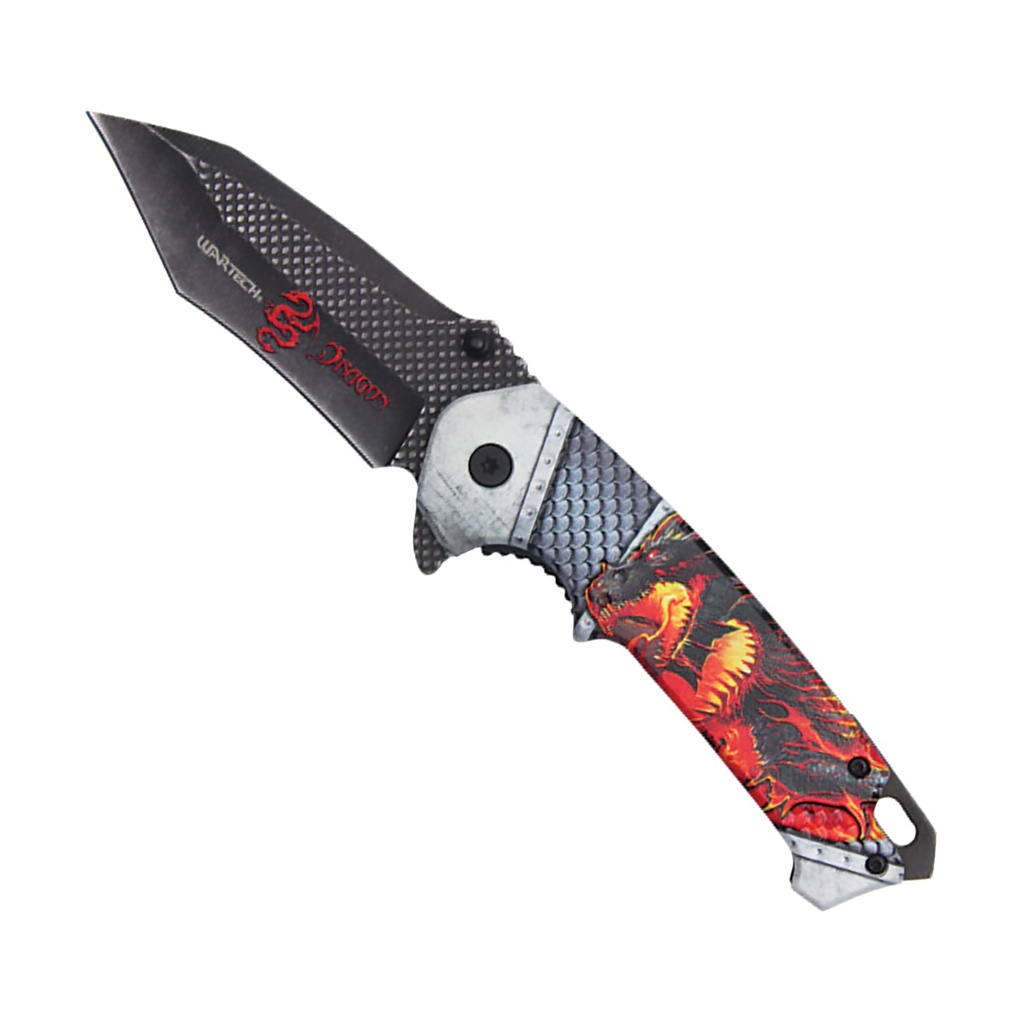
This isn’t a toy dragon knife; it’s a spring assisted folder built to be worked. The flipper rides a tuned assist that snaps the stonewashed clip point into lock with authority, while the liner lock bites down solid. Textured dragon-scale aluminum gives real traction, not just fantasy looks. At 3.5 inches of working edge and a pocket clip that actually carries, it’s the piece you grab when you want mythic styling wrapped around a legitimate EDC tool.
Automatic Knives for Sale vs. True Assisted Action: Where This Dragon Lives
If you’re hunting for an automatic knife for sale, you’re already speaking the right language: action first, everything else second. This piece sits in that same world of fast deployment and mechanical satisfaction, but with a crucial distinction — it’s a spring assisted folder, not a button-fired automatic. That matters both for how it behaves in hand and how it fits into your local laws.
The Mystic Dragon design takes the fantasy-dragon aesthetic and bolts it onto a real EDC-capable mechanism. You get the quick-acting assist, a confident lockup, and a blade that will actually cut, not just pose for photos.
Why Enthusiasts Who Buy Automatic Knives Respect a Good Assisted Folder
If you regularly buy automatic knives, OTFs, or even old-school switchblades, you already know: the action is the whole story. This knife uses a flipper tab paired with an internal torsion spring. Once you overcome that initial detent with a decisive index finger push, the assist takes over and snaps the blade into position with a crisp, mechanical certainty.
Is it a true automatic knife for sale in the federal sense? No — there’s no button or slide on the handle that fires the blade. But the deployment feel lives in that same neighborhood: fast, one-handed, and satisfying.
Action and Lockup: How the Spring Assist Actually Feels
The flipper tab is sized properly — enough surface to grab, without turning the knife into a pocket snag. The detent holds the blade closed against casual bumps, but it isn’t a knuckle-busting chore to overcome. Once you start that motion, the internal assist spring kicks in and drives the stonewashed clip point open in a single, unbroken arc.
Lockup is handled by a liner lock, cut with enough relief to disengage cleanly, but with enough meat left to inspire confidence. Viewed from the spine, the liner seats on the early-to-mid portion of the tang — exactly where you want it on a working assisted folder. No lazy half-engagement, no overtravel hitting the opposite scale.
Blade Geometry: Clip Point with Tactical Intent
The blade brings a clip point profile with a tanto-influenced attitude — a strong tip, a defined swedge, and a straight working edge that makes more sense in cardboard and cord than in glass display cases. At around 3.5 inches of cutting surface and an 8-inch overall length, you’re in that sweet-spot EDC range: long enough to matter, short enough to carry without feeling like you’ve pocketed a fixed blade.
The stonewashed finish isn’t just a style choice; it hides use. Everyday scuffs and micro-scratches get lost in the texture instead of screaming from a polished surface. For a user who actually cuts with their knives instead of babying them, that’s worth more than mirror polish and marketing gloss.
Mechanics, Steel, and Real-World Use for Buyers Who Usually Buy Automatic Knives
Serious buyers who browse automatic knives for sale aren’t fooled by fantasy art alone. They look at pivot tuning, lock geometry, and how the knife feels when you actually push it through something more substantial than packing tape. This dragon earns its place in that conversation.
Pocket Reality: Balance, Clip, and Thumb Ramp
Closed, you’re at about 4.5 inches. That’s compact enough to disappear in a front pocket, especially with the single-position pocket clip keeping it pinned against the seam. The clip rides in a working position — not ridiculously deep carry, but deep enough that you’re not advertising the dragon art to the whole room. The handle’s scale texturing and that thumb ramp on the spine give your grip three points of control: index on the flipper choil, thumb on the ramp, and palm locked into the scales.
The handle is aluminum with a matte finish, dressed with dragon-scale texture and red/orange artwork. That texture does more than look cool — it creates micro ridges that bite into the skin, so when your hand is wet, cold, or tired, the knife stays planted instead of trying to twist free.
Not an Automatic Knife, But in the Same Carry Conversation
If you’ve ever looked up whether an automatic knife is legal to carry in your state, you know the law doesn’t care about marketing fluff. The mechanism definition is what matters. Here’s where this knife fits into that legal framework.
Under U.S. federal law, an automatic knife (often called a switchblade) is generally defined as a knife that opens by a button, spring, or other device in the handle. This spring assisted knife requires you to start opening the blade with the flipper; the assist only takes over after you manually engage the blade. That distinction usually places it outside federal switchblade restrictions.
However, state and local laws vary wildly. Some states lump assisted and automatic action together; others draw a clean line between manual, assisted, OTF, and switchblade. If you’re used to shopping automatic knives for sale, you already know the drill: check your state and local statutes before you treat any fast-opening blade as your daily carry, especially around schools, government buildings, or restricted workplaces.
For Collectors Who Already Own an Automatic Knife or OTF
If your case already holds a couple of button-fired autos, maybe a double-action OTF, and a few old lockbacks, where does this knife fit? It’s your bridge piece — the one that wears fantasy art without sacrificing real-world function.
The dragon artwork and scale motif give it a visual story that most budget assisted folders don’t even try for. But the mechanics mean you can actually beat on it: cut rope, break down boxes, open bags of mulch, or carve tinder without feeling like you’re abusing a wall-hanger.
Think of it as the knife you hand to the friend who says, “I love your OTF, but I’m not ready for that price or legal complexity yet.” They still get the thrill of a quick-acting, one-handed folder and a knife that looks like it stepped out of a fantasy sketchbook, but the mechanism keeps it squarely in assisted territory.
What Buyers Ask Before Purchasing an Automatic Knife
Are automatic knives legal?
In the U.S., federal law regulates automatic knives (switchblades) mainly in terms of interstate commerce and possession on federal property. The real complexity happens at the state and local level. Some states fully allow automatic knives for sale and carry; others restrict blade length, opening mechanism, or who can own them (for example, law enforcement exemptions). Many states treat assisted opening knives more leniently than true automatics, because you must initiate the opening manually via a flipper or thumb stud.
This particular knife is spring assisted, not a true automatic or OTF, but you should still confirm your state and local laws before carrying it, especially concealed. Laws change, and ignorance won’t help you if a traffic stop turns into a gear inspection.
What’s the difference between an automatic knife, OTF, and a switchblade?
Mechanically, here’s how it breaks down:
- Automatic knife / switchblade: In U.S. knife language, those terms are usually interchangeable. A spring holds the blade closed inside the handle. Pressing a button or actuating a slide on the handle releases that spring and fires the blade open. You don’t move the blade itself; you hit the control.
- OTF (out-the-front): A specific type of automatic where the blade travels along the length of the handle and emerges from the front. Single-action OTFs fire out automatically and must be manually retracted; double-action OTFs use the same control to fire and retract.
- Assisted opening (this knife): The blade is manually started open by your finger on a flipper or thumb stud. Once you pass a certain point, an internal spring helps complete the opening. The control is on the blade, not a separate button in the handle, which is why most laws treat it differently from a classic switchblade.
What makes this automatic-style knife worth buying?
Three things: tuned assist, usable geometry, and visual identity. The spring-assist is snappy without being twitchy — it opens with intent, not by accident. The 3.5-inch stonewashed clip point gives you a practical, sharpenable working edge rather than a fantasy-only dagger profile. And the dragon-scale aluminum handle with artwork turns it into something you’ll actually enjoy pulling from your pocket, not just another anonymous black folder.
If you’re the buyer who usually scrolls past generic listings and goes straight to the automatic knife for sale section, this assisted folder still deserves a spot in your rotation: fast, mechanically honest, and visually distinct.
For the Buyer Who Knows Why Action Matters
This knife is for the person who can explain the difference between an assisted folder and a double-action OTF without looking it up — the buyer who cares how the lock faces, how the spring feels, and how the blade shape translates to actual cutting. You’re not just looking for any automatic knives for sale; you’re building a carry and collection that reflect your understanding of mechanism and purpose.
As a spring assisted folder with a tuned flipper, solid liner lock, stonewashed clip point, and dragon-scale aluminum, it earns its place with action, not hype. If you’re ready to add a fantasy-styled piece that still behaves like a real tool, this is the folder you’ll actually carry.
| Blade Length (inches) | 3.5 |
| Overall Length (inches) | 8 |
| Closed Length (inches) | 4.5 |
| Blade Color | Silver |
| Blade Finish | Stone Washed |
| Blade Style | Clip Point |
| Blade Edge | Plain |
| Blade Material | Steel |
| Theme | Dragon |
| Pocket Clip | Yes |
| Deployment Method | Spring-assisted |
| Lock Type | Liner lock |