Dragonback Strike Tanto Assisted Folder - Stonewash Gray
15 sold in last 24 hours
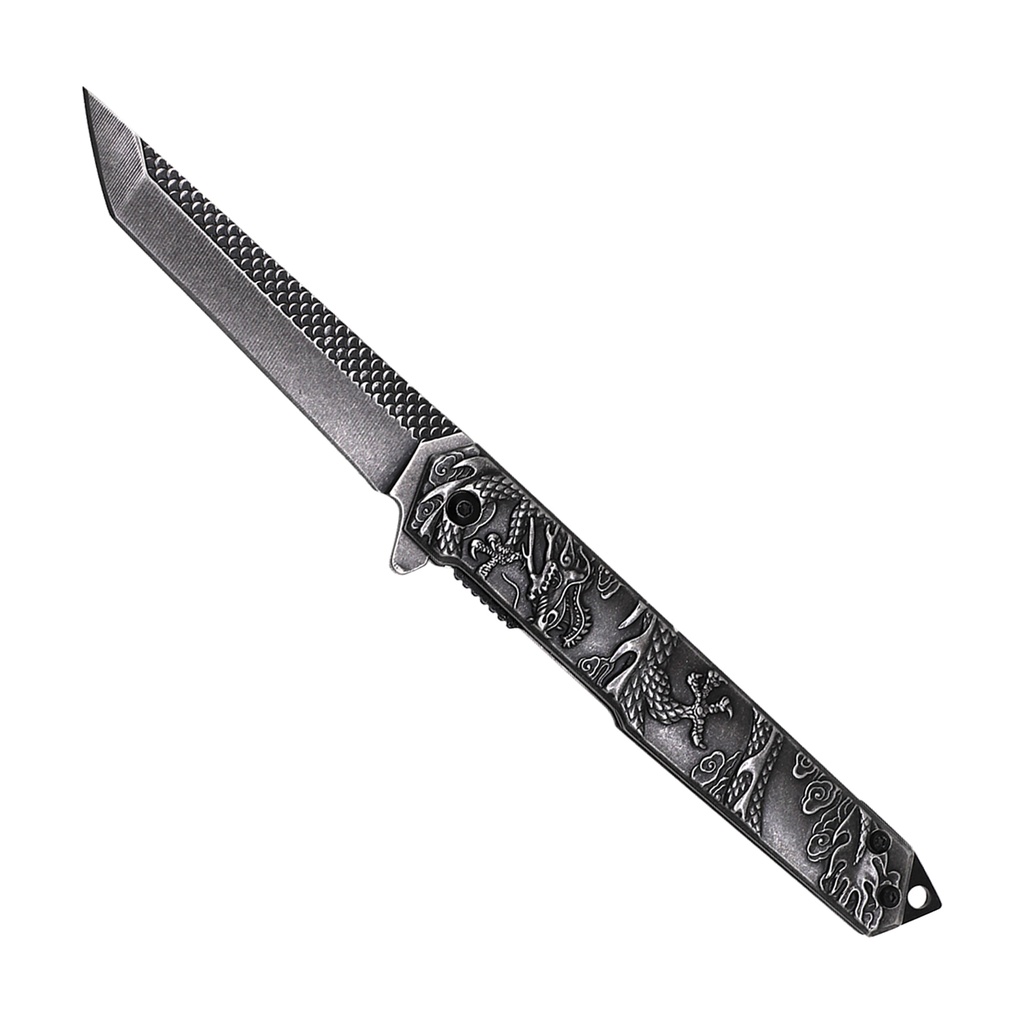
This is not an automatic knife for sale; it’s a spring-assisted tanto built for enthusiasts who care how a blade actually moves. Hit the flipper and the assist snaps the 3.75" 440 stainless into lockup with a clean, positive liner lock. The dragon-scale handle gives real traction, not just decoration, while the stonewash steel shrugs off pocket wear. At 4.75" closed and 8.5" open, it’s that rare fantasy-themed EDC that feels as good in hand as it looks on the shelf.
When a Spring-Assisted Tanto Earns a Spot Next to Your Automatic Knives
If you spend your time hunting for the next automatic knife for sale, you already know the difference between gimmick and engineering. This Dragonback Strike isn’t an automatic knife, and that’s exactly why some collectors reach for it alongside their autos and OTFs. It’s a spring-assisted tanto folder with a tuned flipper, a stonewashed 440 stainless blade, and a dragon spine aesthetic that actually works in the hand instead of just in photos.
Mechanically, it slots into the same mental shelf as your favorite automatic EDC: fast, predictable deployment from a closed position with one hand, but driven by an assist spring rather than a button-fired auto mechanism. If you’re the kind of buyer who reads action reviews before price tags, this one is speaking your language.
Automatic Knife for Sale vs. Assisted Folder: Why This Action Still Matters
When you go to buy automatic knife designs for serious use, you’re chasing a few predictable things: clean deployment, secure lockup, and a blade that doesn’t complain when it actually cuts. This assisted tanto hits those same marks, just with a different drive system.
Here, the flipper tab and internal spring do the work once you break the detent. You get a fast, authoritative snap without the legal baggage of a true automatic or switchblade in many jurisdictions. The liner lock engages with a satisfying, positive bite, and the full metal handle keeps the whole platform rigid. No flex, no vague lock engagement, just a clear on/off between open and closed.
Why the Spring Assist Feels So Clean
A good assist action should feel like a controlled cascade: you nudge the flipper, the spring takes over, and the blade tracks straight to full lock without stutter. On this knife, the detent is set firm enough that it won’t ghost open in-pocket, but light enough that a deliberate flick fires the blade every time. Enthusiasts used to automatic knives will recognize the same demand for repeatable action here — and they’ll appreciate that this one delivers without button-play or side-to-side slop.
Liner Lock and Geometry that Don’t Cut Corners
Plenty of budget folders call it a liner lock and leave it at that. This one actually gets the geometry right. The lock bar engages with enough surface on the tang to inspire confidence, but doesn’t overtravel into the far side of the blade. That means it’ll wear in slowly and stay serviceable, not chew itself out of spec in a month of fidgeting. For anyone who’s tuned or adjusted automatic knives, this attention to lock interface will feel familiar and welcome.
Blade, Steel, and Stonewash: Built to Be Carried, Not Just Posed
The blade is a 3.75-inch American tanto in 440 stainless steel, riding in a stonewash finish that actually makes sense for real carry. 440 isn’t exotic, but it’s honest: decent corrosion resistance, easy to sharpen, and tough enough for the everyday abuse most EDC knives see. Think more "cutting down boxes and cord" and less "worrying about patina."
The American tanto profile brings a reinforced tip and a clear secondary point, which is exactly what you want if your cutting tasks lean more toward push cuts, scoring, or working against harder materials. Pair that with the stonewash and you get a blade that hides micro-scratches and pocket wear instead of turning every mark into a bright, glaring reminder you actually use your knives.
Handle Ergonomics Under the Dragon Art
The full metal handle wears a raised dragon and cloud relief, but this isn’t a smooth, glossy fantasy prop. The sculpting creates real purchase along the scales and body, acting like built-in texturing where your fingers naturally land. That means you can put torque into the cut without the handle trying to spin or walk out of your grip. In practice, it feels less like a novelty piece and more like a themed version of a solid EDC frame.
Everyday Carry Reality: Pocket Clip, Dimensions, and Balance
Closed, this knife sits at 4.75 inches, which plants it squarely in the comfortable pocket EDC range. Open, you’ve got a full 8.5 inches of reach — enough blade presence for real work without crossing the line into ungainly. The pocket clip keeps it anchored and ready, and the lanyard hole at the butt gives you options if you like a fob or retention cord on your knives.
The balance point hovers close to the pivot, which is exactly where you want it on a working folder. It keeps tip weight under control for detailed cuts but still gives enough mass in the blade to make that spring-assisted deployment feel decisive.
Legal Context: Why Some Buyers Choose Assisted Over an Automatic Knife for Sale
Here’s the part too many product pages skip: legality. Under U.S. federal law, automatic knives (true autos and many switchblades) are restricted in interstate commerce, with some carve-outs for military, law enforcement, and specific uses. On top of that, state and local laws layer their own rules on automatic knives, OTF designs, and traditional switchblades — including where you can carry and how you can buy automatic knife models across state lines.
Spring-assisted knives like this one occupy a different category in many jurisdictions. Since you initiate the opening with the flipper and the blade is not released solely by a button or automatic mechanism, a lot of states treat assisted folders more leniently than full automatic knives. That doesn’t mean you can ignore your local laws, but it does mean this knife is often easier to carry legally than a dedicated automatic or OTF switchblade.
Bottom line: check your state and local regulations before you carry, but understand that assisted-openers like this are specifically chosen by many enthusiasts who want near-automatic speed with fewer legal headaches.
What Buyers Ask Before Purchasing an Automatic Knife
Are automatic knives legal?
In the U.S., automatic knives and switchblades sit under a mix of federal and state rules. Federal law (the Switchblade Knife Act) restricts interstate shipment of automatic knives except in certain exempted cases (military, law enforcement, some one-armed individuals, and specific industrial or commercial uses). That’s separate from state law, which decides whether you can own, carry, or conceal an automatic knife, OTF, or switchblade inside that state.
Many states have relaxed their automatic knife laws, but several still limit blade length, carry method, or outright ban autos. Assisted-opening knives like this one are distinct from automatic knives under most statutes, because you must manually start the blade with a flipper or thumb stud before the assist spring takes over. Always verify your state and local laws before you buy automatic knife models or carry anything that could be classified as an auto.
What’s the difference between an automatic knife, OTF, and a switchblade?
An automatic knife (or "auto") is a folding knife where the blade opens from the handle under spring tension when you press a button, lever, or similar control. A switchblade is the traditional legal term often used in statutes to describe these automatic knives. In collector language, "switchblade" usually means a side-opening automatic — the blade pivots out like a regular folder, just driven by a spring.
OTF (out-the-front) knives are a specific subset of automatic knives where the blade travels linearly out of the front of the handle instead of pivoting from the side. OTF switchblades can be single-action (you cock them manually, they fire automatically) or double-action (the same switch both deploys and retracts the blade under spring tension). This Dragonback Strike is neither an automatic nor an OTF; it’s a spring-assisted folder, meaning you start the opening stroke, and an assist spring finishes it.
What makes this automatic knife worth buying?
This isn’t an automatic knife, but it’s worth a spot in the same collection for three reasons. First, the action: the assist is tuned well enough that the deployment feels closer to an auto than a budget folder, with clean, repeatable lockup. Second, the build: 440 stainless in a stonewash finish, a proper liner lock, and a full metal handle put it ahead of the plastic-heavy novelty market.
Third, the dragon spine aesthetic isn’t lazy engraving — the relief actually enhances traction and grip. For an enthusiast who already owns OTFs and side-opening autos, this is the kind of assisted knife you buy when you want something you can both carry and display without feeling like you compromised on mechanics.
For Collectors Who Know Why Action Matters in Every Knife They Buy
If you’re the person your friends message when they’re hunting for an automatic knife for sale, you already think in terms of action quality, lock integrity, and real-world carry. This Dragonback Strike spring-assisted tanto won’t replace your autos or OTFs — it’ll sit beside them as the knife you grab when you want that fast, mechanical satisfaction in a package that threads the legal needle in more places. It’s a display piece that earns its pocket time, not just its shelf space.
| Blade Length (inches) | 3.75 |
| Overall Length (inches) | 8.5 |
| Closed Length (inches) | 4.75 |
| Blade Color | Silver |
| Blade Finish | Matte |
| Blade Style | American Tanto |
| Blade Edge | Plain |
| Blade Material | 440 Stainless Steel |
| Handle Finish | Matte |
| Handle Material | Metal |
| Theme | Dragon |
| Pocket Clip | Yes |
| Deployment Method | Spring-assisted |
| Lock Type | Liner lock |