
Field-Worn Mercenary War Sword - Brown Wood
11 sold in last 24 hours
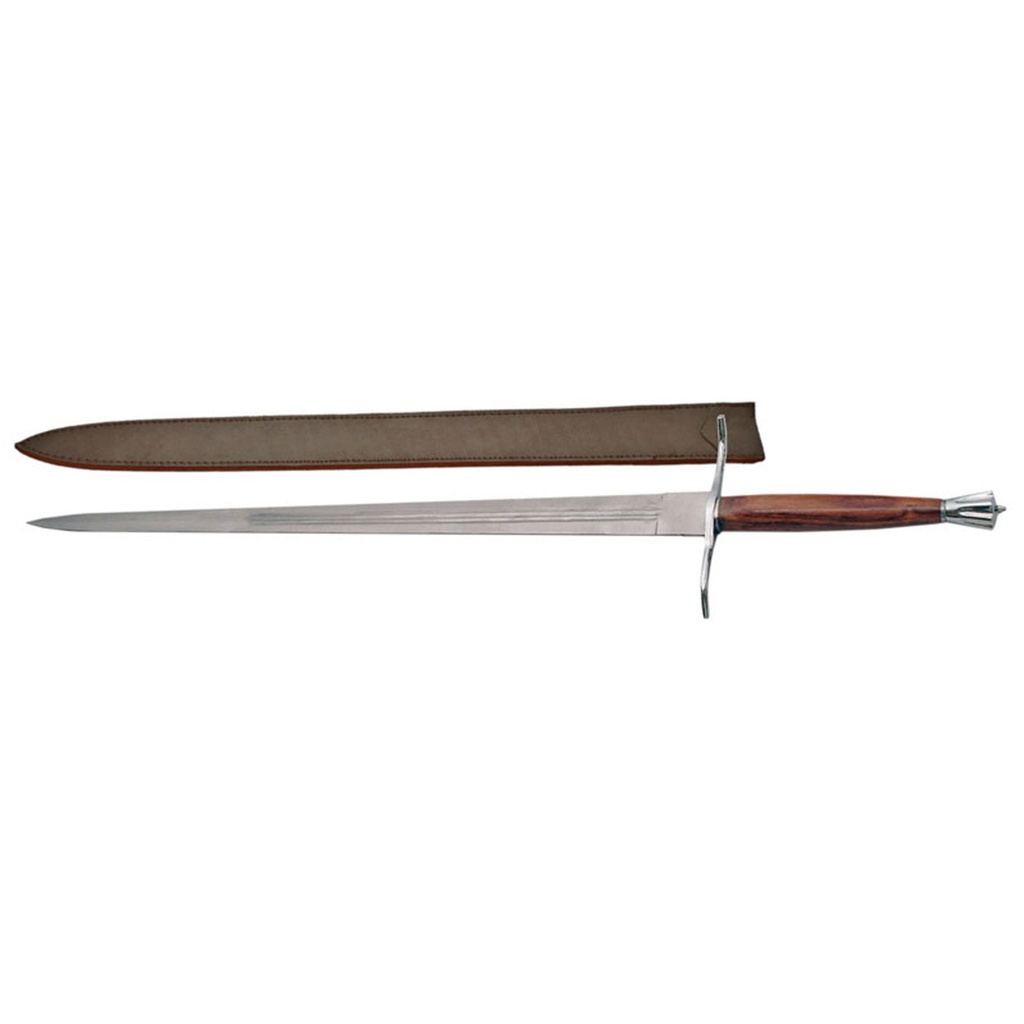
This 50" mercenary sword is built like a working blade, not a costume prop. The long, straight single edge with full-length blood groove keeps weight manageable while preserving stiffness for thrusts. A simple crossguard, faceted pommel, and smooth brown wood handle deliver a secure, no-nonsense grip. Paired with a fitted brown sheath, it’s ready for display, training, or reenactment. If you prefer swords that look like they’ve seen campaigns instead of glass cases, this is that kind of steel.
Field-Worn Mercenary War Sword - Brown Wood
The 50" Mercenary War Sword is what happens when you strip the fantasy out of a medieval blade and leave only what a working fighter would have paid for. Long, narrow, with a proper blood groove and a plain wood grip, this isn’t trying to be a king’s presentation piece. It’s built like something carried by the man on the payroll—the one who lives or dies by his sword, not by how ornate it looks on a mantle.
Practical Medieval Sword Design for Buyers Who Care About Function
This sword sits squarely in the practical medieval arming/battle sword category. At 50 inches overall, it has the reach of a long sword with the clean geometry of a straight, single-edged cut-and-thrust blade. The central blood groove isn’t window dressing—it lightens the blade while keeping enough spine for rigidity, exactly what you want in a thrust-oriented, battlefield-style sword.
The line is honest: straight blade, tapered point, functional fuller, and a crossguard that does its actual job—protecting the hand and indexing your grip. There’s no overbuilt fantasy geometry to fight through, which means better balance, a more intuitive point, and a profile that makes sense for cutting drills or stage combat where predictable handling matters.
Blade Geometry and Blood Groove: Where the Performance Lives
The blade is long, straight, and single-edged with a defined tapered point. That geometry puts it right in the cut-and-thrust lane: enough edge length for committed cuts, and a spine and tip profile that track well in the thrust. The blood groove (fuller) runs along the center of the blade, reducing weight without sacrificing structural integrity along the spine—exactly why fullers exist on real working swords.
That full-length fuller also helps the blade feel less like a crowbar and more like a weapon: quicker transitions, easier recovery after a cut, and a point that doesn’t feel like it’s dragging behind your intent. On a budget-friendly sword, seeing the fuller placed correctly, in line with the blade’s center, is a good indicator that someone at least respected the idea of proper geometry.
Balance, Reach, and Handling Reality
At 50" overall, you’re getting serious reach. While the exact point of balance isn’t specified, the combination of long blade, full-length fuller, and a solid metal pommel suggests an attempt to pull that balance back toward the hand. With the simple crossguard and wood handle, you’re not fighting unnecessary mass at the hilt, which helps the sword move like a blade, not a bar.
In hand, this style of sword is typically suited for two main uses: cutting drills and theatrical/stage work where a straight line and obvious profile photograph well. For wall display, that same geometry reads as "real" to anyone who has seen historical European swords, not just movie props.
Hilt Construction: Wood, Steel, and a Working-Style Pommel
The handle is all business: smooth brown wood over the tang, shaped into a taper that locks in naturally under the hand. No busy patterns or gaudy studs—just a grip that looks like it was meant to be used and used hard. The wood’s natural tone pairs with the steel for that "field-worn" mercenary aesthetic: simple, functional, and visually honest.
The crossguard is a straightforward metal bar with slight downward curves at the ends. That curve keeps your hand protected while giving a subtle visual cue to your grip orientation. The pommel finishes in a faceted or nut-style cap—again, more in line with practical swords than over-designed fantasy hilts. It visually balances the blade and suggests a counterweight, which is exactly what you want at the back of a long sword.
Sheath: Carry, Storage, and Display
The included brown sheath completes the package and matters more than most people admit. A 50" blade without a sheath is a storage problem; with one, it becomes a portable training tool or display piece that you don’t have to baby. The stitched edge and slim profile keep it true to the functional medieval theme—something a working mercenary might have actually worn on campaign.
Who This Mercenary Sword Is Really For
This sword isn’t chasing the high-end collector who wants etched blades, gilded hilts, and custom scabbards. It’s built for three buyers:
- Reenactors and roleplayers who want a believable, practical-looking sidearm that doesn’t scream "movie prop."
- Stage and cosplay users who value reach, clear silhouette, and an unmistakably medieval profile.
- Collectors who appreciate the logic of a plain mercenary sword as a counterpoint to the usual heroic or royal pieces on the wall.
If you’ve already got the ornate showpiece blades, this is the sword that looks like it actually paid the bills.
What Buyers Ask Before Purchasing an Automatic Knife
While this product is a fixed-blade medieval-style sword, serious blade buyers often cross-shop automatic knives, OTF models, and even traditional switchblades. The questions below appear on nearly every enthusiast order page, so we address them here for clarity—especially if you’re building a collection that includes both swords and modern automatic knives.
Are automatic knives legal?
In the United States, automatic knives—often called autos or switchblades—sit under a different legal framework than a sword like this. Federal law (the Switchblade Knife Act) generally restricts interstate commerce in automatic knives, but it makes clear exceptions for military, law enforcement, and some other specific uses. Day-to-day legality is decided at the state and sometimes local level.
Some states allow automatic knives to be owned and carried with few restrictions; others limit blade length, restrict carry but allow home ownership, or ban automatic knives outright. Swords, by contrast, are usually treated as large fixed blades: they may be legal to own but regulated in terms of how and where you can carry them. Before you buy an automatic knife or plan to carry any large blade in public, you must check your specific state and local laws—statutes change, and there’s no substitute for current, local information.
What's the difference between an automatic knife, OTF, and a switchblade?
Collectors and serious users draw clear lines here:
- Automatic knife (auto): A knife that opens with a spring-driven mechanism when you deliberately activate a button, lever, or similar control. Most autos are side-openers, where the blade pivots out from the side like a standard folder.
- OTF (out-the-front) knife: A specific type of automatic where the blade travels linearly out of the front of the handle. Many OTF knives are double-action (the same control both deploys and retracts the blade), though some are single-action (spring-powered out, manual retraction).
- Switchblade: Legally and historically, "switchblade" is often a regulatory term for automatic knives—especially side-opening autos. In enthusiast circles, it’s used more narrowly and usually with a nod to classic patterns. Not every locking folder with a quick action is a switchblade; it needs spring-driven automatic deployment.
This 50" Mercenary War Sword is not an automatic knife, OTF, or switchblade—it’s a full-length fixed blade. No springs, no buttons, just a solid steel blade and a hilt built around it. But if you’re the kind of buyer considering this sword, you’re probably the kind of buyer who understands and cares about those distinctions in your modern knives too.
What makes this sword worth buying?
On paper, it’s simple: 50" overall, blood groove, wood handle, sheath included. In hand and on the wall, it’s the combination of those choices that sells it:
- Honest geometry: A straight, tapered blade with a real fuller and a thrust-ready point gives you a silhouette that looks right to anyone who knows medieval steel.
- Working-class aesthetic: Plain brown wood grip, simple crossguard, and practical pommel create the look of a hired blade’s sidearm, not a glass-case relic.
- Functional sheath: The fitted brown sheath means the sword is actually usable for transport, storage, training, or costume—not just something you gingerly move from box to wall.
- Collection balance: If your rack is full of fantasy blades and heroic showpieces, a mercenary sword adds a grounded, "real fighter" counterweight that makes the rest of your collection more interesting.
You’re not buying this to baby it. You’re buying it because it looks like it’s already done the work.
Closing the Loop: A Mercenary Sword for the Collector Who Knows the Difference
The Field-Worn Mercenary War Sword - Brown Wood isn’t pretending to be anything it’s not. It’s a 50" medieval-style sword with a straight, single-edged blade, true blood groove, functional crossguard, and a no-nonsense wood handle, backed by a sheath so you can actually live with it instead of just stare at it in a box.
If you’re the kind of buyer who can talk for an hour about the difference between a double-action OTF and a side-opening automatic knife, you already understand why this sword has its place. Different category, same mentality: honest steel, practical design, and a piece that looks like it belongs to someone who earns their keep by how they use it.
Note: Extra shipping may apply to swords due to length and handling requirements.