Frontier Trail Heritage Hunting Knife - Buffalo Horn
13 sold in last 24 hours
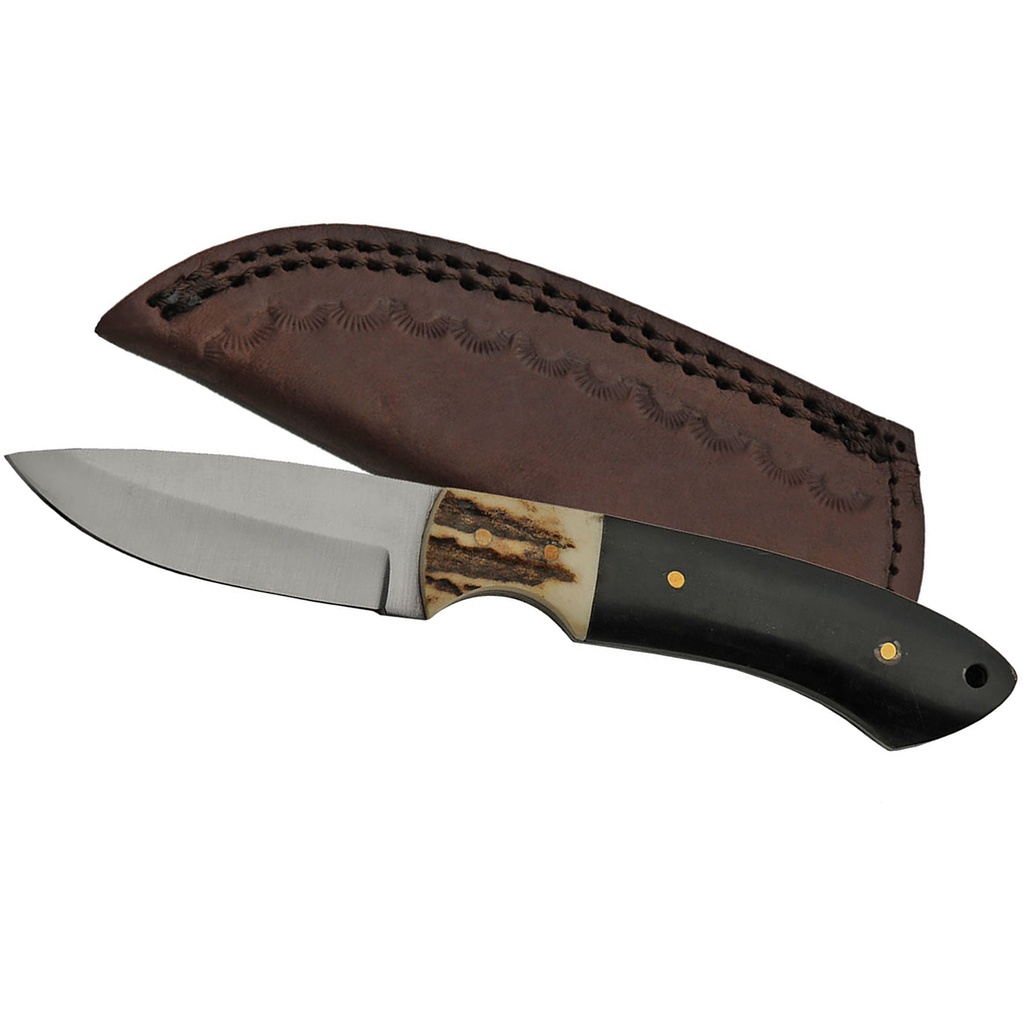
This isn’t a wall-hanger; it’s a working fixed blade that earns its place on your belt. The Frontier Trail Heritage Hunting Knife pairs a 3-inch stainless drop point with a full tang and contoured buffalo horn handle for real control on small game and camp chores. Brass pins and a leather belt sheath keep it rooted in classic hunting tradition. Compact, secure in hand, and easy to sharpen in the field, it’s the knife you forget about until you need it—and then it delivers.
Frontier Trail Heritage Hunting Knife - Buffalo Horn
The Frontier Trail Heritage Hunting Knife is what happens when you strip a field knife down to what actually matters. No gimmicks, no oversized blade you’ll never use—just a compact, full-tang fixed blade that disappears on your belt and shows up when precision counts. At 7 inches overall with a 3-inch stainless drop point, it’s built for real-world hunting and camp work, not catalog photos.
Why This Fixed Blade Hunting Knife Works When Others Don’t
A proper hunting knife isn’t a fantasy Bowie or a tactical cosplay piece. It’s a tool. This one earns its keep with a few non-negotiables:
- Full-tang construction running the length of the buffalo horn handle so you can twist, pry gently, and bear down without wondering what’s happening under the scales.
- 3-inch drop point blade that gives you a controllable tip for field dressing and fine work, with enough belly for slicing and general camp chores.
- Natural handle materials—buffalo horn with stag-style character—that lock into your hand and don’t feel like cheap injection-molded plastic.
- Leather belt sheath that rides where you need it and doesn’t rattle, flash, or get in the way.
It’s a traditional fixed blade hunting knife in the best sense: simple, honest, and ready to be used hard.
Blade, Steel, and Edge: The Working Heart of This Field Knife
The blade is where you find out if a hunting knife is serious or just decorative. Here you’re looking at a matte-finished stainless steel drop point built for real use and easy maintenance.
Drop Point Geometry Done for the Field, Not the Display Case
The drop point profile gives you a strong spine that carries thickness toward the tip without turning it into a clumsy wedge. That means you can open up game cleanly without the blade diving too deep, and you still have a fine enough point for controlled cuts, caping around joints, or even light whittling back at camp.
The plain edge runs a subtle, usable curve—enough belly for slicing hide and food prep, without a dramatic sweep that’s hard to sharpen on a simple stone. This is a blade shape you can keep tuned in the field with basic gear.
Practical Stainless for Real-World Hunting Conditions
The stainless steel here is chosen for what most hunters actually face: blood, moisture, and the occasional neglect before cleanup. You’re not babysitting a carbon showpiece; you’re carrying a blade that shrugs off a damp sheath and cleans up quickly. Edge retention is balanced toward ease of sharpening—exactly what you want when a quick touch-up on a pocket stone matters more than chasing exotic steel specs.
Handle and Ergonomics: Buffalo Horn That Actually Fits Your Hand
Plenty of knives brag about natural materials, then ruin them with lazy shaping. This handle earns its place.
- Buffalo horn scales with stag-style character bring that classic hunting look without feeling brittle or cheap.
- Finger groove and gentle palm swell give you a natural indexing point so the knife seats the same way in your hand every time.
- Three brass pins, including a rear lanyard hole, mechanically lock the scales to the full tang and add a warm visual contrast against the darker horn.
The result is a compact fixed blade that doesn’t dance in your grip when things get slick. From small game to cutting cordage, you can choke up, back off, and still feel exactly where the edge is.
Carry and Use in the Field
At 7 inches overall, this isn’t the kind of hunting knife you have to think about. You put it on your belt and forget it.
- Brown leather belt sheath with decorative stamping and clean stitching keeps the knife close without broadcasting itself.
- Compact profile means it won’t jab you when you sit, crouch, or climb into a stand.
- Integrated pommel at the butt of the full tang gives you a secure endpoint in the hand and a solid anchor for lanyard use if you’re working around water or steep terrain.
It’s the kind of fixed blade that quietly becomes your default—opening feed bags, cleaning fish, or pulling camp duty between seasons.
What Buyers Ask Before Purchasing an Automatic Knife
Even though the Frontier Trail Heritage is a fixed blade hunting knife, if you’re the kind of buyer who usually searches for an automatic knife for sale, you’re probably cross-shopping mechanisms and legal realities. Let’s address the questions that come up in that world, and why a fixed blade like this sometimes makes even more sense.
Are automatic knives legal?
In the United States, knife law is a mix of federal import rules and state-specific carry laws. Federally, automatic knives (often casually called switchblades) are regulated mainly in terms of interstate commerce and import under the Federal Switchblade Act. That law restricts how automatic knives move across state lines in commercial channels, but it doesn’t by itself control how you carry one day-to-day—that’s up to your state and sometimes your city or county.
Some states allow automatic knives for everyday carry with few restrictions, others limit blade length, opening mechanism, or who can carry them, and a handful still ban certain automatic or switchblade-style mechanisms outright. Always check your current state and local laws before you buy or carry an automatic knife, because the details change and enforcement can be very specific.
By contrast, a traditional fixed blade hunting knife like this Frontier Trail Heritage is often treated more clearly in the law—many jurisdictions recognize it as a field or hunting tool when carried with legitimate outdoor intent. That’s one reason seasoned outdoorsmen still default to a compact fixed blade on the belt, even if they enjoy automatics in their collection or pocket.
What’s the difference between an automatic knife, OTF, and a switchblade?
Mechanism matters, and terminology gets sloppy fast if you’re not careful:
- Automatic knife: A folding knife that opens its blade using a spring or similar mechanism when you press a button, lever, or switch built into the handle. You start the action with a control; the spring does the rest.
- OTF (out-the-front) automatic: A specific type of automatic knife where the blade deploys straight out the front of the handle instead of swinging from the side. These can be single-action (automatic out, manual retraction) or double-action (automatic out and automatic retraction via the same switch or slider).
- Switchblade: In common language, this usually refers to what the law calls an automatic knife—spring-driven opening triggered by a button or switch. It’s more of a legal and cultural term than a technical category.
The Frontier Trail Heritage isn’t an automatic knife, OTF, or switchblade at all—it’s a fixed blade. There is no folding joint, no spring, no deployment button. The blade is permanently locked in the open position because it doesn’t move. That simplicity is exactly why many hunters trust a small fixed blade for the messy, important work and keep their automatics for pocket carry and collection enjoyment.
What makes this hunting knife worth buying?
Collectors and serious users don’t buy on looks alone—they buy on details that hold up when the novelty wears off:
- Full tang under natural horn: You’re not getting a partial, hidden, or rat-tail tang that can fail under torque. The steel runs the length of the handle, clearly visible along the spine.
- Proven field geometry: The 3-inch drop point is a sweet spot for small to medium game and general camp use. It’s short enough for control, long enough for utility.
- Traditional materials, honest build: Buffalo horn, brass pins, leather sheath—this is a classic hunting package that doesn’t pretend to be something it’s not.
- Low-visibility, high-utility carry: Brown leather sheath keeps things quiet, comfortable, and under the radar around camp and in the field.
If you already own a stable of automatic knives or OTFs, this is the fixed blade that complements them: same appreciation for build quality, different job description.
For the Buyer Who Chooses Tools on Purpose
If you’re the kind of person who can talk steel, grind, and action for half an hour, you already know why a compact fixed blade belongs in the same world as your favorite automatic knives. The Frontier Trail Heritage Hunting Knife doesn’t try to replace an automatic knife for sale in your pocket—it gives you a dependable, traditional edge on your belt for the work that actually happens once the season starts.
Natural materials, full-tang construction, and a practical 3-inch drop point: it’s the knife you reach for when it matters, and the one that quietly builds its own history every time you take it into the field.
| Blade Length (inches) | 3 |
| Overall Length (inches) | 7 |
| Blade Color | Silver |
| Blade Finish | Matte |
| Blade Style | Drop Point |
| Blade Edge | Plain |
| Blade Material | Stainless Steel |
| Handle Finish | Gloss |
| Handle Material | Buffalo Horn/Stag |
| Theme | None |
| Handle Length (inches) | 4 |
| Tang Type | Full Tang |
| Pommel/Butt Cap | Integrated |
| Carry Method | Belt Carry |
| Sheath/Holster | Sheath |