Frontline Heritage Commando Dagger Knife - Wood/Steel
15 sold in last 24 hours
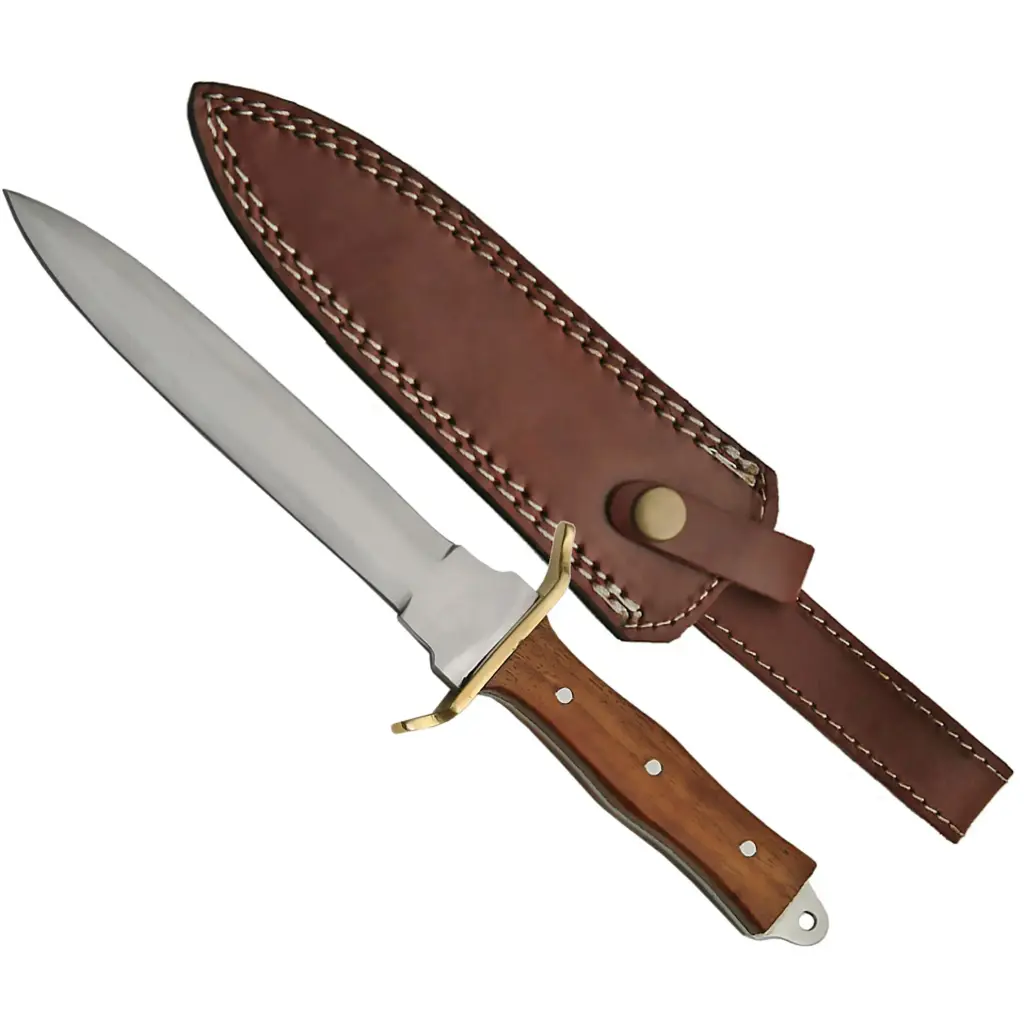
This is a fixed-blade commando dagger built on classic lines, not mall-ninja fantasy. The Frontline Heritage Commando Dagger Knife rides a full tang under smooth wood scales, with a 7-inch double-edged steel blade and brass guard for honest hand indexing. At 11.5 inches overall with a leather belt sheath, it’s sized like the field daggers that actually saw use. For the collector who respects traditional materials and clean geometry, this is a straightforward, purpose-built blade.
Fixed-Blade Commando Dagger for Buyers Who Respect Real Steel
If you’re looking for an automatic knife for sale, you already know this isn’t it — and that’s exactly why the Frontline Heritage Commando Dagger Knife matters. In a market obsessed with springs and buttons, this one wins by doing the old work the old way: full tang, double-edged steel, brass guard, and wood scales riding over honest steel. It’s a classic commando-style dagger built as a fixed blade, not a toy and not a movie prop.
Why This Fixed Commando Dagger Belongs Next to Your Automatic Knives for Sale
Serious collectors don’t live on automatics alone. For everyone who comes to buy automatic knife models or hunt down the next OTF and switchblade variant, there’s always a short list of fixed blades that earn permanent rail space in the case. This dagger is one of those pieces.
At 11.5 inches overall with a 7-inch double-edged blade, the proportions echo classic military commando designs. The full-tang construction is visible along the handle edges, and that matters: when you run a blade this long and this narrow, tang integrity is everything. There’s no hinge, no button, no coil spring—just steel running uninterrupted from tip to lanyard hole.
Steel, Geometry, and Balance: Where This Dagger Actually Earns Its Keep
Most listings throw out a steel name and call it a day. This one earns its spot differently: geometry plus construction. You’re looking at a polished, double-edged dagger profile with a central spine. That central ridge stiffens the blade, giving better point stability during thrusts and reducing flex along the length. On a 7-inch dagger, that’s not decoration—it’s structure.
Full Tang and Old-School Hardware
The tang is fully exposed at the pommel with a lanyard hole, and the wood scales are pinned with multiple rivets. That’s not ornamental. Pins distribute stress along the handle so the scales don’t try to walk off the tang under torsion. For a fixed dagger, especially one echoing commando use, that’s the difference between a wall-hanger and a field-capable piece.
Handle, Guard, and Real-World Grip
The smooth brown wood scales, brass crossguard, and visible spine give you a proper tactile index, even without aggressive texturing. The brass guard has just enough flare to block the hand from riding up on a thrust without snagging on every belt or pack strap. It’s a field-forward design — you can actually draw and re-sheath this from the leather without fighting the hardware.
Leather Sheath and Carry: Traditional, Functional, Honest
The included brown leather sheath isn’t an afterthought. It’s stitched with contrast thread and cut for belt carry, with a retention strap and snap. That strap does more than keep the knife from walking free in the brush; it also allows you to carry a double-edged dagger securely without overbuilding the sheath mouth.
For an automatic knife enthusiast who usually clips a side-opening automatic or OTF to the pocket, this dagger scratches a different itch: deliberate carry. Belt it on when you actually mean to use or display it, then retire it to a rack or case next to the rest of your collection. It’s not pretending to be an EDC folder — it’s unapologetically a full-sized fixed blade.
Legal Reality: Fixed-Blade Dagger vs Automatic, OTF, and Switchblade Laws
Here’s where this piece quietly solves a problem that follows every automatic knife for sale online: legal complexity. In the U.S., automatic knives, OTF knives, and what statutes often call “switchblades” are subject to specific federal and state rules. Federal law (the Switchblade Knife Act) restricts interstate commerce in switchblades, and many states have their own rules on owning, carrying, or concealing an automatic or OTF.
This Frontline Heritage is a fixed-blade dagger, not an automatic knife, not an OTF, and not a switchblade under federal definition. There is no button, no spring, and no automatic deployment mechanism. That usually places it under your state’s general fixed-blade and dagger regulations instead of automatic and switchblade statutes.
Translation: in many jurisdictions, this can be simpler to own and display than an automatic or double-action OTF. But dagger and fixed-blade laws still vary widely by state and even city—length limits, concealment rules, and where you can carry all come into play. Before you belt this on or stash it in a vehicle, check your local and state codes for dagger and fixed-blade restrictions, not just automatic knife or switchblade laws.
Collector Context: Why a Fixed Commando Dagger Matters in an Automatic-Focused Collection
If your search history is full of terms like “best automatic knife for EDC,” “double action automatic knife for sale,” and “automatic knife legal to carry,” you’re the buyer this was made for. You already care about action quality and mechanism precision. This dagger gives you something else to appreciate: the simplicity of a single piece of steel doing its job without help from a spring.
Old-World Materials with Purpose, Not Pretense
Wood scales, brass guard, polished steel, leather sheath—this isn’t tactical cosplay. It’s the material set you saw on the knives that actually rode on belts in the mid-20th century. For a display case heavy on modern automatics, coated steel, and synthetic handles, this dagger becomes a visual and historical counterpoint. It tells a different story sitting beside your favorite side-opening automatic or OTF double-action.
Display Presence Without the Drama
On the wall, in a shadow box, or in a drawer full of modern folders, that 7-inch double-edged blade, brass guard, and warm wood handle announce exactly what it is: a classic commando-style field dagger. No skulls, no sawbacks, no gimmicks. Just clean geometry and proportional hardware. Collectors notice that. So do knife people who’ve handled the real thing at shows and in old collections.
What Buyers Ask Before Purchasing an Automatic Knife
Are automatic knives legal?
In the U.S., legality of automatic knives, OTF knives, and switchblades is a patchwork of federal and state law. Federal law (the Switchblade Knife Act) mainly regulates interstate commerce and shipment of switchblades, defined as knives that open automatically by button, inertia, or other mechanical device. Many states now allow ownership and carry of automatic knives, but others still restrict them, limit blade length, or distinguish between open carry and concealed carry.
This particular product is a fixed-blade dagger, not an automatic knife, OTF, or switchblade. That usually means it falls under different sections of state law (fixed blades, dirks, daggers) instead of automatic knife statutes. Still, you must check your own state and local regulations for both fixed-blade and dagger rules before carrying it. Laws change, and responsibility is on the owner, not the seller.
What’s the difference between an automatic knife, OTF, and a switchblade?
Mechanically, an automatic knife (side-opener) has a spring-loaded blade that pivots out from the side of the handle when you press a button or release. An OTF knife (out-the-front) has a blade that travels linearly out of the front of the handle; some are single-action (spring deploy, manual reset) and some are double-action (spring assist both ways). In U.S. legal language, both of these are generally treated as switchblades—a broader term in statutes for any knife that opens automatically via a button, switch, or other mechanical device.
This Frontline Heritage Commando Dagger Knife is none of those. It’s a fixed-blade dagger: the blade is exposed, permanently fixed to the tang, and carried in a sheath. No buttons, no springs, no assisted action. That distinction is crucial for both collectors and for understanding how laws apply.
What makes this automatic-knife-adjacent dagger worth buying?
You’re not buying this instead of an automatic knife; you’re buying it because you already respect mechanisms and steel. The value is in the full-tang construction, the double-edged dagger geometry with a central spine, the brass guard and pinned wood scales, and the leather sheath that makes it belt-ready out of the box. In a collection full of OTF and automatic knives for sale, it becomes the fixed-blade counterpoint that proves you understand the difference between chasing hype and owning blades that will still look right 20 years from now.
For the Buyer Who Knows Why Mechanism Matters
When you scroll past every automatic knife for sale looking for something with real lineage, this is the piece you stop on. The Frontline Heritage Commando Dagger Knife doesn’t try to compete with your favorite double-action OTF or side-opening automatic. It complements them—classic field geometry, honest materials, fixed-blade simplicity. You’re not just filling a slot; you’re rounding out a serious knife collection with a dagger that would look right at home next to the automatics, not beneath them.
| Blade Length (inches) | 7 |
| Overall Length (inches) | 11.5 |
| Weight (oz.) | 6.53 |
| Blade Color | Silver |
| Blade Finish | Polished |
| Blade Style | Dagger |
| Blade Edge | Plain |
| Blade Material | Steel |
| Handle Finish | Smooth |
| Handle Material | Wood |
| Theme | Old-World |
| Handle Length (inches) | 4.5 |
| Tang Type | Full Tang |
| Carry Method | Sheath |
| Sheath/Holster | Leather Sheath |