Grim Clockwork Skull Sword Cane - Brass & Black
12 sold in last 24 hours
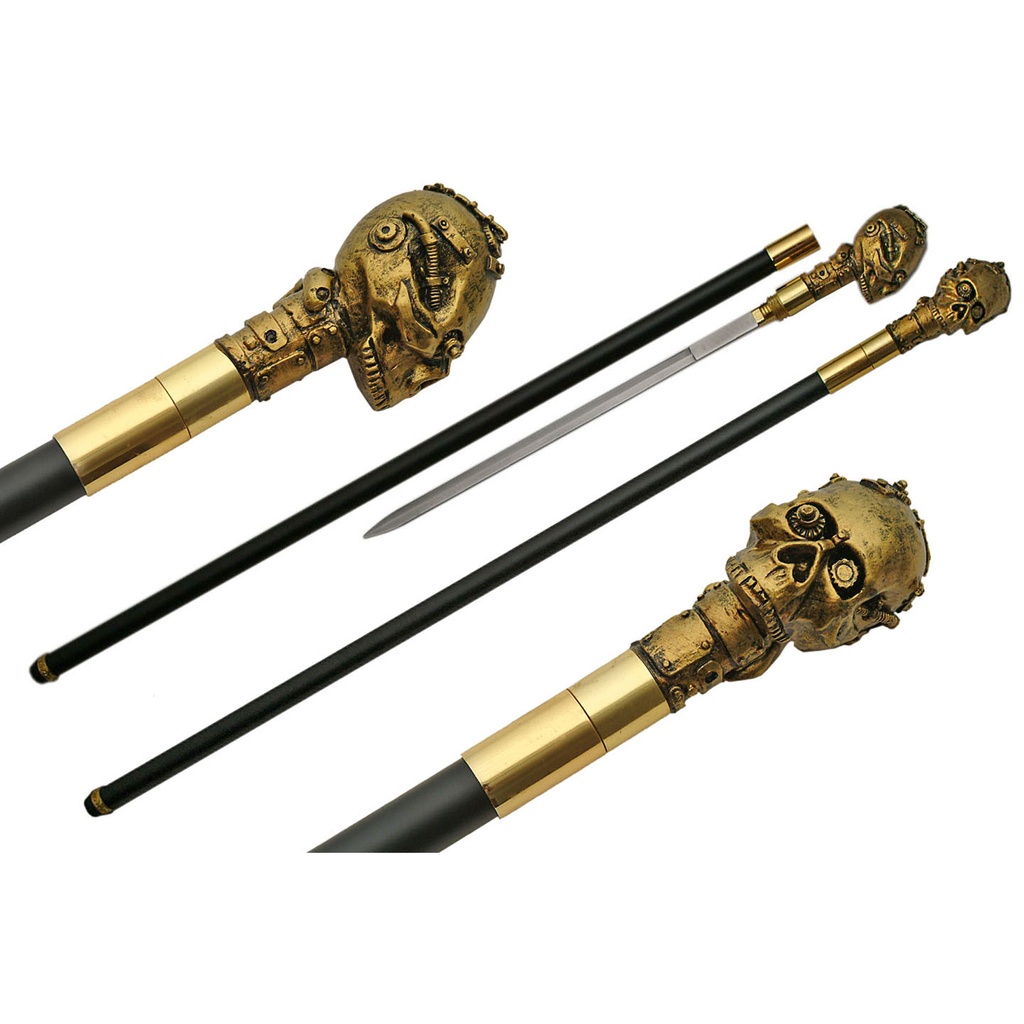
This isn’t a costume prop; it’s a Grim Clockwork Skull Sword Cane built for collectors who care about detail. The antiqued brass-finish skull pommel carries riveted, mechanical texture, while the black shaft hides a slim steel blade that draws cleanly from the collar. At full length, it has presence without feeling gaudy, making it ideal as a gothic or steampunk display piece, stage prop, or signature accent in a themed collection.
Grim Clockwork Skull Sword Cane – Brass & Black Presence with a Hidden Edge
The Midnight Sovereign Skull-Pommel Sword Cane is built for the buyer who understands that display pieces still need discipline. The brass-finish skull, the understated black shaft, and the concealed steel blade combine into a gothic-steampunk sword cane that feels more like a prop from a well-budgeted period thriller than a throwaway novelty. It’s about controlled drama: a statement piece that looks like it belongs in a curated collection, not a costume bin.
Why This Skull Sword Cane Earns a Spot in a Serious Collection
Plenty of canes hide blades. Very few get the visual hierarchy right. Here, the eye goes exactly where it should: first to the antiqued brass skull pommel, then to the brass-toned collar, and finally down the matte black shaft. That balance matters if you’re lining this up with other gothic or steampunk pieces.
The skull itself isn’t a cartoon; it leans into mechanical detailing—plates, implied rivets, segmented surfaces—so it reads more as a piece of industrial relic art than a Halloween decoration. Pair that with the straight, no-frills shaft and you get a clean contrast: ornate at the top, disciplined below. Collectors who display by theme—skulls, Victorian, or occult-industrial—will notice how easily this anchors a shelf or wall rack.
Concealed Blade, Clean Separation
Functionally, this is a sword cane: a cane body with a hidden, slim steel blade that draws from beneath the skull pommel. The brass-colored collar at the junction isn’t just cosmetic; it visually and physically marks the transition point between handle and cane, so even someone unfamiliar can intuit where the separation occurs. That detail makes handling and demonstrating it to guests feel natural and controlled.
Display-First, Not Daily-Use Mobility Gear
This is not a medical-grade support cane and shouldn’t be treated like one. It’s a display-oriented sword cane designed for collectors, costumers, and stage or film prop use. The length—about 36.75 inches overall—hits that sweet spot where it looks right in the hand or on camera without overwhelming most users. Think of it as a character piece you happen to own in real life.
Mechanics and Build: What’s Actually Going On Under the Brass
Unlike an automatic knife, there’s no spring-loaded deployment here. This is a manual draw sword cane: you separate the skull pommel and upper section from the shaft, and the blade pulls cleanly from the interior. The appeal isn’t speed of action; it’s the reveal. You’re buying the rhythm of that motion—the twist or pull, the soft release of friction, the slender line of steel sliding clear of the black sheath.
Blade Profile and Feel
The concealed blade is slim and straight, optimized for visual impact and easy sheathing rather than hard use. In the sword cane world, that’s the right choice: broad, heavy blades add weight, stress the junction, and make re-sheathing clumsy. A narrow blade lets the piece keep its line, preserves the cane silhouette, and makes demonstrations smooth and repeatable.
Steel here is utility-grade—sufficient for edge definition and light cutting if the buyer chooses to sharpen it, but this is not a dedicated cutting tool like a high-end automatic knife. The job of this blade is to be there, to look right when drawn, and to go back into its housing without a fight.
Fit, Finish, and the "Click" That Matters
Serious automatic knife buyers obsess over lock-up and action. For a sword cane, the equivalent obsession is about play and closure. The shaft should seat the blade section without rattling, the join should feel positive, and the transition from brass collar to black shaft should look intentional. That’s where this piece delivers: the antiqued brass finish hides minor handling wear better than bright polish, and the matte black shaft visually disappears so the skull and collar can do the talking.
Legal Reality: Sword Cane Ownership vs. Carry
Any time you’re dealing with concealed blades—whether that’s an automatic knife, an OTF, a switchblade, or a sword cane—you need to respect the law. This sword cane is best treated as a display and collection item first, not as something you casually carry in public.
In the United States, federal law focuses more on interstate commerce of automatic knives and switchblades than on sword canes, but states and even cities often have specific restrictions on concealed or disguised weapons. Sword canes are frequently regulated more strictly than openly carried blades of the same length because the blade is hidden inside an everyday object.
Translation: always check your state and local laws before carrying this outside your home or private property. In some jurisdictions, owning a sword cane at home is legal but public carry is not. In others, both ownership and carry might be restricted. When in doubt, treat this as a conversation piece, display item, or controlled-use prop rather than an everyday walking cane.
What Buyers Ask Before Purchasing an Automatic Knife
Are automatic knives legal?
Automatic knives, OTFs, and similar mechanisms sit in a different legal bucket than a sword cane like this, but the same rule applies: law is local. In the U.S., federal law (15 U.S.C. §§1241–1245) restricts the interstate shipment of switchblades and automatic knives to civilians, with exemptions for military, law enforcement, and certain uses. Most of the real complexity lives at the state and city level—some states have fully legalized automatic knives and OTFs for adults, others limit blade length, mechanism type, or carry method, and a few still ban them outright.
Before you buy or carry an automatic knife, research current statutes for your state and municipality, and distinguish between simple ownership at home and concealed or open carry in public. Laws change; don’t rely on rumor or outdated forum posts.
What’s the difference between an automatic knife, OTF, and a switchblade?
Mechanically, an automatic knife is any knife whose blade opens fully via a spring or stored energy when you press a button, lever, or similar control on the handle—no manual blade rotation required after activation. A switchblade is the traditional legal term for that same family of knives, and in many statutes "automatic knife" and "switchblade" are used interchangeably.
An OTF (out-the-front) knife is a specific type of automatic where the blade travels linearly out of the front of the handle, rather than pivoting out from the side on a hinge. OTFs can be single-action (spring deploy, manual retract) or double-action (spring assist in both directions). A sword cane, by contrast, uses no spring or button; it’s a concealed, manually drawn blade housed inside a cane shaft—mechanically much simpler, legally often treated as a disguised weapon.
What makes this sword cane worth buying?
This piece earns its keep on three fronts. First, the visual theme is coherent: the brass-finish skull with mechanical detailing, the matching collar, and the restrained black shaft work together instead of fighting for attention. Second, the concealed blade and clean separation at the collar deliver the one moment a sword cane has to get right: the reveal feels deliberate, not flimsy. Third, it plays well with others—if you already collect skull-themed gear, gothic blades, or steampunk props, this slots into that ecosystem with minimal effort. It’s an easy anchor piece around which to build a display.
Who This Sword Cane Is Really For
If you’re the type of buyer who compares spring tension on automatic knives or debates the merits of side-opening autos versus double-action OTFs, you already understand niche tools and specialized weapons. This sword cane belongs in that same mental category: not an everyday implement, but a focused piece with a clear role.
As a display sword cane, it brings brass-and-black drama without tipping over into caricature. As a prop, it reads well on camera and holds up under closer inspection. As a collector item, it scratches that itch for something a little theatrical, a little Victorian, and unapologetically skull-forward. You’re not buying utility here; you’re buying presence—and you’re doing it with the same deliberate eye you use when you pick out your next automatic knife for sale.
| Overall Length (inches) | 36.75 |
| Theme | Skull |
| Concealment Type | Cane |