Heartline Velocity Spring-Assisted Pocket Knife - Pink Aluminum
8 sold in last 24 hours
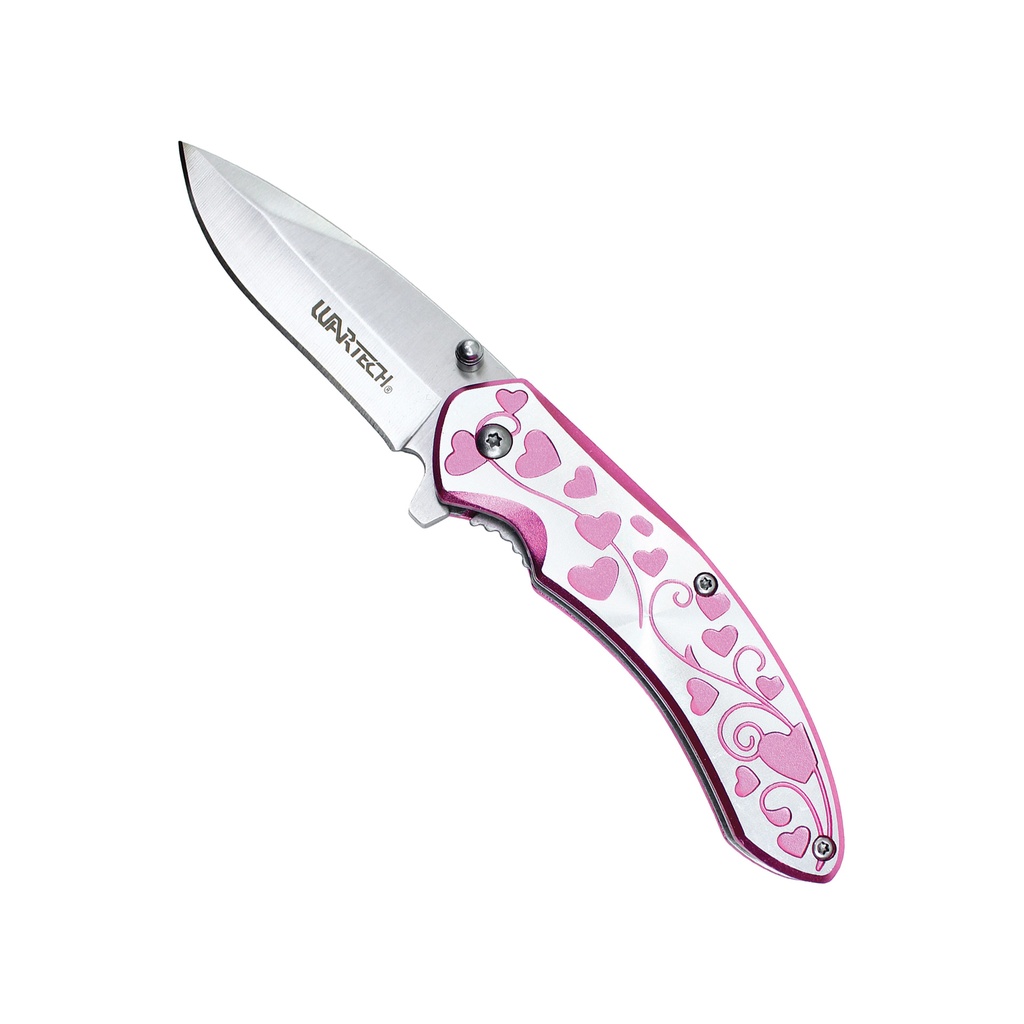
This spring-assisted pocket knife doesn’t just lean into the Valentine theme—it backs it up with real EDC performance. A 3-inch stainless drop point rides on a flipper and thumb stud for fast, positive deployment into a secure liner lock. Glossy pink aluminum scales with heart-and-vine graphics bring unmistakable personality without feeling like a toy. At 7 inches overall with a pocket clip and pocketable 4-inch closed length, it’s a romantic EDC that actually cuts, carries, and works the way a knife should.
Spring-Assisted Pocket Knife for Sale That Actually Earns Pocket Time
Most love-themed knives are novelty pieces: cute, underbuilt, and destined for a drawer. This one isn’t. The Heartline Velocity Spring-Assisted Pocket Knife - Pink Aluminum is a real, working EDC that just happens to wear its heart graphics proudly. If you’re looking to buy a spring-assisted pocket knife for someone who actually uses their gear, this is built to be carried, flicked, and put to work daily.
Why This Spring-Assisted Knife Belongs with Serious Everyday Carry
Mechanically, this is a straightforward, proven formula: 3-inch stainless drop point blade, spring-assisted opening, flipper tab plus thumb stud, and a liner lock. Nothing gimmicky, nothing fragile. The assist is tuned for decisive snap without feeling over-sprung or harsh. That means you can ride the flipper with confidence, not white-knuckle it and hope the blade clears.
The 7-inch overall length gives you enough blade to be useful without jumping into full-size tactical territory. Closed at 4 inches, it disappears in a pocket but still fills the hand better than the usual micro-gift knives.
Action and Deployment: Where the Knife Earns Respect
On spring-assisted knives, the difference between “fine” and “I’ll actually carry this” comes down to three points: detent, spring timing, and how cleanly the lock engages. This knife hits that balance. The detent is strong enough that the blade stays put in pocket, but once you start the motion with the flipper, the spring takes over and drives the blade home with a clean, audible lockup.
The dual deployment is not just for show. The flipper gives you fast, index-finger access when you need an immediate open. The thumb stud is there for those times you want a slower, more controlled, one-hand open in tighter spaces or when you’re cutting in close to something you don’t want to damage. Liner lock engagement is solid and consistent across repeated flicks — exactly what you want on a budget-friendly EDC that still needs to inspire confidence.
Blade and Steel: Stainless That Does Its Job
The blade is a matte-finished stainless drop point with a plain edge. No, it’s not a boutique powdered steel, and that’s the point. On a knife aimed at real-world daily use and gift buyers, simple stainless is the correct call: it resists rust, takes an edge quickly on modest sharpening gear, and shrugs off the kind of food, tape, and cardboard abuse that most everyday carry knives see.
The drop point profile gives you a usable tip for detail work and enough belly for slicing. Paired with the matte finish, you get a blade that’s practical, low-glare, and easy to maintain. It’s built to be used, not babied.
Automatic Knives for Sale vs. Spring-Assisted: Know What You’re Buying
If you’re searching for an automatic knife for sale and landed here, it’s worth being precise with terminology. This is not an automatic, OTF, or classic switchblade. It is a spring-assisted folding knife. That means the blade requires intentional manual input — you start it with the flipper or thumb stud — and only then does the internal spring take over and complete the opening.
Why does this matter? Because buyers who want to buy an automatic knife are often chasing a very specific experience: press a button, the blade fires from closed to locked with no manual start. That’s an automatic. This knife gives you a similar fast, satisfying snap, but with the controlled, legal-friendly operation of an assisted opener in many jurisdictions.
How It Carries: Real EDC Dimensions, Not a Toy
At 4 inches closed and 7 inches overall, this knife sits right in the sweet spot for everyday carry. The glossy aluminum handle scales keep weight down, while the liners and hardware give it enough structure that it doesn’t feel flimsy when you bear down on a cut.
The pocket clip tucks it in place for tip-down carry, ready to index on the flipper tab as soon as you draw. The exposed liner jimping near the flipper gives you tactile feedback when deploying, and doubles as a grip point when you’re doing push cuts or choking up. This isn’t a safe-queen; it’s sized and set up to ride in pocket all day.
Visual Theme: Valentine EDC That Still Feels Like a Tool
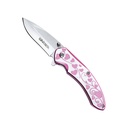
The pink and white heart-and-vine graphics make the theme obvious: this is a Valentine-ready knife, a romantic EDC that actually works. The gloss aluminum scales catch light, but the blade remains clean, matte, and all business. That contrast is intentional — handle for personality, blade for performance.
For collectors and enthusiasts, that matters. A themed knife that still respects the fundamentals — blade geometry, lock reliability, deployment quality — is far more interesting than another novelty trinket with a laser-etched slogan and sloppy action.
Collector Angle: When a Gift Knife Becomes a Gateway EDC
For a lot of new carriers, this kind of knife is the gateway. It looks approachable and personal, but the first time they feel the assisted snap, watch the liner lock fall into place, and use the blade on real tasks, they’re in. From a collector standpoint, that transitional role is valuable. It’s the knife that gets someone from “cute” to “what’s the action like?” — and that’s how new enthusiasts are made.
What Buyers Ask Before Purchasing an Automatic Knife
Are automatic knives legal?
In the United States, federal law (notably the Switchblade Knife Act) restricts interstate commerce in automatic knives — the true push-button or slide-to-fire switchblade type — with some exemptions for military, law enforcement, and one-armed users. However, most day-to-day legality is determined at the state and sometimes local level. Some states allow automatic knives and switchblades with few restrictions, others limit blade length, carry method, or who may possess them, and a few still prohibit them outright.
This particular knife is a spring-assisted folder, not an automatic or OTF. In many jurisdictions, assisted openers are treated differently and are more broadly legal to carry because they require manual initiation of the blade before the spring engages. That said, laws change and enforcement varies. Before you buy any automatic knife, switchblade, OTF, or assisted opener, you should check your current state and local laws — and when in doubt, consult an attorney or your local authorities rather than relying on internet hearsay.
What’s the difference between an automatic knife, OTF, and a switchblade?
Collectors draw clear lines here:
- Automatic knife / switchblade: In common modern use, these terms both refer to a knife where a button, lever, or concealed actuator releases a spring-driven blade from fully closed to fully open with no manual rotation. Side-opening automatics pivot like a normal folder, but fire from closed to locked with a push.
- OTF (out-the-front): A type of automatic where the blade travels linearly out the front of the handle rather than pivoting. Double-action OTFs can extend and retract the blade using the same switch; single-action OTFs usually require manual retraction.
- Spring-assisted folder: What you’re looking at here. The blade is manually started open via a flipper or thumb stud, and only after you’ve moved it partway does an internal spring take over to complete the opening. No button, no from-zero-to-open fire.
Mechanically and legally, these distinctions matter. Enthusiasts care because the action feel, maintenance, and carry behavior are all different. Lawmakers care because intent and perceived risk differ between a button-fired switchblade and an assisted EDC that still needs deliberate manual input.
What makes this spring-assisted knife worth buying?
It earns its keep in three ways: mechanism, proportions, and purpose. Mechanism first — the assisted action is tuned well enough that even an experienced knife user won’t roll their eyes; the detent, spring timing, and liner lock engagement all land in the “usable and satisfying” category. Proportions next — a 3-inch stainless drop point at a 7-inch overall length is a proven EDC format that actually cuts and carries comfortably.
Purpose is where this knife steps out from the commodity crowd. The Valentine-ready, heart-and-vine pink aluminum handle hits the romantic and feminine brief without sacrificing function, making it a legitimate gift knife for someone who actually cares whether their blade deploys cleanly and cuts well. That combination — real-world mechanics wrapped in expressive styling — is what turns this from another novelty into a piece an enthusiast can respect.
For Enthusiasts Who Care How a Knife Opens as Much as How It Looks
If your idea of "nice" isn’t just a pretty handle but a dialed-in spring-assisted action, a trustworthy liner lock, and a blade that can be sharpened and used hard, this pink Valentine EDC hits that mark. It’s not an automatic knife for sale, but it lives in the same world of mechanical satisfaction — built for people who judge a knife by its action, not just its color.
| Blade Length (inches) | 3 |
| Overall Length (inches) | 7 |
| Closed Length (inches) | 4 |
| Blade Color | Silver |
| Blade Finish | Matte |
| Blade Style | Drop Point |
| Blade Edge | Plain |
| Blade Material | Stainless Steel |
| Handle Finish | Glossy |
| Handle Material | Aluminum |
| Theme | Hearts |
| Pocket Clip | Yes |
| Deployment Method | Spring-assisted |
| Lock Type | Liner lock |