Heritage Vein Gentleman’s Assisted Knife - Polished Wood
6 sold in last 24 hours
This is not an automatic knife; it’s a spring assisted gentleman’s folder with Damascus-style attitude. The dagger-profile blade rides on a flipper tab, jumping to attention with a clean, one-hand snap into a solid liner lock. Patterned steel and polished wood scales give it that show-table presence, while the pocket clip keeps it honest as an EDC. If you care how a knife deploys and how it looks doing it, this one earns pocket time.
Heritage Vein Gentleman’s Assisted Knife - Polished Wood
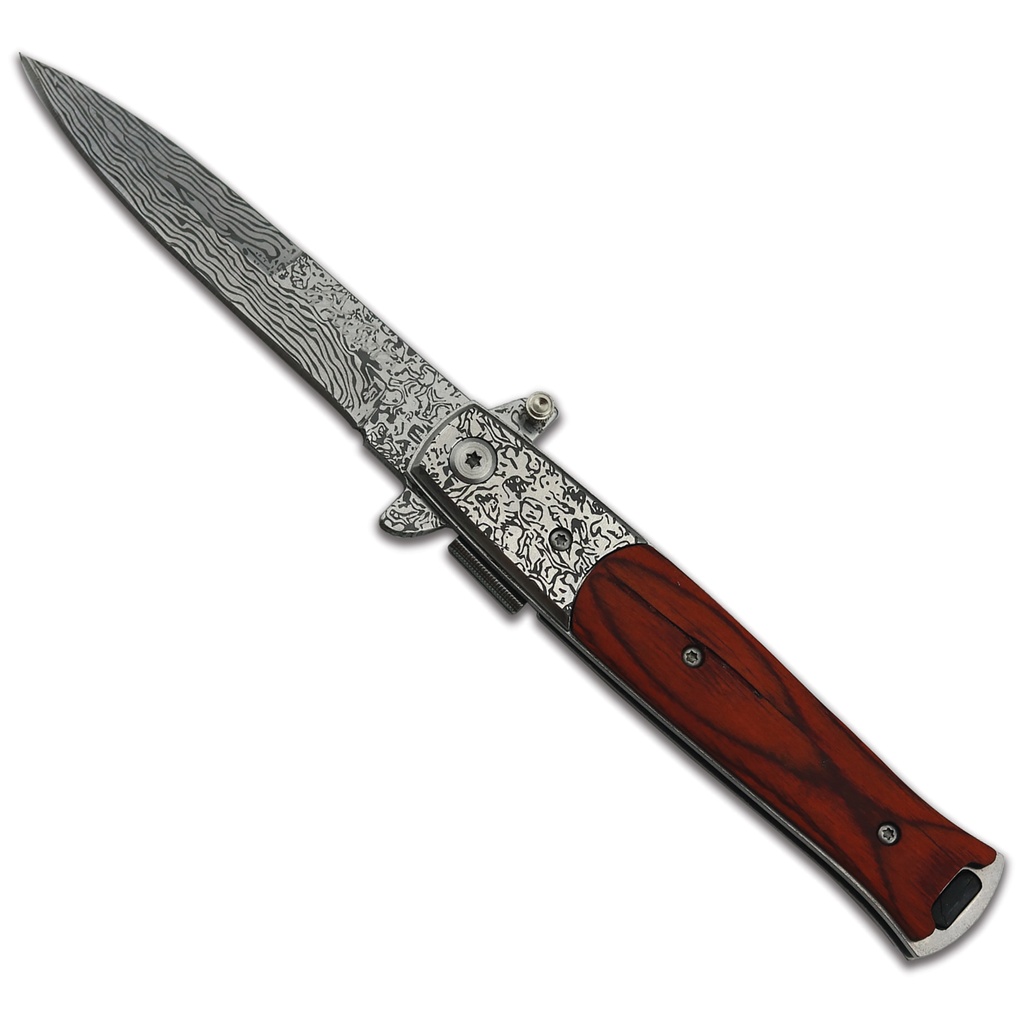
This is where classic stiletto lines meet modern assisted deployment. The Heritage Vein Gentleman’s Assisted Knife looks like it walked off a custom table at a regional show: Damascus-style blade pattern, polished wood scales, etched bolsters. But in hand, it’s a fast, flipper-driven spring assisted knife built for real pocket time, not just glass-case duty.
Understanding the Mechanism: Not an Automatic Knife, a True Spring Assisted Folder
Let’s get the mechanics straight, because that’s where serious buyers separate marketing hype from reality. This is not an automatic knife and not an OTF. It’s a spring assisted folding knife built around a flipper tab and liner lock.
With an automatic knife, pressing a button or hidden actuator releases the blade under spring tension from a fully closed, at-rest position. In a spring assisted knife like this one, you start the motion manually using the flipper tab; once you overcome a short detent, an internal torsion spring takes over and drives the blade into lock-up. The action is quick, authoritative, and one-hand friendly, but legally and mechanically it is distinct from a true automatic or switchblade.
Flipper-Driven Action and Liner Lock Confidence
The flipper tab on the spine side of this dagger-profile blade gives you a predictable, repeatable deployment index. A light pull back on the tab engages the spring, snapping the blade into a positive liner lock. That liner lock nests cleanly inside the handle, giving you familiar, intuitive closure with a thumb push and a gentle swing down. It’s the kind of action you can run all day at the desk without thinking about it.
Dagger Profile, Damascus-Style Patterning
The blade runs a slim dagger profile with a central spine, keeping the overall geometry narrow and point-driven. You get a plain edge for real cutting performance—no serrations to snag on packaging or material—while the Damascus-style etching does the visual heavy lifting. The pattern runs the full length of the steel and carries into the bolsters, so from tip to pommel the knife reads as a single, coherent design instead of a generic folder with a printed blade.
Why Collectors Notice This Spring Assisted Knife for Sale
Collectors don’t stop at "nice pattern." They look at proportion, action, and how the design ties together. Here, the long, Damascus-style dagger blade and matching bolsters hit the visual note of a classic Italian-inspired stiletto, while the polished reddish-brown wood scales add warmth and an old-world sense of craft.
The pocket clip, hardware, and pommel all stay visually quiet, which is exactly what you want on a pattern-forward piece. The blade remains the focal point, with the wood grain acting as a natural counterpoint to the etched steel. In a case full of black G10 and stonewash, this one stands out immediately without looking gaudy.
EDC Reality: How It Actually Carries
On paper, it looks like a show knife. In pocket, it behaves like a slim EDC. The dagger profile keeps the blade narrow, which means less bulk against your leg. The pocket clip anchors it in place and lines it up for a clean draw. The liner lock and flipper pairing mean you can deploy and close one-handed without weird finger gymnastics.
This is the knife you slip into a pair of jeans or slacks when you want something with a bit more personality than a sterile, tactical folder, but still want practical cutting geometry for daily tasks—breakdown, mail, light utility, and the inevitable “can you open this?” moments.
Steel, Fit, and Finish: What Matters to Enthusiasts
The Damascus-style treatment here is visual, but the underlying steel and build still have to earn their keep. The patterned finish helps break up wear marks and micro-scratches over time, making this a forgiving carry in the real world. Paired with a plain edge and a straightforward bevel, it sharpens easily on basic stones or guided systems.
Fit at the bolsters, alignment of the central spine on the dagger profile, and clean engagement of the liner lock are where buyers with a few knives under their belt start looking closely. On a piece like this, you’re watching for even grinds, centered blade when closed, and a lock that hits solidly without excessive travel. Those mechanical details matter more than any marketing copy ever will.
Damascus Look Without the Diva Maintenance
True pattern-welded Damascus can be fussy, demanding extra care and sometimes commanding a price that keeps it out of casual rotation. This Damascus-style patterned blade gives you the visual rhythm of layered steel without turning the knife into a safe queen. Wipe it down after use, keep a light film of oil at the pivot and along the blade if you’re in humid environments, and it will keep its show-ready looks while still doing work.
Legal Context: Where This Spring Assisted Knife Sits
Because this is a spring assisted knife and not a push-button automatic knife or true switchblade, it often falls under different sections of knife law than full automatics or OTF knives. Many jurisdictions treat assisted opening folders like standard folding knives, provided they require manual initiation of the blade before the spring engages.
That said, knife law is local. City, county, and state rules can differ—and they change over time. Some regions group assisted and automatic knives together; others draw careful lines between them. Before you buy or carry, check your state and local statutes and, if needed, consult reliable legal resources or counsel. The responsibility for legal carry always sits with the owner.
What Buyers Ask Before Purchasing an Automatic Knife
Are automatic knives legal?
Under U.S. federal law, automatic knives (true switchblades) are restricted mainly in interstate commerce and certain federal jurisdictions, not outright banned nationwide. States and municipalities, however, set their own rules about owning, buying, and carrying both automatic knives and OTF designs. Some allow automatic knives with few limitations, others restrict blade length, and some prohibit civilian carry entirely.
This particular knife is spring assisted, meaning it is not a classic automatic knife or switchblade, but you should still treat it with the same respect and do the same homework. Always verify your local laws on automatic knives, assisted openers, and concealed carry before you clip anything in your pocket.
What’s the difference between an automatic knife, OTF, and a switchblade?
In enthusiast language, "automatic knife" is the broad category: a knife whose blade deploys from the closed position under spring tension at the push of a button, lever, or similar control. "Switchblade" is the traditional term—often used in legal statutes—for side-opening automatic knives, where the blade swings out from the handle on a pivot. "OTF" (out-the-front) knives are a specific type of automatic where the blade travels linearly out of the front of the handle, often in single-action or double-action configurations.
This Heritage Vein piece is none of those. It’s a spring assisted folder: you start the opening stroke manually with the flipper, and the internal spring simply helps complete the motion. Same one-hand speed for most users, very different mechanism and often a different legal treatment.
What makes this automatic-style assisted knife worth buying?
Mechanically, you’re getting reliable, repeatable one-hand deployment with a flipper and liner lock—simple, proven components that are easy to live with daily. Aesthetically, the Damascus-style pattern and polished wood scales give it a presence most budget folders can’t touch. Functionally, the dagger-profile blade and plain edge keep it useful for real cutting instead of just looking sharp in photos.
For a collector, it fills that “heritage look, modern mechanism” slot without demanding safe-queen treatment. For an enthusiast EDC buyer, it’s the knife you carry when you’re tired of anonymous black handles but still care how the action feels every time you flip it open.
For Enthusiasts Who Choose Their Gear on Purpose
If your interest in knives starts with action, geometry, and how a design actually lives in the hand, this spring assisted stiletto-style folder hits the right notes. It may show up in the same search results as an automatic knife for sale, but the mechanism under your thumb is different—and that difference matters. The Heritage Vein Gentleman’s Assisted Knife is for the buyer who understands those distinctions and wants a piece that looks like it belongs in a display case but is built to ride clipped in pocket, day after day.
| Blade Color | Silver |
| Blade Finish | Patterned |
| Blade Style | Dagger |
| Blade Edge | Plain |
| Blade Material | Steel |
| Handle Finish | Glossy |
| Handle Material | Wood |
| Theme | Damascus |
| Pocket Clip | Yes |
| Deployment Method | Flipper tab |
| Lock Type | Liner lock |