
Hexline Vector Spring-Assisted EDC Knife - Slate Gray Steel
3 sold in last 24 hours
This is the assisted opening knife for buyers who care how a blade actually moves. The spring-assisted spear point snaps out of the slate gray steel handle with a clean, confident arc, then locks down on a solid liner. At 4.75" closed and 6.36 oz, it carries like serious hardware, not a toy. The acid-etched blade pattern and geometric grip give collectors something to study, while the low-ride clip keeps it quietly in your pocket.
Hexline Vector: Engineered Assisted Opening Knife for the Buyer Who Watches the Action
The Hexline Vector Spring-Assisted EDC Knife - Slate Gray Steel is for the buyer who actually pays attention to how a knife deploys. This isn’t a novelty switchblade knockoff and it’s not pretending to be an automatic knife. It’s a purpose-built, spring-assisted folding knife that lives in that sweet spot between pure manual and true automatic — fast, controllable, and mechanically honest.
If you’ve ever stood at a knife show table and cycled a folder open and closed twenty times just to feel the timing, you’ll understand why this one matters. The geometry, the weight, the way the assist kicks in at the right moment — that’s the Hexline story.
Spring-Assisted Precision: Why This Is Not an Automatic Knife for Sale
Let’s get the mechanism straight. The Hexline Vector is a spring-assisted folding knife, not an automatic knife, not an OTF, and not a switchblade. That distinction matters — legally, mechanically, and for how you carry it.
On this knife, you start the action manually. You nudge the flipper or thumb stud (depending on configuration) past a defined point in the arc, and only then does the internal assist spring take over. It’s cooperation, not delegation. The spring doesn’t fire the blade from a button; it finishes the motion you began.
That gives you three advantages over a typical automatic knife for everyday carry:
- Control: You decide when the assist kicks in, so deployment feels intentional, not twitchy.
- Pocket safety: With a proper detent and manual start, accidental deployment is far less likely than on a sloppy button-fired automatic or switchblade.
- Legal breathing room: In many jurisdictions, assisted openers are treated differently than full automatic knives — and that can be the difference between carrying daily and leaving it at home.
Pair that with a liner lock that actually bites—no vague half-engagement here—and you get a knife that feels like a tool, not a gamble.
Blade and Steel: Acid-Etched Spear Point Built for Real Use
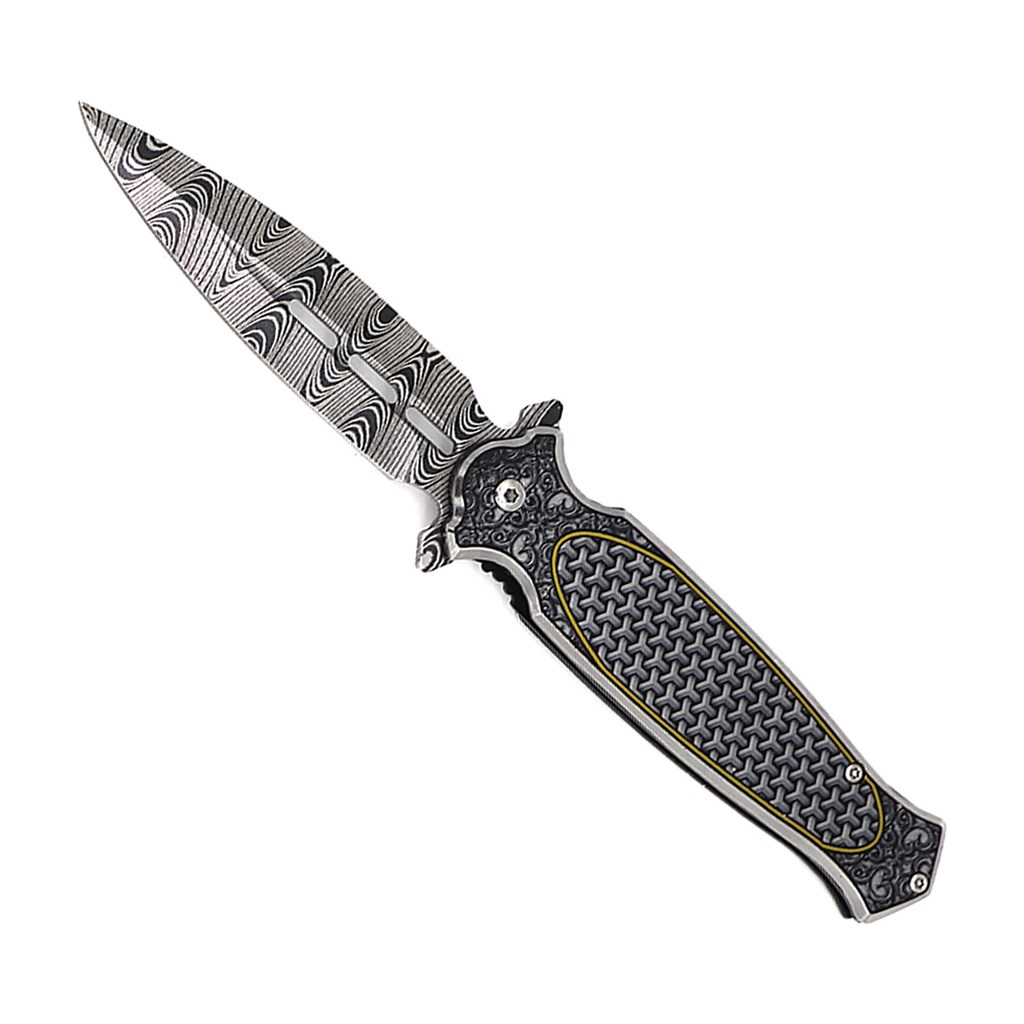
The Hexline runs a 3.75" spear point blade in steel with an acid-etched finish. This isn’t just a cosmetic pattern; the etch breaks up reflections, adds micro-texture, and gives the blade a subdued, work-focused presence instead of a mirror-polished ego trip.
The spear point geometry is a smart choice for an EDC that leans tactical:
- Symmetrical profile for precise point work and piercing.
- Plain edge for clean slicing, easy field sharpening, and predictable performance on rope, cardboard, or webbing.
- Balanced tip strength – thinner than a tanto, but not so fine you baby it.
The steel is a workhorse grade chosen to match the price point and purpose: reliable edge retention, easy to touch up on a basic stone or ceramic rod, and tough enough for real life instead of lab tests. This isn’t marketed as exotic super steel; it’s the knife you hand to a friend without flinching because you know it’ll do the job and sharpen back quickly.
Action Tuning and Lock-Up
Where this assisted opening knife earns respect is in the timing. The assist isn’t a hair-trigger slam; it’s tuned so you feel a distinct break point where the spring takes over and drives the blade to full lock. That last snap into the liner lock is positive and audible — exactly what you want in a working EDC.
The liner lock engages solidly behind the tang, not barely on the corner. Add the jimping near the pivot and finger guard, and you can drive this blade with intent without feeling like you’re about to slip forward.
Slate Gray Steel Geometry: How This Knife Actually Carries
On paper, the Hexline Vector is a 4.75" closed, 8.375" overall, 6.36 oz assisted opening knife. In the pocket, it feels like a serious piece of hardware: substantial, confident, and clearly made of steel rather than featherweight polymer. If you like knowing there’s a knife there when you pat the pocket, this weight makes sense.
The all-steel handle in matte slate gray isn’t about flash. It’s about durability and a unified aesthetic: blade, frame, and clip all read as one engineered object. The geometric inlay with its repeating cross pattern gives your fingers more than flat metal to hang onto, and the border line around the inlay visually frames the knife like a finished piece, not stamped sheet stock.
Low-Ride Clip and Discreet Profile
The low-ride pocket clip keeps most of the handle buried in your pocket. That matters if you’re carrying in an office, vehicle, or anywhere you don’t want your knife to be the loudest thing in the room. Combined with the slate gray finish, it reads as industrial hardware rather than a shiny showpiece.
The modern geometric theme — etched blade, angular handle, matte steel — makes this a natural fit for buyers who like their EDC to look engineered rather than tactical cosplay.
Legal Reality Check: Assisted Opening vs Automatic Knife Legal to Carry
Buyers who care about action also tend to care about the law, and they should. In the United States, federal law (the Switchblade Act) mainly targets true automatic knives and switchblades in interstate commerce and certain federal jurisdictions. It doesn’t explicitly ban assisted opening knives that require manual initiation of the blade.
Most states draw a legal line between:
- Automatic knives / switchblades: Blade deploys by pressing a button, switch, or hidden mechanism in the handle.
- Assisted opening knives: Blade requires manual pressure on a stud, flipper, or tang to start movement before any spring assists deployment.
The Hexline Vector sits firmly in the assisted opening category. In many jurisdictions, that makes it easier to carry than a full automatic knife or OTF switchblade. But here’s the part too many dealers skip: state and local laws vary wildly. Some states restrict blade length, others care about how it opens, and a few still treat anything spring-assisted suspiciously.
The only responsible advice: check your current state and local laws before you buy or carry. Don’t rely on hearsay. Look up your state code or consult an attorney if you’re pushing the edge of what’s allowed.
What Buyers Ask Before Purchasing an Automatic Knife
Are automatic knives legal?
In the U.S., automatic knives and switchblades are regulated by federal law for interstate commerce and in certain federal jurisdictions, but most of the real-world rules come from state and local law. Some states now allow automatic knives and OTFs for most adults; others still restrict or ban them, especially for concealed carry or specific blade lengths.
The Hexline Vector is not an automatic knife — it’s an assisted opening folder. That said, you should treat it with the same legal respect: laws change, definitions differ, and enforcement can be inconsistent. Always verify your local knife laws before carrying anything with a spring-assisted or automatic-style action.
What’s the difference between an automatic knife, OTF, and a switchblade?
Enthusiasts separate these for a reason:
- Automatic knife: A broad term for knives where a button, switch, or similar control in the handle releases the blade using stored spring energy. Many side-opening automatics fall here.
- Switchblade: Traditionally a legal term for push-button automatic knives where the blade opens automatically by pressing a button or device in the handle. In many laws, “automatic knife” and “switchblade” overlap.
- OTF (out-the-front): A type of automatic where the blade deploys (and sometimes retracts) straight out the front of the handle, usually via a sliding switch. These are often double-action OTF automatic knives.
The Hexline Vector doesn’t fit any of those. It’s spring-assisted: you manually start the blade moving, then the spring helps complete the open. Mechanically and legally, that’s a different category from a switchblade or OTF automatic knife.
What makes this assisted opening knife worth buying?
Three things make the Hexline Vector worth a spot in a serious EDC rotation:
- Dialed-in assist timing: The spring engages exactly when you want it, with a clean snap into a solid liner lock.
- Purposeful design: Acid-etched spear point, geometric slate gray steel handle, and low-ride clip create a unified, modern, discreet tool.
- Real-use balance: A blade long enough to work (3.75"), weight that feels like hardware (6.36 oz), and construction you won’t baby.
If you’re building out a collection that covers manual, assisted, and automatic action types, this is the assisted opening slot done right.
For the Enthusiast Who Chooses Mechanics First
The Hexline Vector Spring-Assisted EDC Knife - Slate Gray Steel belongs with buyers who notice detent strength, care about the line where an assist spring kicks in, and can feel the difference between a lazy lock and a proper bite. It’s not an automatic knife for sale, and that’s the point — it’s the assisted opener you reach for when you want fast deployment, mechanical honesty, and a design that looks like it was actually engineered, not decorated.
If your pocket is reserved for tools that earn their spot, this one will make sense from the first snap into lock.
| Blade Length (inches) | 3.75 |
| Overall Length (inches) | 8.375 |
| Closed Length (inches) | 4.75 |
| Weight (oz.) | 6.36 |
| Blade Color | Gray |
| Blade Finish | Acid Etch |
| Blade Style | Spear Point |
| Blade Edge | Plain |
| Blade Material | Steel |
| Handle Finish | Matte |
| Handle Material | Steel |
| Theme | Geometric |
| Pocket Clip | Yes |
| Deployment Method | Spring-assisted |
| Lock Type | Liner lock |