
Hideyoshi Legacy Hand-Forged Samurai Sword - Black Saya Gold Crest
3 sold in last 24 hours
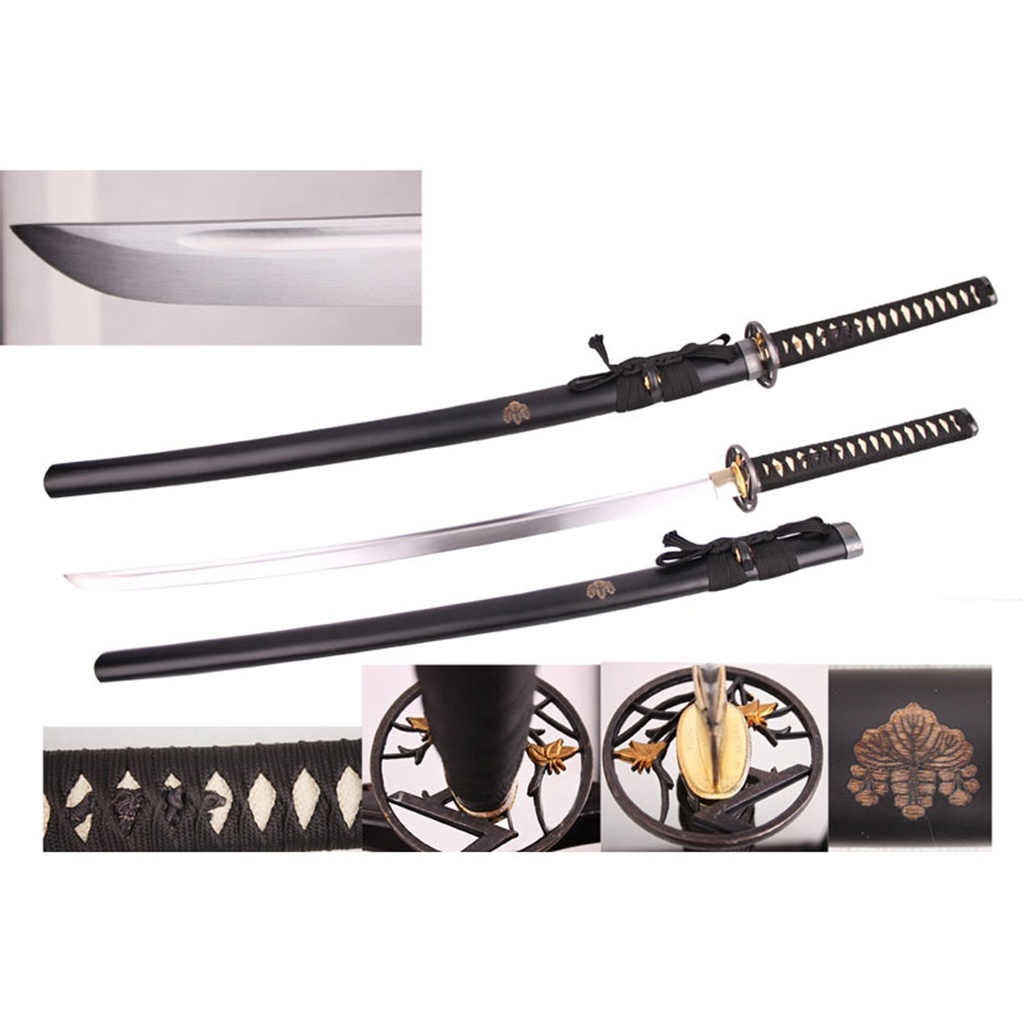
This is a full-length samurai sword, not a wall toy. The Hideyoshi Legacy Hand-Forged Samurai Sword pairs a 41" polished 1045 high carbon steel katana blade with a traditional black saya and gold crest accents. The bo-hi, floral openwork tsuba, and rayskin-wrapped tsuka give it the right weight, sound, and feel when drawn. It’s a display-worthy piece that still respects real katana construction, built for collectors who know the difference.
Hideyoshi Legacy Hand-Forged Samurai Sword – Black Saya Gold Crest
The 41" Hideyoshi Legacy is a traditional samurai sword built for collectors who actually care how a blade is put together. This isn’t fantasy steel with random kanji stamped on the side. It’s a hand-forged 1045 high carbon steel katana, full-length, with a bo-hi, proper tsuka wrap over rayskin, and a black saya wearing a gold crest that looks like it belongs in an armor rack, not a costume shop.
Why This Samurai Sword Belongs in a Serious Collection
Start with what matters: the blade. At 41" overall, you’re getting a classic katana proportion with a curved, single-edged profile that tracks with real Japanese patterns. The 1045 high carbon steel is on the more forgiving end of the traditional spectrum — not a brittle showpiece, but a blade that can take a working edge and handle casual cutting without complaining.
The polished finish and defined kissaki (tip) give it the right visual line from habaki to point. The visible bo-hi (fuller) isn’t just cosmetic; it lightens the blade and gives you that clean tachikaze — the cut-through-air sound — when your form is on point. That’s the kind of detail real sword people listen for.
Hand-Forged 1045 Steel: What You’re Actually Getting
1045 high carbon steel, properly heat-treated, lands in that practical zone where you can sharpen it easily, it will take a respectable edge, and it won’t punish you with catastrophic chipping if you’re less than perfect. You’re not buying a competition cutter, you’re buying a display-focused samurai sword with honest steel that respects the basic rules: carbon content, heat treatment, and geometry.
For the money, a hand-forged 1045 katana like this is ideal for light practice, kata, or static display where you still want the steel to be real, not pot metal pretending to be a blade.
Design Details That Separate It from Generic Wall Hangers
What makes this sword stand out is the visual discipline: black and gold, used sparingly, where it counts. The saya is a clean black with a gold crest emblem near the koiguchi. That crest is what sells the "lineage" story — it looks like it belongs to a family line, not a marketing department.
The tsuba is a dark metal openwork guard with floral and branch motifs picked out in gold accents. It’s decorative, yes, but it stays within samurai-era nature themes instead of drifting into dragons-on-everything cliché. Up close, the openwork pattern gives you depth and shadow, which plays nicely against the polished blade and gold habaki.
Tsuka, Rayskin, and Wrap: Where Feel Meets Tradition
The tsuka (handle) is wrapped in black cord over off-white rayskin panels, in the familiar diamond pattern that actually locks into your grip instead of sliding around. Rayskin (samegawa) isn’t just there to look traditional — it adds texture and bite under the cord so the wrap stays planted when you draw and resheath.
That black ito over ivory-toned same, with dark metal fittings and the gold habaki, gives the whole sword a restrained, formal look. This is more daimyo’s sidearm than anime prop.
How This Katana Lives in a Collector’s World
This sword is built as a display and light-practice piece. On a stand, the black saya and gold crest pull focus immediately, with the sageo cord tied cleanly along the side. Drawn, the polished 1045 blade and bo-hi line carry the eye right up to the floral tsuba. It looks right from across the room and holds up under a close, critical look.
For iaido or form work, the weight distribution and bo-hi help keep it from feeling like a crowbar. It’s not a custom smith’s one-of-one, but if you’re building out a samurai-themed display, dojo corner, or starting a katana collection, this is exactly the kind of honest, well-appointed piece that fills the "real but not ruinous" spot on the rack.
Steel, Edge, and Realistic Use
The edge comes sharpened, suitable for light cutting — think bottles, tatami substitutes, and similar targets, assuming your technique isn’t reckless. 1045 won’t compete with higher-carbon, differentially hardened art blades in sheer performance, but that’s not the brief here. You get a forgiving, serviceable edge on a blade that looks the part and behaves predictably.
In practical terms: this is an excellent sword for collectors who want something beyond a dull stainless display katana, but aren’t looking to jump straight into top-tier custom work.
Legal and Practical Context: Owning a Samurai Sword
Unlike an automatic knife, OTF, or switchblade, a full-length samurai sword like this falls into a different legal and practical category. In most regions, ownership of a katana-length sword in the home is legal, but public carry can be heavily restricted or outright banned, especially in urban areas.
This is a display and training piece. Treat it as such: stand, dojo, controlled private property. If you’re transporting it — to a dojo, show, or collector meetup — use a proper carrying case, keep it sheathed, and know your local regulations. Laws can vary widely by country, state, and even city, and they almost always distinguish long blades from everyday carry knives.
What Buyers Ask Before Purchasing an Automatic Knife
Are automatic knives legal?
Short version: under U.S. federal law, automatic knives (including many OTF and switchblade designs) are regulated mainly in terms of interstate commerce, military and law enforcement exceptions, and import rules. The real complexity is at the state level. Some states allow automatic knife carry with few restrictions, others limit blade length, opening mechanism, or who can carry, and a few still ban them outright.
If you’re looking to buy an automatic knife alongside this samurai sword, you need to check your specific state and local laws on automatic knives, OTF knives, and switchblades before carrying one. Owning an automatic in your home is often treated differently than carrying it in public. Always confirm current statutes — laws in this space change more often than most people realize.
What’s the difference between an automatic knife, OTF, and a switchblade?
Enthusiast language matters here. An automatic knife is any knife where the blade deploys from a closed position using a built-in spring, activated by a button, lever, or similar control — no manual wrist flick needed. A classic side-opening automatic opens from the side like a standard folding knife, but the spring does the work.
An OTF (out-the-front) automatic is a subcategory where the blade travels linearly out of the front of the handle. Single-action OTF knives deploy automatically and are manually retracted, while double-action OTFs both deploy and retract under spring power via a sliding switch.
"Switchblade" is the legacy legal and cultural term, usually referring to automatic knives in general, especially side-openers with a button in the handle. In enthusiast circles, we tend to use "automatic knife" and then get specific: side-opening auto, OTF, double-action, and so on.
What makes this automatic knife worth buying?
Since you’re here for the samurai sword but thinking ahead to automatic knives for sale, apply the same logic you’d use on this katana. Don’t buy the story, buy the mechanics. On an automatic, that means judging spring strength, lockup, button or slide geometry, and how the steel choice matches the knife’s intended role — EDC, defensive, or collection.
The automatic knives that earn a place next to a piece like the Hideyoshi Legacy are the ones with tuned action (no bounce-back, no mushy engagement), sensible blade steel for everyday carry, and build quality that doesn’t rattle when you shake it. If it feels like a toy, leave it to the tourists.
Why the Hideyoshi Legacy Deserves Space on Your Rack
The Hideyoshi Legacy Hand-Forged Samurai Sword is for the collector who cares about construction, not just cosplay. Hand-forged 1045 high carbon steel, real rayskin under a tight black wrap, bo-hi, floral openwork tsuba, and a black saya with a gold crest — all the right traditional notes, hit cleanly.
If your collection already includes a few serious pieces — maybe a favorite automatic knife for EDC, an OTF you break out for friends, and a couple of fixed blades — this sword is the logical step when you want to move from pocket steel to full-length samurai heritage. It’s a display katana with honest materials and the kind of details that make other enthusiasts stop, look twice, and nod.