High Desert Ridge Skinning Knife - Turquoise Horn
8 sold in last 24 hours
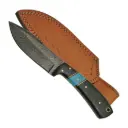
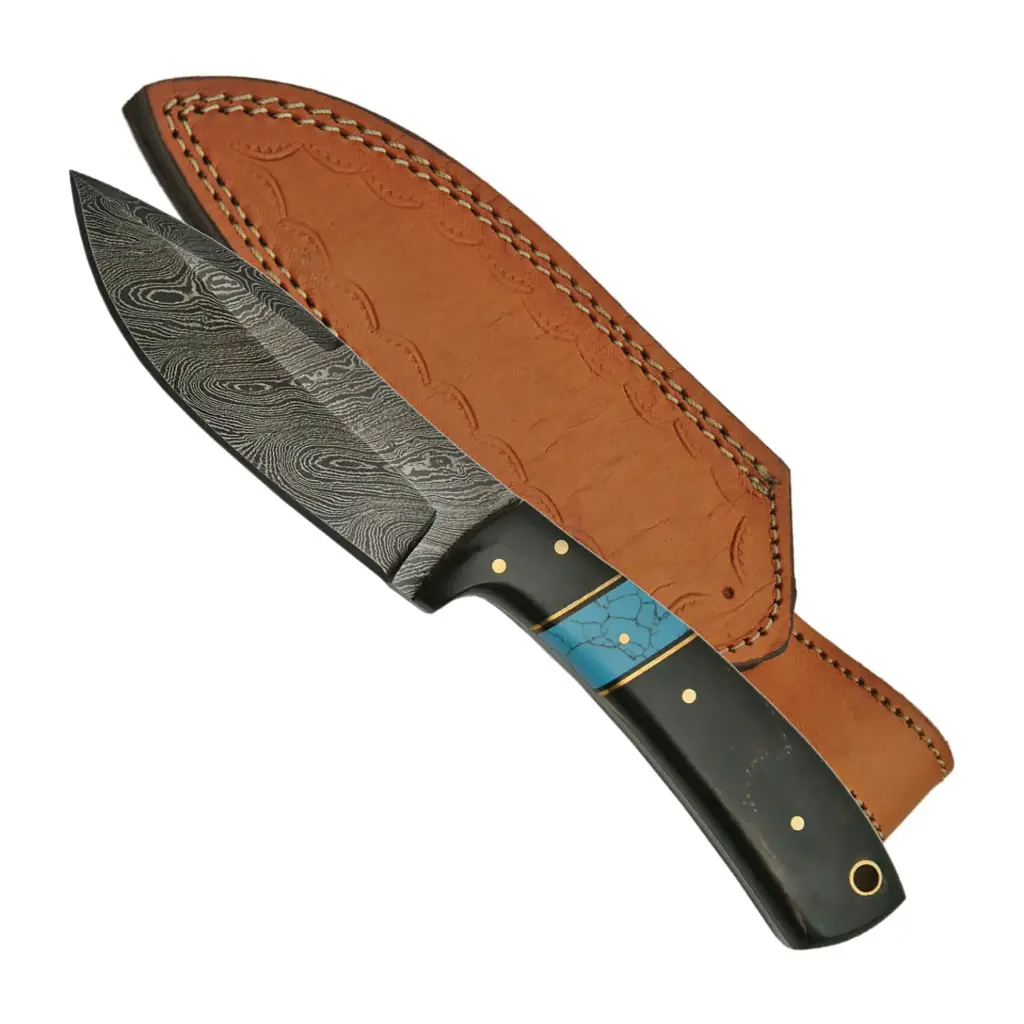
This fixed-blade High Desert Ridge Skinning Knife takes the classic Damascus skinner and gives it a collector’s handle. An 8-inch full-tang build with a 4-inch drop-point edge delivers real control in the tag-filled moments that matter. Turquoise inlay set into polished horn, brass spacers, and a tooled leather belt sheath finish the package. It’s built to break down game cleanly, but the Damascus pattern and inlay details make it a piece you’ll actually want to lay out on the table after the hunt.
Fixed-Blade Damascus Skinning Knife Built for the Field, Finished for the Display Case
The High Desert Ridge Skinning Knife - Turquoise Horn isn’t pretending to be a tactical folder or an automatic knife. This is a full-tang Damascus skinning knife tuned for real field work: breaking down animals cleanly, under control, without fighting your edge or your handle. The collector details — turquoise inlay, polished horn, brass spacers, and a tooled leather sheath — just happen to make it something you’re proud to lay out with the rest of your gear.
Why Serious Buyers Choose a Damascus Skinning Knife for Sale Over a Folder
There’s a time for an automatic knife and a time for a fixed blade. When you’re elbow-deep in a deer or hog, you want a rigid spine, no moving parts, and a handle that stays exactly where you put it. That’s where this Damascus skinning knife earns its keep.
- Full-tang construction: The steel runs the full length of the 8-inch knife, from Damascus tip to lanyard hole, giving you a stable platform for controlled cuts and torque in joints.
- 4-inch drop point edge: Enough blade to open, cape, and quarter without excess length that fights you in tight work.
- True skinner profile: The broad, slightly curved belly and fine tip are tuned for long, sweeping cuts that ride just under hide without diving into meat.
Automatic knives, OTFs, and switchblades are about speed of deployment. A purpose-built skinner like this is about stability, geometry, and edge behavior when your hands are cold, bloody, or gloved.
Damascus Steel and Edge Performance: What’s Really Going On
Damascus is more than just pretty patterning if it’s done correctly. This blade uses layered Damascus steel, etched to reveal the swirl, but built to be worked.
Layering, Toughness, and Real-World Use
Traditional Damascus is about combining hardness and toughness in one working edge. In practical terms for a hunting knife, that means:
- Good edge retention for a full field-dressing session without constant touching up.
- Sufficient toughness to survive light bone contact and joint work without chipping out.
- Sharpenability that doesn’t punish you when you hit the stones at camp or back home.
The broad 4-inch blade gives you enough flat to lock onto a stone or rod at a repeatable angle, which matters more than whatever marketing hardness number someone printed on a box.
Handle Geometry: Turquoise Horn That Actually Works in the Hand
A lot of hunters have handled pretty knives that turn slick as soon as the work starts. This horn and turquoise handle is built to avoid that mistake:
- Polished horn slabs shaped with a palm-filling curve to keep the knife seated under pressure.
- Turquoise inlay that adds visual pop without compromising the contour or grip.
- Brass spacers and pins that aren’t just decorative — they tie the stack together over the full tang.
- Lanyard hole at the butt so you can run a wrist thong if you’re working over water, in snow, or off a stand.
It’s a working handle first, with the kind of Western, horn-and-stone aesthetic that collectors actually look for.
Field Carry, Sheath, and How This Knife Rides on the Belt
Even with an automatic knife riding in your pocket, a fixed skinner on your belt is still the grown-up solution when it’s time to process game. This knife ships with a fitted leather sheath designed for belt carry.
- Stamped leather sheath: Tooled patterning that matches the Damascus showpiece feel without getting in the way of draw or resheathing.
- Belt carry loop: Keeps the knife riding where you expect it, instead of flopping or shifting when you’re climbing into a stand or over deadfall.
- Full coverage: Blade and edge are fully enclosed, protecting you, your truck seat, and the edge you just sharpened.
This is the knife that goes on your hip when you leave camp. The automatic or OTF can stay in your pocket for everything else.
What Buyers Ask Before Purchasing an Automatic Knife
You’re looking at a fixed-blade Damascus skinning knife here, not an automatic knife. But most serious knife buyers run both: a reliable auto or OTF for EDC and a fixed blade for the field. So let’s clear up the two biggest automatic knife questions that always come up at the same table.
Are automatic knives legal?
In the United States, automatic knife legality is a federal-plus-state puzzle. Federally, the Switchblade Act restricts interstate commerce in automatic knives (including many OTF and switchblade designs) but carves out exceptions for military, law enforcement, and certain uses. Day-to-day legality is mostly a state and local issue.
Some states allow automatic knives and OTF knives for general carry, some limit blade length, some restrict concealed carry, and a few still ban them outright. Switchblade laws can also differ between cities and counties inside the same state. The only safe move is this:
- Check your current state law for “automatic knife,” “switchblade,” and “gravity knife” language.
- Look for any local city or county ordinances that add extra restrictions.
- Verify whether there are different rules for carry versus simple ownership at home.
This fixed-blade Damascus skinner generally lives under standard fixed-blade and hunting-knife regulations, which are often more permissive than automatic knife carry laws — but you are always responsible for knowing your local rules before carrying any knife.
What’s the difference between an automatic knife, OTF, and a switchblade?
Collectors and serious users don’t throw these terms around loosely, and neither should any dealer.
- Automatic knife (side-opening): A folding knife where the blade is held closed under spring tension and opens automatically when you hit a button, scale release, or lever. Most classic autos are side-openers.
- OTF (Out-The-Front) knife: A type of automatic where the blade travels in and out of the handle along a track through the front, usually via a sliding switch. Many modern OTFs are double-action — the same control deploys and retracts the blade.
- Switchblade: In U.S. legal language, this is the broad term that usually covers both automatic knives and OTF designs that open by button, switch, or spring, as opposed to manual or assisted-openers.
This High Desert Ridge Skinning Knife is neither automatic nor OTF. It’s a fixed-blade Damascus skinner — no springs, no button, just a full-tang blade pinned to a handle, built for maximum strength and zero mechanical failure points in the field.
What makes this Damascus skinning knife worth buying?
Collectors and hunters both look for the same core realities: geometry, materials, construction, and honesty of design.
- Purpose-built shape: The blade grind, belly, and tip are unapologetically tuned for skinning and field dressing, not mall-ninja cosplay.
- Layered Damascus steel: Real patterning over real working steel, giving you edge performance that respects your time at the stones.
- Full-tang reliability: When your hands are slick and cold, a fixed blade that can’t fold on you is non-negotiable.
- Turquoise horn handle: Aesthetic without compromise — a grip you can trust, with materials you don’t see on every generic field knife.
- Display and use balance: This is the knife you can bleed on in November and still lay out on a felt-lined drawer in January without apology.
If you already own a few automatic knives or OTFs, this Damascus skinner fills the gap they were never meant to cover: controlled, repeatable performance on real game in real conditions.
For the Buyer Who Knows Why a Fixed Skinner Belongs Next to Their Automatic Knife
If you’re the kind of buyer who can tell the difference between a lazy switchblade and a properly tuned double-action OTF, you already understand why this High Desert Ridge Skinning Knife earns a spot next to them. The automatic knife handles the fast, everyday tasks. This Damascus fixed blade handles the work you actually remember.
Eight inches of full-tang Damascus, a 4-inch skinner edge, turquoise-and-horn handle, brass-detailed construction, and a fitted leather sheath — built for the field, good enough for the collection. It’s not trying to be everything. It’s trying to be the right tool for one job, and it does that extremely well.
| Blade Length (inches) | 4 |
| Overall Length (inches) | 8 |
| Blade Color | Silver |
| Blade Finish | Damascus |
| Blade Style | Drop Point |
| Blade Edge | Plain |
| Blade Material | Damascus Steel |
| Handle Finish | Polished |
| Handle Material | Horn |
| Theme | Damascus |
| Handle Length (inches) | 4 |
| Tang Type | Full Tang |
| Pommel/Butt Cap | Lanyard Hole |
| Carry Method | Belt Carry |
| Sheath/Holster | Leather Sheath |