Honor Crest Fast-Action Assisted Opening Knife - Matte Black
12 sold in last 24 hours
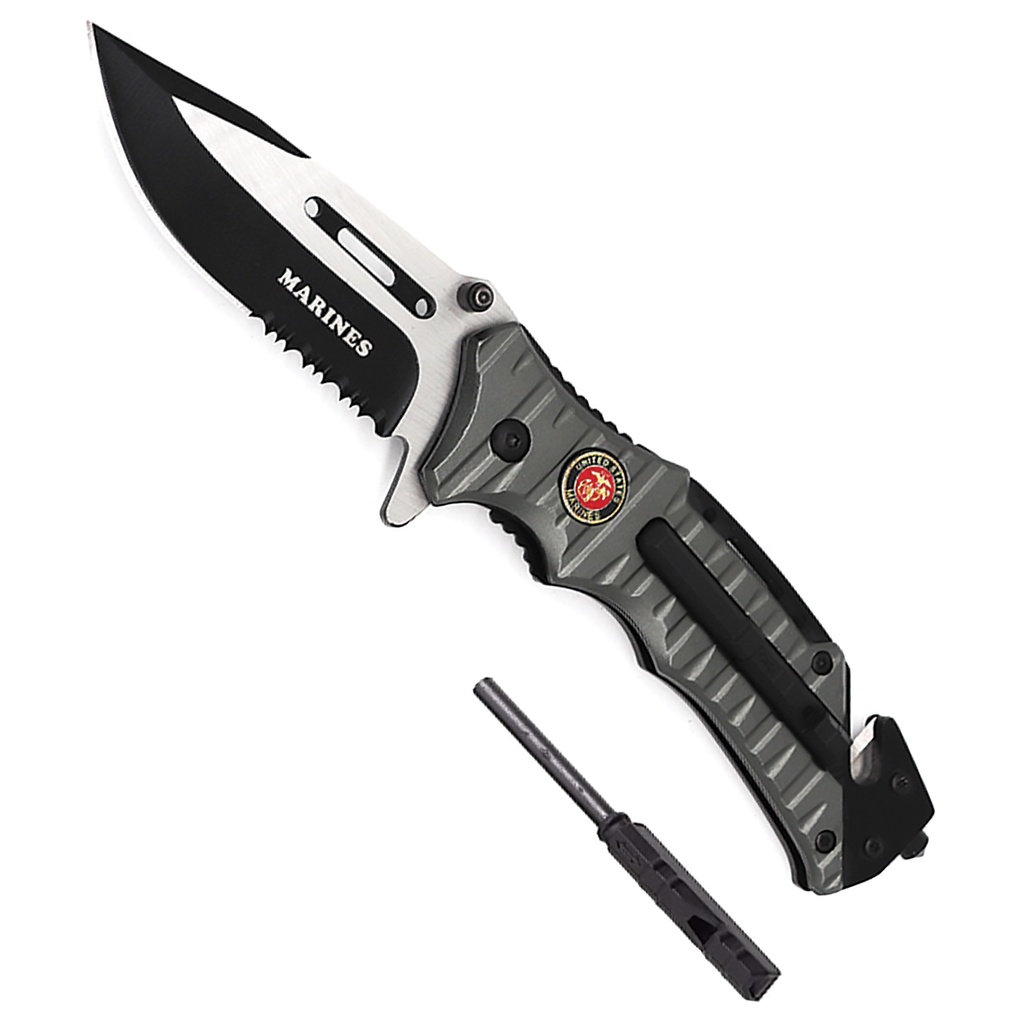
This is not a toy; it’s a Marine-themed assisted opening knife built for real use. A spring-assisted clip point blade with partial serrations snaps out fast from a secure liner lock frame, while the matte black profile rides low and quiet in the pocket. The Marine crest medallion, glass breaker, and integrated fire starter push it past novelty into true field-ready territory. If you care how a knife deploys and locks up, this one earns its space in your EDC rotation.
Marine-Themed Assisted Knife for Buyers Who Care About Action
If you’re here to actually use a knife, not just look at logos, this Marine-themed assisted opener deserves a closer look. The Marine crest and MARINES blade text set the tone, but the story is in the mechanics: a spring-assisted folding knife with a clip point, partial serrations, and a liner lock that snaps into place with the kind of authority you can feel in your thumb.
Buyers who search for an automatic knife for sale are usually chasing one thing: fast, one-hand deployment that works every time. This knife answers that need with a tuned assisted mechanism that feels closer to an automatic in real-world speed, while staying in the assisted opening category for more flexible carry in many jurisdictions.
Why This Feels Like an Automatic Knife for Sale Without Crossing the Line
Mechanically, this is spring-assisted, not a true automatic knife, OTF, or switchblade. That distinction matters. With an automatic knife, pressing a button or switch fires the blade from the handle under spring tension. Here, you start the motion manually via the thumb hole; once you overcome initial resistance, the assist spring takes over and drives the blade the rest of the way into lockup.
For the user, the experience is what you care about: fast, repeatable deployment you can hit under stress, wet hands, or gloves. For the law, that difference between a button-fired automatic knife and an assisted opener can mean the gap between restricted and widely legal. If you’ve been hunting for automatic knives for sale but you live in a state that frowns on them, this is the kind of action you buy when you still want speed but need to respect the local rulebook.
Action and Lockup: What the Mechanism Actually Feels Like
The blade rides on a spring-assisted pivot tuned to snap decisively into place once you clear the detent. No lazy half-opens if you do your part. The liner lock engages on the heel of the tang with a clear, tactile stop — you know it’s locked without looking. That’s what you want in a duty-inspired folding knife, and it’s what separates a real tool from the gas-station specials cluttering the "automatic knife for sale" search results.
Blade Geometry and Edge Configuration
The clip point profile gives you a controllable tip for detail work and piercing tasks, while the partially serrated section low on the edge chews through cord, webbing, and fibrous material that would laugh at a plain edge. The black-coated spine and silver primary bevel aren’t just cosmetic; the darker spine cuts down on glare and visually thins the edge, helping you track your cut line.
Field-Ready Details Beyond the Typical Automatic Knives for Sale
Most budget-friendly knives wearing military branding are content to slap on a logo and call it done. This one adds features that make sense in the field: an integrated glass breaker at the butt and a removable fire starter rod housed in the handle. That’s not collector fluff; that’s situational leverage.
The glass breaker is there for when you need to get someone out of a vehicle, not when it’s convenient. The fire starter is your backup when the lighter fails, or you’re down to what’s clipped to your pocket and what’s in your head. Those are the sort of small, deliberate design decisions that make a knife worth carrying, not just displaying.
Marine Crest and Identity: More Than Decoration
The Marine Corps crest medallion in the handle is the visual focal point — red, gold, and globe anchor against the subdued gray metal scales. For Marines and Marine families, that’s not just branding, it’s a reminder of standards: gear is expected to work. While this is not issued equipment, a knife that wears the emblem has to at least behave like it understands the assignment: deploy cleanly, lock solidly, and survive real use.
Carry, Ergonomics, and Everyday Use
A knife that feels great in hand but rides terribly in pocket never gets carried. This one is built as a pocketable tactical EDC: folding format, spring-assisted deployment, and a matte black pocket clip that keeps it pinned where you want it. The clip rides in a way that lets the handle disappear against dark fabric, but leaves enough exposed for a positive draw.
The textured gray metal handle has ribbed machining and contouring that matter when your hands are sweaty, cold, or gloved. Combined with the thumb ramp and jimping on the spine, you can choke up behind the clip point and drive the blade with confidence instead of babying it. Marine-themed or not, that’s what a working knife should feel like.
Legal Context: Assisted Opener vs Automatic Knife for Sale
When people search for the best automatic knife for EDC, they quickly run into the wall of state law. Under U.S. federal law, true automatic knives and switchblades are restricted in interstate commerce with specific carve-outs for military, law enforcement, and certain collectors. State and local laws then layer additional restrictions on possession and carry — some allow automatic knives, some ban them outright, and others sit in the gray area.
This knife is spring-assisted, not a push-button automatic knife or OTF switchblade. In many states, assisted opening knives are treated as conventional folding knives because the user must manually start the blade by applying pressure to a thumb stud, hole, or flipper, rather than pressing a button in the handle. That mechanical distinction often makes assisted openers easier and more broadly legal to carry than automatics.
That said, knife law is extremely jurisdiction-specific and changes over time. Before you buy any automatic knife, assisted opener, or OTF, check your state and local regulations, and if you travel, check those destinations as well. Ultimately, it’s your responsibility to confirm what’s legal to own and to carry where you live.
What Buyers Ask Before Purchasing an Automatic Knife
Are automatic knives legal?
On the federal level in the U.S., automatic knives and switchblades are regulated by the Federal Switchblade Act, which restricts interstate commerce and mailing but does not itself criminalize simple possession by most civilians. The real complexity comes from state and local laws. Some states fully allow automatic knives; others limit blade length, restrict carry but not ownership, or ban them outright except for law enforcement or active-duty military.
This particular Marine-themed knife is a spring-assisted folding knife, not a true automatic knife or OTF switchblade. That usually places it in a less restricted category than a button-deployed automatic knife for sale, but you still need to verify your local knife statutes. Laws change, and enforcement attitudes vary; serious buyers treat legal research as part of responsible ownership.
What's the difference between an automatic knife, OTF, and a switchblade?
Mechanically, these terms point to how the blade deploys:
- Automatic knife / switchblade: In common U.S. usage, these are the same thing — a knife where a button, switch, or similar control in the handle releases a spring-loaded blade. Press, and the blade snaps into position under stored spring energy.
- OTF (out-the-front): A subtype of automatic where the blade travels straight out the front of the handle rather than swinging out on a pivot. Many OTF knives are double action, meaning the same slider both deploys and retracts the blade.
- Assisted opening (this knife): You start the blade manually via thumb stud, hole, or flipper. Once you overcome a detent, an internal spring assists the rest of the travel. It feels nearly as fast as an automatic but is mechanically distinct.
So while you may see this knife sitting next to automatic knives for sale on some sites, it belongs in the assisted opening category, which often comes with different legal treatment.
What makes this automatic-style knife worth buying?
If you’ve handled enough knives, you know why some end up in a drawer and a few earn permanent pocket time. This one earns it on three fronts:
- Action: The assisted opening mechanism snaps the blade into lock-up decisively, with a liner lock engagement you can trust.
- Utility: Clip point geometry, partial serrations, glass breaker, and fire starter add up to a tool that handles both daily tasks and emergency scenarios.
- Identity: Marine text and crest deliver more than decoration; they carry expectations that the knife will actually work when called on.
If you’re looking to buy an automatic knife but your laws or budget push you toward assisted opening, this Marine-themed folder gives you fast deployment, real-world features, and a visual story that belongs in a serious user’s rotation.
For Enthusiasts Who Choose Their Gear With Intent
The Marine Crest Rapid-Deploy Assisted Opening Knife in matte black is for the buyer who scrolls past the generic "automatic knives for sale" listings and looks for details: how the mechanism works, how the lock engages, what the grip feels like under load. It’s not a true automatic knife, and it doesn’t pretend to be — it’s an assisted opener tuned to deliver automatic-level speed with better legal footing in many places.
If your idea of the best automatic knife for EDC is really about deployment speed, dependable lockup, and features that justify the space in your pocket, this knife belongs in the conversation.
| Blade Color | Black |
| Blade Finish | Matte |
| Blade Style | Clip Point |
| Blade Edge | Partial-Serrated |
| Handle Finish | Matte |
| Handle Material | Metal |
| Theme | Marine Theme |
| Pocket Clip | Yes |
| Deployment Method | Spring-assisted |
| Lock Type | Liner lock |