Imperial Dragon Tri-Blade Samurai Sword Set - Red
13 sold in last 24 hours
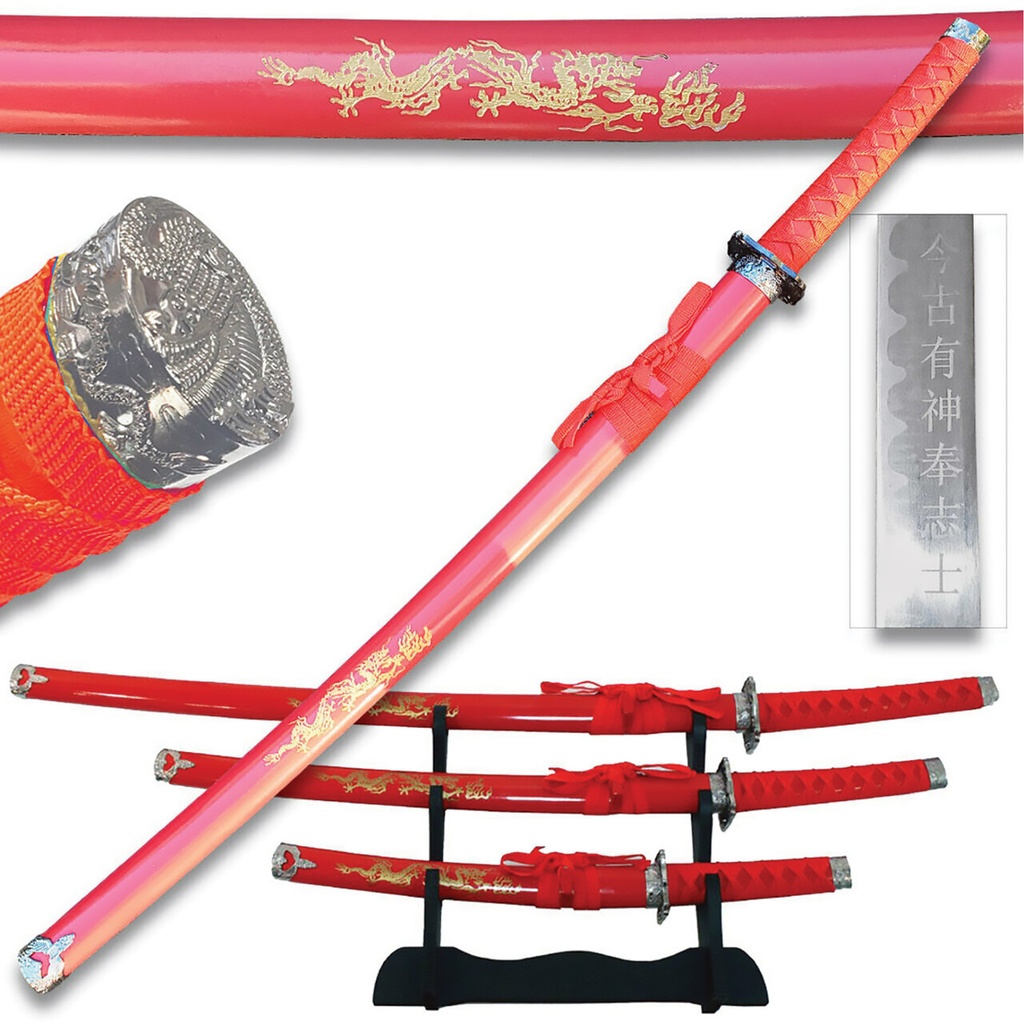
This isn’t a random wall-hanger trio. The Imperial Dragon Tri-Blade Samurai Sword Set brings together a katana, wakizashi, and tanto in a unified red-and-gold dragon theme. Each curved 440 stainless blade carries vertical script, while the red scabbards are carved with gold dragons and finished in high gloss. Fabric-wrapped handles and matching sageo cords complete the look, and the included black stand turns the whole set into a ready-to-stage centerpiece for any samurai or dragon-themed collection.
Imperial Dragon Tri-Blade Samurai Sword Set - Red
The Imperial Dragon Tri-Blade Samurai Sword Set - Red is built for one purpose: to be the visual centerpiece of a Japanese-inspired display. Three classic forms — katana, wakizashi, and tanto — are tied together with a unified dragon motif, high-gloss red scabbards, and matching handle wraps. This isn’t a single sword trying to carry the whole show; it’s a coordinated dragon shrine on a stand.
Display-Ready Samurai Sword Set for the Dragon Collector
At a glance, this is a three-piece Japanese-style sword set: full-length katana, mid-length wakizashi, and short tanto. All three blades are curved, echoing traditional samurai geometry, and all three ride in red scabbards carved with gold dragons. The included black stand is sized for the full trio, so you’re not improvising a display. Out of the box, this is a complete dragon-themed focal point for a shelf, office, or media room.
Each piece uses 440 stainless steel, which makes sense for a display-focused set like this. 440 is corrosion-resistant, easy to maintain, and holds its polish well — the finish stays clean under ambient light and occasional handling, which is what you want from a decor-forward samurai sword set.
Craft Details That Make This Sword Set Worth Owning
Collectors know the difference between a random mixed set and a deliberately coordinated series. Here, the theme is consistent from tip to pommel: red and gold, dragons throughout, and matching proportions across the trio.
Coordinated Katana, Wakizashi, and Tanto Layout
The katana is the longest blade in the set, the wakizashi follows in medium length, and the tanto anchors the bottom tier. That tiered profile on the stand matters visually: you get a cascading silhouette rather than three competing lines. For anyone building a Japanese sword corner, this is a fast way to get the classic daishō feel plus a tanto backup in one move.
Dragon Motif from Saya to Pommel
The scabbards (saya) are high-gloss red with carved gold dragons running along the length. The dragons aren’t an afterthought graphic; they read as the spine of the design when viewed across the stand. Dragon-embossed pommel caps echo the same theme at the back end, and the silver-tone tsuba (guards) add contrast so the red-and-gold doesn’t wash out under light. It’s an unapologetically bold palette — red, gold, black, and silver — and it works because the motif is consistent on all three swords.
Construction, Steel, and Realistic Use Expectations
This is a decorative sword set built around 440 stainless blades. That choice tells you a lot. 440 isn’t the high-carbon workhorse you’d pick for a live-cutting katana; it’s the steel you choose when corrosion resistance, shine, and low maintenance matter more than traditional hard-use performance. For a display-oriented Japanese dragon sword set, that’s a rational priority.
The blades are etched with vertical Asian-style script, adding another layer of visual interest when drawn. The edges are typically kept at a display-friendly grind in sets like this, which suits collectors who want the look without turning their living room into a dojo. If you want a true cutting tool, you’re shopping purpose-built, live-blade katana; if you want a visually unified dragon set that behaves well as decor, 440 stainless and polished finishes make sense.
Handle Wrap and Grip Aesthetic
The handles are fabric-wrapped in a red diamond-pattern style, echoing traditional tsuka-ito visually, even if this is not a hand-tied, fully traditional build. For a collector who cares about silhouette and visual authenticity more than period-correct construction, the effect is right: red over a contrasting underlayer, consistent across all three pieces, giving the set continuity from scabbard to grip.
Where This Dragon Sword Set Belongs in a Collection
This is a display-first samurai sword set. It works in a few specific situations: the anime or samurai fan who wants a bold dragon centerpiece; the collector building a dragon-themed corner with statues, art, and blades; or the decorator who needs a statement piece above a low console or behind a desk. The included black stand makes staging easy — no hunting for aftermarket racks or improvising wall mounts.
Because all three scabbards share the same carved dragon pattern and color, the set reads as a single, intentional art object rather than three random swords thrown together. That cohesion is what separates this from bargain-bin assortments: the eye reads one strong theme, not visual noise.
What Buyers Ask Before Purchasing an Automatic Knife
Even though this product is a samurai-style sword set — not an automatic knife, OTF, or switchblade — buyers who collect blades often shop across categories. If you’re also looking at an automatic knife for sale alongside this display set, the questions below are the ones serious enthusiasts keep coming back to.
Are automatic knives legal?
In the United States, automatic knives are regulated at both the federal and state levels. Federally, the Switchblade Knife Act restricts interstate commerce in automatic knives and switchblades, with some exceptions for military, law enforcement, and certain uses. The real deciding factor for carry, though, is your state and sometimes even your city. Some states allow automatic knives and OTF models with few restrictions, some limit blade length or carry method, and others ban them outright. Before you buy an automatic knife or switchblade for EDC, you need to check the current knife laws in your specific state and locality — not just a generic national summary — and confirm that automatic knife carry is legal for your situation.
What’s the difference between an automatic knife, OTF, and a switchblade?
"Automatic knife" is the umbrella term: a folding or out-the-front blade that deploys by pressing a button, lever, or similar actuator, with spring power completing the opening. A side-opening automatic looks like a standard folder but snaps open from the side when you hit the release. An OTF (out-the-front) automatic drives the blade straight out of the handle along its length; double-action OTF models use the same control to deploy and retract the blade. "Switchblade" is the older, popular term that U.S. law still uses for many automatic knives, but serious buyers tend to use more precise language — automatic, OTF, side-opener — to describe the actual mechanism.
What makes this automatic knife worth buying?
When you’re evaluating an automatic knife for sale, you’re looking past marketing claims and into the mechanics: reliable lockup, consistent spring strength, minimal blade play, and a deployment that doesn’t hesitate or half-fire. Steel choice matters too — not just the name, but how it’s heat-treated and ground. A good automatic knife will balance snappy action with control, ride comfortably in the pocket, and use components (pivot, button, safety if present) that stand up to repeated use. The point is simple: a worthwhile automatic knife isn’t just fast; it’s mechanically honest, with an action that feels the same on the hundredth deployment as it did on the first.
Closing the Loop: From Dragon Display to Daily Carry
The Imperial Dragon Tri-Blade Samurai Sword Set - Red is your statement piece — a coordinated dragon-themed katana, wakizashi, and tanto on a stand, built in low-maintenance 440 stainless and finished in unapologetic red and gold. Pair it with a well-chosen automatic knife for sale in your carry rotation, and you cover both ends of the enthusiast spectrum: one blade set for the wall, one for your pocket, both chosen because you care about how your steel looks, feels, and functions in the real world.