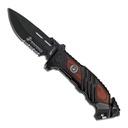
Iron Harbor Marine-Rescue Spring Assisted Knife - Brown Pakkawood
7 sold in last 24 hours
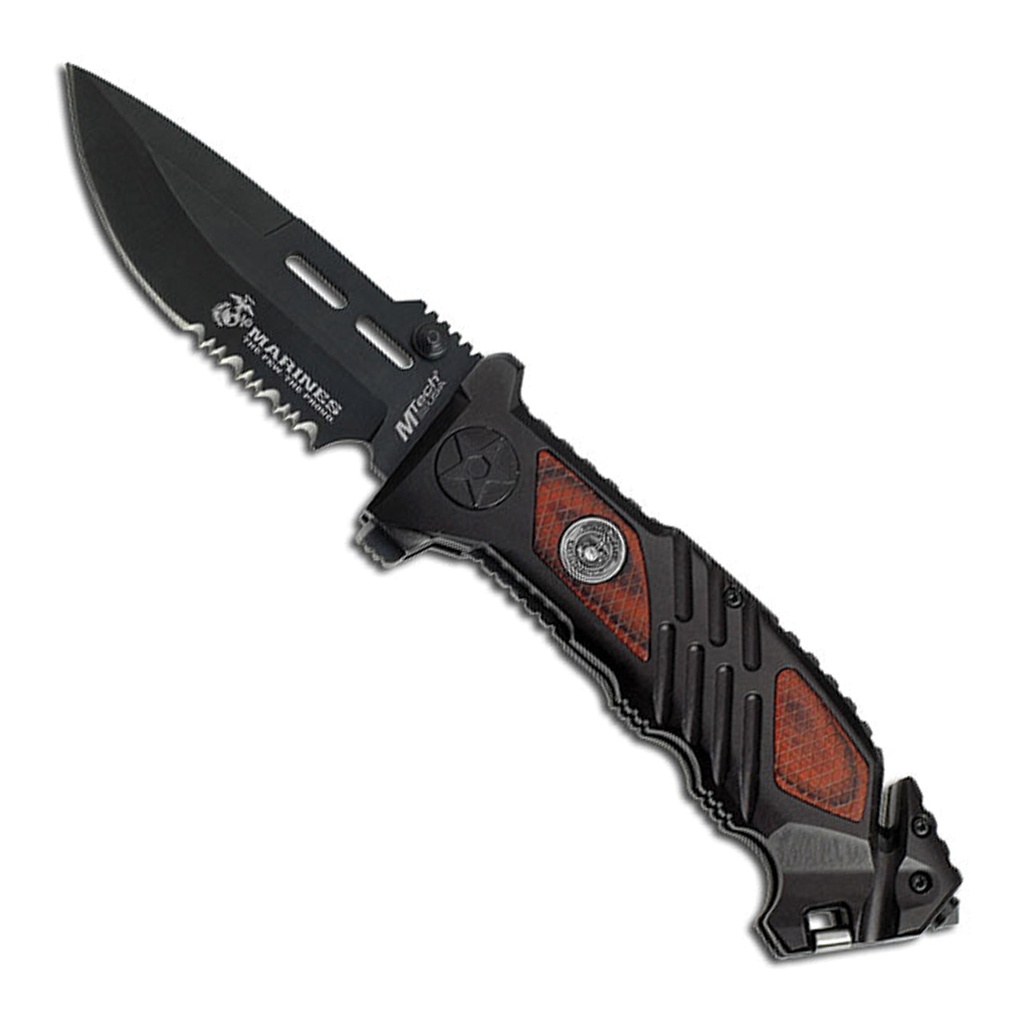
This spring assisted knife is built like a compact rescue kit with a Marine accent. The 3.75" black 440 stainless blade snaps into action with a decisive assisted deployment, backed by a solid liner lock. Partial serrations bite through webbing and cord, while the glass breaker and seat belt cutter turn this into a true emergency EDC. Brown pakkawood inlays over a tactical frame give it that dress-uniform-meets-duty-rig feel—made for buyers who actually use their knives, not just post them.
Spring Assisted Knife for Sale with Real Marine-Rescue Credentials
The Iron Harbor Marine-Rescue Spring Assisted Knife - Brown Pakkawood isn’t pretending to be a movie prop. It’s a spring assisted rescue folder that borrows its attitude from the Marines: do the job, no nonsense, and look professional while you’re doing it. If you’ve been hunting for a spring assisted knife for sale that actually justifies a slot in your EDC rotation, this one earns its keep with honest mechanics and a purpose-built rescue feature set.
Why This Spring Assisted Knife Belongs in a Serious EDC Lineup
Start with what matters: deployment and lockup. This is a classic side-opening spring assisted knife, not an automatic knife, OTF, or switchblade. You preload the blade with manual pressure via the opening slot; the torsion spring takes over and snaps it to lock with authority. That hybrid manual/assisted setup is why many enthusiasts choose spring assisted over true automatic when they want speed without stepping into stricter legal territory.
The 3.75" black matte 440 stainless drop point blade carries a partial serration—practical, not decorative. Plain edge forward for slicing, serrated section near the handle for cutting through fibrous material. Think seat belts, webbing, and heavy cord. At 9" overall and 5" closed, it sits in that full-size tactical EDC lane: big enough to work, compact enough to ride in-pocket all day.
Action and Lock: Assisted Speed with Liner Lock Confidence
A good spring assisted knife rises or falls on its action tuning. Here, the assisted opener is set up for a positive, confident snap—no lazy half-deploys if you do your part. The blade’s opening cutout gives you immediate purchase, even with gloves or wet hands. That spring engagement hits the sweet spot: fast, but not so twitchy that it feels nervous in hand.
The liner lock is classic and familiar. Engagement is solid without overtravel, meaning you get reliable lockup without needing a pry bar to disengage. Jimping along the spine and the pronounced finger grooves anchor your grip when you’re bearing down, whether you’re cutting rope or punching through safety glass with the integrated glass breaker.
440 Stainless Steel: What You’re Really Getting
440 stainless is not exotic-super-steel territory, and that’s fine—this is a duty-forward EDC, not a safe queen. Properly heat-treated 440 gives you good corrosion resistance, easy field sharpening, and adequate edge retention for a working knife you’re not afraid to actually use. In a rescue-oriented piece, the ability to put a serviceable edge back on quickly matters more than chasing marginal gains in edge life.
Marine-Themed Spring Assisted Knife for Sale with Real Rescue Features
The Marine branding and emblem aren’t just slapped on as decoration; the design language backs them up. Marine Corps text and insignia ride on the black blade and handle, but the feature set reflects a job to be done: glass breaker at the pommel, seat belt cutter integrated into the handle, and a partly serrated edge ready for fast material removal.
Brown pakkawood inlays over a textured, tactical frame are a smart design choice. You get that dress-uniform warmth from the wood, contrasted against the black blade and hardware that read purely tactical. It’s the visual equivalent of dress blues over body armor—capable, not costume.
Rescue Tool Integration That Actually Makes Sense
Too many “rescue” knives bolt on features that never see real-world use. Here, the glass breaker is properly placed at the pommel: you maintain a secure grip and drive the point into automotive glass without rethinking your hand position. The dedicated seat belt cutter sits at the handle end, allowing controlled, blind cuts on trapped webbing where a standard open blade would be risky.
Combine those with a spring assisted action and partial serrations, and you have a coherent rescue toolkit in a single folding knife—exactly what you want if you carry for that one bad day you hope never shows up.
Pocket Reality: How This Knife Carries and Works Day to Day
At 5" closed and about 7 oz, this isn’t a dainty gentleman’s folder; it’s a full-size tactical rescue knife with some presence. The pocket clip keeps it where you park it, and the overall footprint is what most EDC enthusiasts expect from a hard-use folder. The weight is justified by the tool loadout—blade, liner lock, glass breaker, seat belt cutter—so you’re not carrying ounces of pure vanity.
The handle’s deep finger grooves and surface texturing, paired with the pakkawood inlays, give you a grip that locks in even when your hands are wet, gloved, or cold. This is a knife you can actually work with, not just photograph.
Legal and Practical Context for Carrying a Spring Assisted Knife
This is where definitions matter. This Iron Harbor piece is a spring assisted knife, not a fully automatic knife, not an OTF, and not a traditional switchblade. You must start the blade manually; the spring only assists once you’ve initiated opening. In many jurisdictions, that places it in a different legal category than an automatic knife or switchblade, and that’s a big part of why enthusiasts choose spring assisted mechanisms for EDC.
However, knife laws are highly state- and city-specific. Some regions treat assisted openers more leniently; others are stricter or vague. Always check your local and state regulations regarding blade length, assisted-opening mechanisms, and any restrictions on carry in vehicles, schools, or government buildings. Federal law in the U.S. focuses largely on interstate commerce and mailing of automatic knives and switchblades; assisted openers like this typically fall outside those restrictions but can be regulated locally. Translation: this is generally more carry-flexible than an automatic knife, but due diligence is still on you.
What Buyers Ask Before Purchasing an Automatic Knife
Are automatic knives legal?
In the U.S., automatic knife and switchblade legality is a patchwork. Federally, automatic knives and switchblades are restricted in interstate commerce and mailing, but not outright banned to own. The real complexity is at the state and local level: some states allow automatic knives and OTFs with few limits, others allow possession but restrict carry, and a few still prohibit them outright. Blade length, intent, and where you carry (vehicle, workplace, public buildings) can all matter.
This Iron Harbor Marine-Rescue knife is spring assisted, not an automatic knife or switchblade, which often makes it easier to carry under many state laws. Still, the only responsible approach is to check your specific state statutes and any city ordinances before you clip any knife—automatic, spring assisted, or otherwise—into your pocket.
What’s the difference between an automatic knife, OTF, and a switchblade?
Mechanically, the distinctions are straightforward:
- Automatic knife / switchblade: Press a button, lever, or slide on the handle and the blade deploys under spring power from the fully closed position. “Automatic knife” and “switchblade” are often used interchangeably in legal language.
- OTF (out-the-front) automatic: A specific type of automatic where the blade shoots straight out the front of the handle, single-action or double-action, via a thumb slide or button.
- Spring assisted knife (this knife): You start opening the blade manually using a thumb stud, flipper, or cutout; once you overcome a certain point, an internal spring assists the rest of the way to lock. There is no button that opens it from fully closed.
The Iron Harbor is in that third category: a side-opening spring assisted folder, which is why many buyers use it where they might not be comfortable carrying a true automatic knife or OTF.
What makes this spring assisted knife worth buying?
It’s the combination of honest mechanics and coherent purpose. You get a tuned spring assisted action with solid liner lockup, a 440 stainless partially serrated blade that’s easy to maintain, and genuinely useful rescue tools—glass breaker and seat belt cutter—implemented where they actually work. The Marine-themed styling and brown pakkawood inlays push it over the edge for collectors who appreciate military-inspired pieces, but the knife doesn’t hide behind its graphics. It deploys fast, cuts what it should, and carries like a serious EDC tool.
For Enthusiasts Who Choose Function First
If you gravitate toward knives that actually do the work their branding implies, this Marine-rescue spring assisted folder earns its pocket time. It’s a full-size, rescue-ready EDC that respects mechanical realities and legal boundaries while giving you a blade you won’t be afraid to use. For the buyer who debates action types and steel choices instead of just colors, this is the kind of spring assisted knife for sale that proves you’ve done your homework.
| Blade Length (inches) | 3.75 |
| Overall Length (inches) | 9 |
| Closed Length (inches) | 5 |
| Weight (oz.) | 7.12 |
| Blade Color | Black |
| Blade Finish | Matte |
| Blade Style | Drop Point |
| Blade Edge | Partial-Serrated |
| Blade Material | 440 Stainless Steel |
| Handle Finish | Anodized |
| Handle Material | Pakkawood |
| Theme | Marine Theme |
| Safety | Seat belt cutter |
| Pocket Clip | Yes |
| Deployment Method | Spring-assisted |
| Lock Type | Liner lock |