Knotwork Rescue Rapid-Assist Pocket Knife - Onyx Black
8 sold in last 24 hours
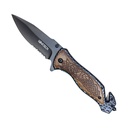
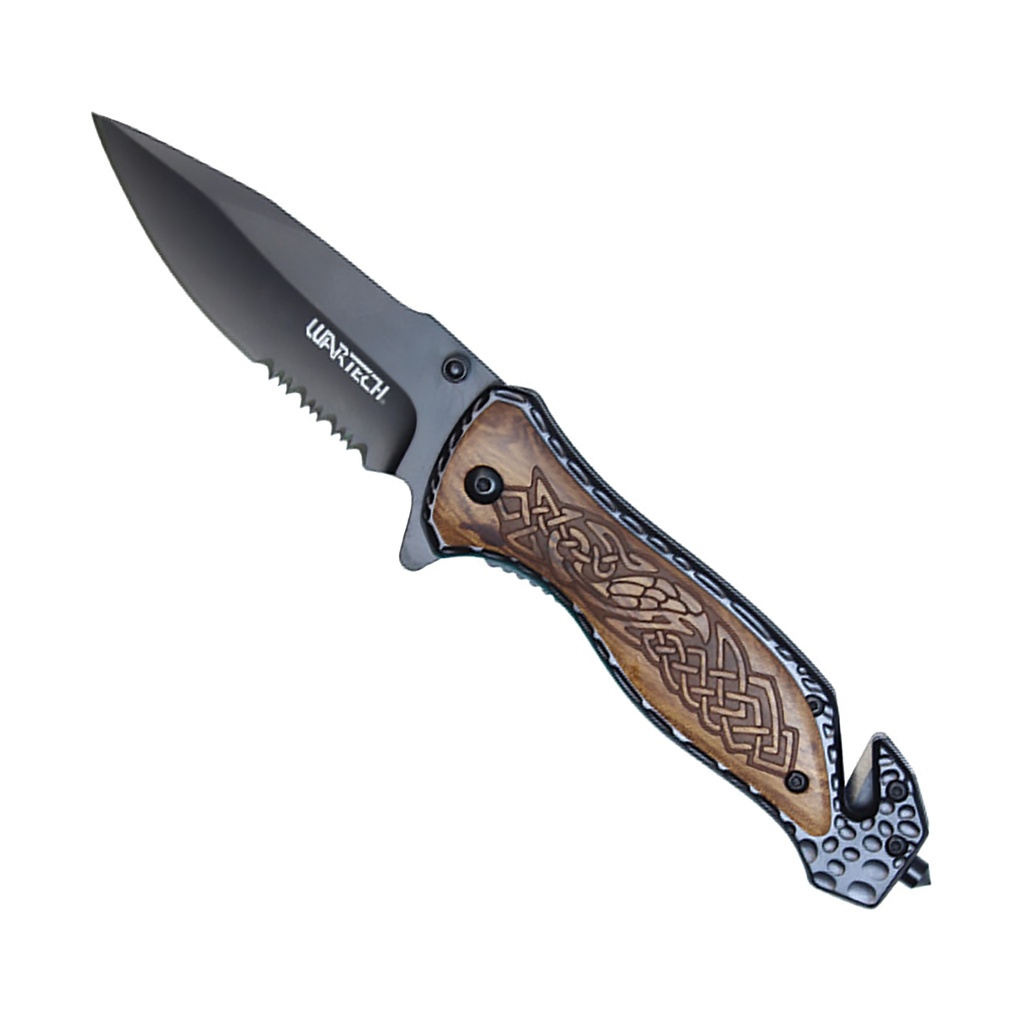
This is not an automatic knife; it’s a dialed-in spring-assisted EDC built for real use. The Knotwork Rescue Rapid-Assist Pocket Knife pairs a matte black, partially serrated clip point with a one-handed assisted opening that snaps cleanly into a solid liner lock. Celtic knotwork inlaid into the handle gives actual traction, not just decoration, while the seatbelt cutter and glass breaker make this a legitimate rescue tool. It carries slim, deploys fast, and feels like a promise you can keep.
When Heritage Meets Hardware: An Assisted Knife Built to Be Used
The Knotwork Rescue Rapid-Assist Pocket Knife - Onyx Black looks like it came out of a Celtic workshop, then got dropped into a modern rescue rig. This is a spring-assisted pocket knife, not an automatic knife, and that distinction matters. You get true one-handed deployment with a thumb stud and internal spring assist, backed by a liner lock that actually inspires confidence instead of doubt. It’s compact, it’s rescue-ready, and it doesn’t pretend to be anything it’s not.
Why This Isn’t an Automatic Knife for Sale – And Why That’s a Good Thing
If you came here looking for an automatic knife for sale, you’re close, but not quite. This is a spring-assisted EDC, and the mechanism line is clear: with an automatic, you hit a button or actuator and the blade fires from a closed, tensioned state. With this assisted opener, you start the motion with the thumb stud; the internal spring takes over and snaps the blade into lockup once you pass the detent. That tiny difference in how deployment starts is the legal and mechanical dividing line.
For an everyday carry user, that means fewer legal headaches in a lot of jurisdictions, but you still get fast, near-automatic deployment. The action feels positive and controlled rather than explosive: you set the intention, the mechanism finishes the job.
Action, Edge, and Control: The Mechanics That Matter
Mechanically, this knife sits in the sweet spot between budget beater and overbuilt showpiece. The 3.5-inch matte black stainless steel clip point comes with a partially serrated edge, which actually makes sense on a rescue-flavored knife. Serrations chew through webbing, rope, or seatbelt material where a straight edge can skate. The black finish reduces glare and knocks down visual noise if you’re using it in the field.
Spring-Assisted Deployment You Can Trust
The spring-assisted action is tuned for reliability over theatrics. Using the thumb stud, you nudge the blade past the detent; from there, the assist kicks in and drives the blade into a secure liner lock. There’s no mush in the lock bar contact, and the engagement is clearly visible through the handle cutout. That visual confirmation of lockup is something serious users appreciate—no guessing whether it’s fully seated.
Rescue Geometry: Serrations, Cutter, and Glass Breaker
The blade’s partial serration isn’t cosmetic. Paired with the integrated seatbelt cutter at the butt and a hardened glass breaker tip, this knife is clearly built around a rescue-EDC crossover role. You’ve got three ways to solve a problem: slice with the primary edge, snag and cut with the hook, or punch glass to get someone out of a vehicle. For an inexpensive assisted opener, that’s functional redundancy done right.
Celtic Knotwork as a Functional Design Choice
The first thing your eye hits isn’t the blade; it’s the handle. That carved Celtic knot inlaid into the wood panel isn’t just visual flair. The raised lines and recesses give a kind of organic traction under the fingers you don’t get from flat aluminum or smooth plastic. Combined with the black metal frame and matte finish, you get a handle that locks into the palm without feeling like a cheese grater.
Carry, Balance, and Pocket Presence
At 4.5 inches closed and about 4.2 ounces, the knife rides in the realistic EDC weight class—substantial enough to feel like a tool, not a toy, but not a brick. The deep-carry style pocket clip keeps it low-profile, and the curve of the handle follows the line of the pocket instead of fighting it. Jimping on the spine gives your thumb a positive anchor point when you’re bearing down on a cut.
Legal Context: Assisted Opening vs Automatic, and Why It Matters
Here’s where terminology actually matters. This knife is a spring-assisted opener, not an automatic knife, not an OTF, and not a traditional button-operated switchblade. Under U.S. federal law, automatic knives and switchblades are regulated differently than assisted openers. Federally, assisted openers are generally treated as standard folding knives because the user must manually start the blade’s movement before the spring engages.
State and local laws, however, can still vary widely. Some states limit blade length, certain rescue features, or how “assisted” a mechanism can be before they treat it more like an automatic knife. Before you buy an assisted or automatic knife for carry, check your state and local regulations, including city ordinances. The upshot: in many places, an assisted opener like this is easier to carry legally than a true automatic or OTF switchblade—but you are responsible for knowing your local rules.
What Buyers Ask Before Purchasing an Automatic Knife
Are automatic knives legal?
Under U.S. federal law, automatic knives (often called switchblades) are restricted mainly in terms of interstate commerce and certain federal jurisdictions, like federal buildings and specific federal lands. The real complexity comes at the state and local level. Some states allow automatic knives and OTF knives with few restrictions; others ban them outright, limit blade length, or restrict carry versus ownership.
Assisted opening knives like this one typically fall into a different category because you must manually begin opening the blade before the assist engages. Many states treat assisted openers the same as conventional folding knives, but not all. Before you buy any automatic knife for sale—or an assisted knife for everyday carry—confirm your specific state and city laws. Statutes change, and ignorance won’t help you if you’re stopped and searched.
What’s the difference between an automatic knife, OTF, and a switchblade?
Mechanically, here’s the breakdown:
- Automatic knife / switchblade: In most contexts, these are the same thing. A button, lever, or hidden actuator fully deploys the blade under spring pressure from a closed position. You don’t have to start the blade manually.
- OTF (out-the-front): A subtype of automatic knife where the blade travels straight out of the front of the handle, rather than pivoting from the side. OTF knives can be single-action (one direction powered) or double-action (extends and retracts under spring power using a slider).
- Assisted opening (this knife): A side-opening folder where you manually start the blade with a thumb stud or flipper. Once you get past a certain angle, an internal spring takes over and snaps the blade into lockup. It feels almost automatic but doesn’t meet the legal definition of a switchblade in many jurisdictions.
The Knotwork Rescue Rapid-Assist Pocket Knife falls squarely into the assisted opening category, not automatic, not OTF, and not a button-operated switchblade.
What makes this automatic-style assisted knife worth buying?
In a sea of generic assisted openers, this one justifies its space in your rotation with details that actually matter. The assisted action is tuned correctly—no gritty half-throw, no overzealous snap that tries to jump out of your hand. The partially serrated blade and rescue features (seatbelt cutter, glass breaker) give it a clear job description: emergency-capable EDC, not just a pocket ornament.
Then there’s the handle. The Celtic knot wood inlay is more than a graphic; it changes how the knife indexes and grips in the hand. You can hand this to someone who knows knives and they’ll feel the difference between this and the flat, anonymous metal slabs that crowd the low-end market. If you appreciate function with a story behind it, this assisted opener earns its keep.
For the Enthusiast Who Chooses Mechanism on Purpose
If you’re the kind of buyer who can explain the difference between an automatic knife for sale, an OTF, a switchblade, and a spring-assisted EDC without blinking, this knife will make sense to you immediately. It’s a practical, rescue-ready assisted opener wrapped in Celtic heritage aesthetics that don’t compromise the grip or the action. You’re not just buying another pocket knife—you’re choosing a mechanism, a role, and a design language that actually align with how you carry.
| Blade Length (inches) | 3.5 |
| Overall Length (inches) | 8 |
| Closed Length (inches) | 4.5 |
| Weight (oz.) | 4.2 |
| Blade Color | Black |
| Blade Finish | Matte |
| Blade Style | Clip Point |
| Blade Edge | Serrated |
| Blade Material | Stainless Steel |
| Handle Finish | Matte |
| Handle Material | Metal |
| Theme | Celtic |
| Pocket Clip | Yes |
| Deployment Method | Spring-assisted |
| Lock Type | Liner lock |