Lattice Surge Quick-Deploy Assisted Knife - Teal Aluminum
15 sold in last 24 hours
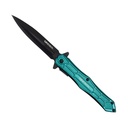
This spring-assisted knife is built for the user who cares about action more than hype. The Lattice Surge Quick-Deploy Assisted Knife snaps open off the flipper with a clean, decisive spring kick, then locks up on a liner lock that doesn’t argue. A 3.5-inch matte black dagger blade gives you precise piercing and controlled slicing, while the teal lattice-milled aluminum scales lock into your hand without chewing it up. At 8 inches overall with a pocket clip, it disappears until you need a fast, reliable EDC cutter.
Spring-Assisted Precision for Buyers Who Care How a Knife Actually Works
The Lattice Surge Quick-Deploy Assisted Knife - Teal Aluminum is for the person who pays more attention to action timing than paint jobs. This isn’t an automatic knife, OTF, or switchblade; it’s a purpose-built spring-assisted folding knife that uses tension and geometry, not gimmicks, to get from pocket to locked in one clean motion. If you’re shopping automatic knives for sale but still appreciate the control of a manual with a boost, this is the middle ground done right.
Automatic Knife for Sale Alternatives: Why a Good Spring-Assisted Folder Still Matters
Enthusiasts hunt for an automatic knife for sale because they want one thing: fast, repeatable deployment. This spring-assisted knife chases the same goal with a different mechanism. Instead of a button-fired coil spring like a true automatic, it uses a tuned torsion spring tied to the pivot. Once you nudge the flipper tab past the detent, the spring does the rest—snapping the 3.5-inch matte black dagger blade into full lock with a satisfying, controlled kick.
Compared to many budget automatics, a well-executed assisted opener like this can actually feel more predictable. There’s less slam, more linear motion, and fewer internal parts to drift out of spec. You get the same pocket-to-cut speed many buyers chase in an automatic knives for sale listing, with a deployment that still feels mechanical and deliberate in the hand.
Mechanics That Earn Enthusiast Respect: Spring, Lock, and Edge
Action and lockup are where this knife justifies its space in a serious EDC rotation. The flipper tab gives you a consistent index point—same motion every time, regardless of gloves or hand position. Once you overcome the detent, the assisted mechanism engages immediately, driving the blade open in a single, fluid arc.
Deployment You Can Read Through the Handle
The teal lattice-milled aluminum scales aren’t just visual flair. That cut geometry gives your fingers a repeatable purchase line right behind the pivot, so you can drive the flipper with authority without over-gripping. Combined with jimping on the spine and near the flipper, it means the knife plants in your hand during deployment instead of shifting forward as the spring fires.
Liner Lock That Doesn’t Make You Babysit It
The liner lock engages with solid, visible contact on the blade tang. No guesswork, no half-hearted lock face just flirting with engagement. For an assisted knife meant for daily carry, that’s non-negotiable. You get the speed people usually look for when they buy automatic knife designs, but the lock feel of a dialed-in folder.
EDC Reality: Dagger Profile, Teal Lattice Control, Pocket-Ready Form
This knife lives in the lane where tactical styling and practical cutting actually overlap. The 3.5-inch matte black dagger-style blade gives you a strong central tip for piercing and detailed work, but the plain edge keeps it honest as a cutter: boxes, straps, cord, tape, the dull daily grind that keeps an EDC honest.
At 4.5 inches closed and roughly 8 inches overall, it’s full enough in hand to work, but still compact enough to disappear along a pocket seam. The tip-down pocket clip is simple, serviceable, and aligned for fast retrieval—no fidget, no guessing where the flipper will land when you draw. Pull, orient, flip, cut. That’s the rhythm.
Looking at an Automatic Knife for Sale? Here’s Where This Fits in the Lineup
If you’re scrolling automatic knives for sale, OTF listings, and the occasional switchblade trying to pick your next piece, this teal lattice spring-assisted is your control sample. It shows you what a tuned assisted mechanism should feel like before you start comparing coil-spring side-openers and double-action OTFs.
Where a true automatic knife uses a button or lever to release the blade under full spring tension, this assisted knife demands you start the motion. That’s not a downgrade; for many collectors, it’s a preference. You get mechanical feedback, less risk of accidental discharge, and often a cleaner lockup than some bargain-bin automatics and switchblade clones.
Legal Context: Assisted Opener vs. Automatic Knife and Switchblade Laws
Any serious buyer looking at an automatic knife for sale knows the legal questions come next. Under U.S. federal law, the term “switchblade” generally covers knives where a button or similar device in the handle releases the blade automatically—classic automatic knives and many OTF designs. This spring-assisted knife requires you to manually start opening the blade via the flipper before the spring engages, which typically keeps it outside federal switchblade definitions.
That said, state and local laws vary wildly. Some jurisdictions treat assisted openers more leniently than automatic knives and OTF switchblades; others blur the definition. Before you carry, you should always:
- Check your state’s knife statutes and any city-level ordinances
- Confirm how your region defines “automatic knife,” “switchblade,” and assisted opening
- Verify blade length limits and any restrictions on dagger-style or double-edged profiles
This knife is designed as an assisted opening folder, not a fully automatic knife, but the only opinion that counts for carry is your local law.
What Buyers Ask Before Purchasing an Automatic Knife
Are automatic knives legal?
At the federal level in the U.S., automatic knives (often called switchblades) are regulated primarily by the Federal Switchblade Act. It restricts interstate commerce and mailing of switchblades, with certain exemptions for military, law enforcement, and one-armed individuals. However, it doesn’t outright ban ownership nationwide.
The real complexity is at the state and local level. Some states fully allow automatic knives and OTF designs; others limit blade length, restrict carry (especially concealed carry), or prohibit them entirely. Many states treat assisted openers more favorably than autos, but a few write broad definitions that could cover both. Before you buy automatic knife models or carry one, you need to read your state’s statutes directly or consult a reliable legal summary. This teal lattice piece, as a spring-assisted knife, is generally treated differently than a true automatic or switchblade—but laws always win over assumptions.
What’s the difference between an automatic knife, OTF, and a switchblade?
Mechanically, here’s the breakdown:
- Automatic knife (side-opening): Blade is held closed under full spring tension and opens automatically when you press a button or release mechanism on the handle. Think classic push-button folders.
- OTF (out-the-front) knife: Blade travels along the handle’s long axis and exits the front. Single-action OTFs deploy with a button and must be manually retracted; double-action OTFs use the same control to both deploy and retract.
- Switchblade: Legal term often used interchangeably with automatic knife, especially in statutes. Many laws treat side-opening automatics and OTFs as switchblades.
- Spring-assisted knife (like this one): You start opening the blade with a thumb stud or flipper; once past a detent, a spring helps finish the opening. No handle button, no automatic release from a closed, fully tensioned state.
This teal lattice knife is strictly a spring-assisted folder, not a true automatic knife, not an OTF, and not a statutory switchblade in most jurisdictions.
What makes this automatic knife worth buying?
When buyers talk about an automatic knife for sale being “worth it,” they’re really talking about action, control, and carry. This spring-assisted EDC earns its slot by combining a fast, decisive deployment with a handle that actually understands grip. The teal lattice milling isn’t cosmetic; it gives positive purchase during the spring kick. The liner lock engages fully and predictably. The 3.5-inch plain-edge dagger profile maximizes utility while keeping the point authoritative. It’s the knife you use to benchmark everything else in the affordable assisted and automatic category—because it shows how a simple mechanism, executed cleanly, should feel.
For the Enthusiast Who Chooses Gear with Intent
If you’re the kind of buyer who scrolls past the copy that calls everything a “switchblade” and actually cares about the difference between automatic knives for sale, OTF mechanisms, and assisted openers, this knife fits your mindset. The Lattice Surge Quick-Deploy Assisted Knife - Teal Aluminum gives you tuned spring-assisted action, reliable lockup, and a distinctive teal lattice grip that feels as intentional as it looks. It’s not trying to be every category at once; it’s a well-executed assisted knife that holds its own next to any automatic knife for sale on your shortlist.
| Blade Length (inches) | 3.5 |
| Overall Length (inches) | 8 |
| Blade Color | Black |
| Blade Finish | Matte |
| Blade Style | Dagger |
| Blade Edge | Plain |
| Blade Material | Steel |
| Handle Material | Aluminum |
| Theme | None |
| Pocket Clip | Yes |
| Deployment Method | Spring-assisted |