Line-Control Quad-Pouch Carbine Case - Olive PVC
12 sold in last 24 hours
This isn’t a fashion sleeve, it’s a working carbine case built for the range line. The olive PVC shell shrugs off weather and abuse, while four front pouches keep mags staged where you actually reach for them. Inside, padded panels and tie-down straps lock a 42-inch rifle in place. Lockable dual zippers and shoulder straps make transport compliant and simple. If your rifle is a tool, this is the case that treats it like one.
Line-Control Quad-Pouch Carbine Case – Built for Real Range Work
The Line-Control Quad-Pouch Carbine Case - Olive PVC is the range gear equivalent of a well-tuned duty rifle: no flash, no gimmicks, just the features that actually matter when you’re hauling a 42-inch carbine to and from the line. Soft rifle cases are either honest tools or decoration. This one is unapologetically a tool.
Soft Rifle Case for Carbine Carry, Not Closet Display
This is a soft rifle case built specifically for carbine-length rifles up to 42 inches. The long rectangular profile, rounded corners, and padded interior are all about protecting optics, rails, and muzzle devices without adding bulk. The olive green PVC shell takes the abuse – benches, truck beds, gravel, and bad weather – so your rifle doesn’t have to.
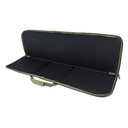
Inside, a black padded interior runs the full length of the case. Three tie-down straps secure the rifle at key balance points, preventing the kind of lateral shift that tweaks optics or bangs turrets against the zipper track. It opens clamshell-style with a full-length dual zipper, so you can lay the rifle in, cinch it, and close up without wrestling around tight corners.
Quad-Pouch Front Layout: Range Rhythm, Not Random Storage
Front and center are four exterior pouches – not thrown on as an afterthought, but spaced for actual range use. Each pouch stages a mag, tools, or small accessories where your hands naturally go when you’re working from a bench or tailgate. Instead of digging in a pack, your line gear lives on the outside of the case you’re already carrying.
Why Four Pouches Matters in Real Use
Quad pouches hit the sweet spot: enough capacity to run drills, zero, and troubleshoot without turning the case into a sagging, front-heavy mess. Two pouches often feels like a compromise; six or more turns the case into a duffel. Four keeps your load balanced and your workflow predictable.
Carry and Transport: Built Around How Shooters Actually Move
Range days are about repetition, not wrestling your gear. This soft rifle case is set up for the way people really move between home, truck, and line:
- Shoulder straps: Throw it on and keep your hands free for ammo cans, targets, or a second rifle.
- Padded carry handles: Sewn webbing with a wrap grip for short hauls that don’t cut into your hand.
- Lockable dual zippers: Two zipper pulls meet at a reinforced point, giving you a padlock-friendly closure that keeps the case closed and your rifle out of casual hands.
- Low-profile silhouette: No bulky exterior structure, no hard corners to catch on truck interiors or door frames.
This isn’t a hard case for airline abuse; it’s a purpose-built soft rifle case for the everyday reality of range trips, classes, and local matches.
Materials That Shrug Off Range Abuse
The olive green PVC outer shell delivers what shooters actually need from a carbine case: abrasion resistance, weather resistance, and a surface that doesn’t care if it gets tossed on gravel or leaned against a wet bench. Inside, the black padded lining cushions your rifle without the delicate, fuzzy fabric that tears the first time a Pic rail snags.
Interior Tie-Downs: The Underappreciated Protection Detail
Three interior tie-down straps are what keep this case from being just another rifle sock with a zipper. By securing the rifle in three spaced points, they change the physics of transport: less internal momentum, less battering of optics and accessories, and less chance of a muzzle nudging the zipper under impact.
Gun Case Transport and Legal Reality
Soft rifle cases like this one sit right at the intersection of practicality and compliance. The lockable zippers offer a simple way to add a padlock, which many shooters choose when transporting to the range, competitions, or through jurisdictions with stricter expectations for firearms in vehicles. It is not a safe, and it doesn’t turn your rifle into a legal non-firearm container – but it does support locked transport where that’s recommended or required.
Laws vary by state and sometimes by city. Some areas specify that firearms must be unloaded and cased, sometimes locked, and often stored separately from ammunition. This case gives you a padded, lockable, easily carried soft solution for that role. The responsibility to know your local and state transport laws remains on you, but this carbine case is designed to help you comply without making your life harder at the range.
What Buyers Ask Before Purchasing an Automatic Knife
Are automatic knives legal?
Under U.S. federal law, automatic knives – often called autos or switchblades – are regulated mainly in interstate commerce, particularly under the Federal Switchblade Act. That law restricts certain forms of interstate shipment and importation, especially to states where these knives are prohibited. Day-to-day carry, ownership, and in-state purchase, however, are governed almost entirely by state and sometimes local law.
In practice, that means automatic knife legality is a patchwork. Some states allow autos with few limits, others impose blade length caps or restrict where they can be carried, and a handful still ban them outright. Before you buy or carry an automatic knife, you confirm the current laws in your state and any state you’ll travel through – and pay attention to city and county ordinances in major metros, which can be stricter than state code.
What’s the difference between an automatic knife, OTF, and a switchblade?
“Automatic knife” is the broad category: a folding knife whose blade deploys from a closed position by pressing a button, lever, or switch, thanks to an internal spring mechanism. An OTF – out-the-front – is a specific subtype of automatic where the blade slides straight out of the handle’s front instead of pivoting out from the side. Many OTFs are double-action: the same control both deploys and retracts the blade.
“Switchblade” is essentially the legacy term that the law uses for automatic knives. In collector and enthusiast circles, it usually refers to traditional side-opening autos, but legally it often covers both side-opening automatics and OTFs. So: all OTFs are automatic knives, most switchblades are automatic knives, but not all automatic knives are OTFs.
What makes an automatic knife worth buying?
A serious automatic knife earns its place with three things: action, build, and intent. The action should be decisive without feeling abusive – fast deployment, solid lockup, and a return that doesn’t chew up the mechanism. Build means real steel heat-treated properly, a pivot and lock that stay tuned, and tolerances that don’t turn to rattle after a month of carry. Intent is design that respects its role: a blade shape that actually cuts, a handle that locks into the hand under load, and a mechanism chosen for use, not just spectacle.
Collectors and hard users alike look for automatics that deliver repeatable action, controlled power, and serviceable construction. When those line up, you’re not just buying a novelty; you’re buying a mechanical solution you can trust to open the same way on the thousandth press as it did on the first.
Why This Carbine Case Belongs in a Serious Shooter’s Kit
This soft rifle case doesn’t pretend to be something it’s not. It’s range gear for people who actually put rounds downrange. The 42-inch padded interior handles carbines with optics, the tie-down straps keep the rifle where you left it, and the quad front pouches make ammo and tools part of the same system, not a separate bag.
If you’re the kind of buyer who cares about the difference between a side-opening automatic knife and a double-action OTF, you’ll appreciate the same honest engineering here: every feature on this carbine case earns its space. No wasted fabric, no decorative nonsense, just the details that make range days smoother and more predictable.
Pair this case with the rifles you actually shoot, not the ones you hide in the safe. It’s built for movement, repetition, and the quiet satisfaction of gear that simply does its job every single time.