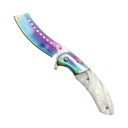
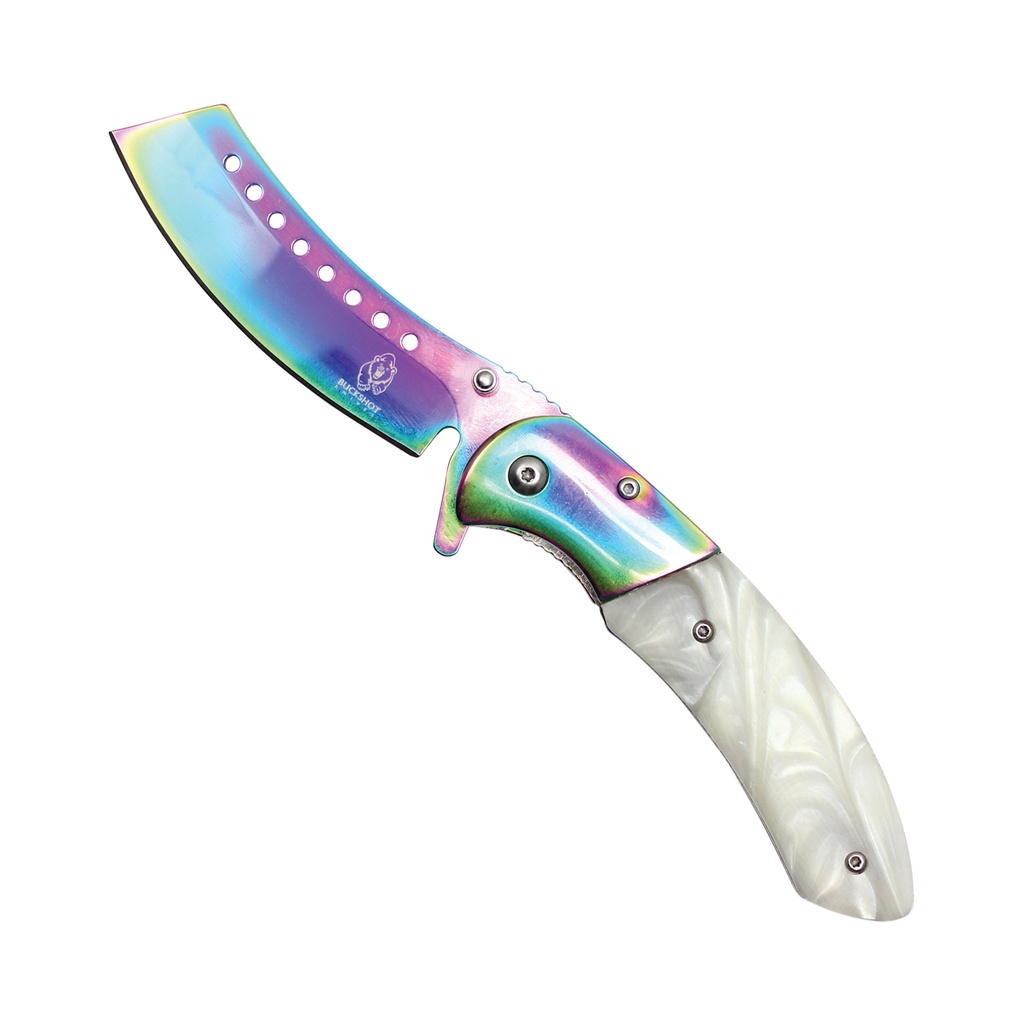

Luminous Arc Spring-Assisted Pocket Knife - Pearl Rainbow
11 sold in last 24 hours
This spring-assisted pocket knife is built for the EDC user who actually cares how a blade moves. The 3.5-inch trailing point rides on a tuned spring-assist and flipper tab, snapping cleanly into a secure liner lock with no hesitation. Rainbow TiN over steel gives you real-world corrosion resistance with that showpiece flash, while the pearlescent white handle fills the hand without bulk. Deep-carry clip, one-handed deployment, and a blade profile that actually cuts—this is a statement knife that still works for a living.
Spring-Assisted Pocket Knife Performance for Buyers Who Care About Action
If you’re looking for a spring-assisted pocket knife that’s more than just shiny hardware, this Luminous Arc build earns its place in your rotation. The blade, the assist, the lockup—everything here is tuned for the person who notices how a knife actually opens and how it carries after the first week.
On paper, it’s a 3.5-inch trailing point spring-assisted folder with a liner lock and pocket clip. In hand, it’s a surprisingly refined EDC that happens to wear a rainbow TiN suit and a white pearl handle. The engineering under the color is what matters.
Spring-Assisted Knife for Sale with Real Mechanical Intent
This isn’t an automatic knife, and it isn’t pretending to be. The deployment is classic spring-assisted: you start the motion with the flipper tab, the internal torsion spring takes over, and the blade snaps to full lock.
Why that matters: assisted opening gives you near-automatic speed without crossing into full automatic or switchblade territory. That’s significant for buyers navigating both performance expectations and local knife laws. You get one-handed opening, positive lockup, and the tactile satisfaction of a tuned action—all in a format that’s easier to carry in more places than a true automatic knife.
Action and Lockup: Where This Knife Earns Respect
The flipper tab is shaped for reliable index finger engagement—no searching for a nail nick, no awkward thumb stud angle. The spring is tuned to a sensible middle ground: light enough to avoid feeling like a bear trap, strong enough that once you break that initial detent, the blade doesn’t stall halfway.
Lockup is via a steel liner lock that engages the tang cleanly, with enough surface contact to inspire confidence without overtravel. The result is an action cycle that feels consistent: predictable detent, assertive snap, repeatable retraction. Enthusiasts will notice the lack of gritty hesitation that plagues cheaper assisted knives.
Blade, Steel, and Grind: The Business End of This Pocket Knife
The 3.5-inch trailing point blade is where the design stops being decoration and starts being useful. That sweeping belly and fine tip give you an edge profile that excels at the kind of real cuts EDC actually sees: slicing cardboard, breaking down packaging, light food prep, zip ties, cord, and tape.
Steel is a work-ready stainless, treated with a rainbow titanium nitride (TiN) finish. TiN isn’t just a visual party trick—it adds surface hardness and corrosion resistance. On a pocket knife that’s going to ride against keys, coins, and sweat, that matters. Color aside, this blade is built for daily abuse, not display-case isolation.
Jimping, Lightening Holes, and Practical Details
Thumb jimping on the spine near the handle gives you purchase when you choke up for controlled cuts. It’s a small detail, but if you’ve ever tried to do fine work on a slick spine, you know how much it helps.
The round lightening holes along the spine aren’t just aesthetic—they pull a little weight out of the blade and shift balance slightly back toward the pivot. On an 8-inch overall knife, that’s the difference between feeling blade-heavy and feeling neutral in the hand.
Carry Reality: This Is an EDC Knife That Actually Rides Well
At 4.5 inches closed, this spring-assisted pocket knife hits the EDC sweet spot: enough handle to grip, not so much that it prints like a brick in your pocket. The deep-carry pocket clip tucks the knife low, keeping that rainbow TiN mostly out of sight until you decide to show it off.
The handle itself is a two-part story. On one side, the same iridescent rainbow finish that runs from blade into scale; on the other, a smooth pearlescent white synthetic with visual depth. It’s more than just color—there’s enough contour to index the knife in hand, and the synthetic construction shrugs off moisture and pocket wear far better than cheap painted metal.
Collector Detail: Where This Knife Steps Above Commodity Flash
There are plenty of rainbow knives in the bargain bin. What separates this one is that the showpiece look is built on a functionally competent base. The flipper tab, tuned assist, jimping, and secure liner lock are design choices you see on knives carried by people who use them daily, not just photograph them.
That balance—flash on the surface, seriousness in the mechanics—is exactly what attracts collectors who enjoy a bit of style but refuse to tolerate sloppy action.
Legal Context: Assisted Opening vs Automatic Knife vs Switchblade
Before anyone hits “buy,” they want to know what they’re actually carrying. This knife is spring-assisted, not automatic. That means:
- You must start the opening manually using the flipper tab.
- Once started, an internal spring completes the opening.
- It does not open by pressing a button or slider in the handle alone.
Under U.S. federal law, automatic knives (often called switchblades) are defined by a blade that opens automatically by pressure on a button, spring, or other device in the handle. An OTF (out-the-front) automatic knife is a subtype of switchblade where the blade travels straight out of the handle. This knife is a side-opening, spring-assisted folder, so it generally falls outside the federal switchblade definition.
However, state and local laws vary widely. Some jurisdictions group assisted openers with manual folders, others treat any spring help with more scrutiny. It’s on the buyer to understand their local regulations before carrying. If your area restricts automatic knives or switchblades, an assisted-opening pocket knife like this is often the more legally comfortable option—but never assume without checking current law.
What Buyers Ask Before Purchasing an Automatic Knife
Are automatic knives legal?
In the U.S., federal law mainly restricts the interstate sale and shipment of automatic knives (switchblades) to civilians, with exceptions for military and certain government users. That said, state and local laws are where most real-world restrictions live. Some states fully allow automatic knives, some allow possession but restrict carry, and others limit blade length or specific mechanisms like OTF switchblades.
This particular knife is spring-assisted, not a true automatic knife. Because you must manually start the blade with the flipper tab, it’s usually treated more like a manual folder than a switchblade. Still, every buyer should verify their own state and municipal codes before carrying, especially if they’re used to automatic knives or switchblades that trigger on a handle button.
What’s the difference between an automatic knife, OTF, and a switchblade?
Enthusiasts use these terms precisely, and so should any serious dealer:
- Automatic knife (switchblade): A knife where the blade opens automatically when you press a button, lever, or slider in the handle. The spring does all the real work once that control is activated.
- OTF (out-the-front) automatic: A specific type of automatic knife where the blade travels straight out of the front of the handle, either single-action (spring deploy only) or double-action (spring deploy and retract). All OTFs are switchblades, but not all switchblades are OTFs.
- Spring-assisted folder (this knife): A folding knife where you begin the opening manually—usually via a flipper tab or thumb stud—and an internal spring then completes the opening. Mechanically and legally distinct from a button-activated automatic.
This Luminous Arc is firmly in the spring-assisted pocket knife category, not an automatic, not an OTF, and not a switchblade in the legal sense.
What makes this knife worth buying?
For the price class, it’s the combination of action, profile, and finish. You’re getting a spring-assisted mechanism that doesn’t feel like an afterthought, a 3.5-inch trailing point that actually cuts well, and a TiN-coated blade that resists wear better than bare budget stainless. Add to that the deep-carry clip, functional jimping, and that white pearl and rainbow aesthetic, and you’ve got a pocket knife that stands out in a drawer full of anonymous black folders.
Collectors appreciate knives that don’t waste their mechanical potential. This piece offers a tuned assist, reliable liner lock, and a visual theme that’s bold without being cartoonish. It’s the kind of EDC you can hand to a fellow enthusiast, flip open once, and see the nod of recognition.
For the Enthusiast Who Chooses Their EDC on Purpose
If you’re the buyer who knows exactly why you prefer an assisted-opening pocket knife over a full automatic knife—and you enjoy a bit of visual drama without sacrificing function—this Luminous Arc build fits. It’s a spring-assisted EDC that respects mechanics first, looks second, and price point last.
Pick it up as your daily carry statement piece, or as the bright outlier in a collection of subdued blades. Either way, you’re choosing a knife where the action, lockup, and blade geometry are designed to be used, not just looked at.
| Blade Length (inches) | 3.5 |
| Overall Length (inches) | 8 |
| Closed Length (inches) | 4.5 |
| Blade Color | Rainbow |
| Blade Finish | Titanium |
| Blade Style | Trailing Point |
| Blade Edge | Plain |
| Blade Material | Steel |
| Handle Finish | Pearlescent |
| Handle Material | Synthetic |
| Theme | Rainbow |
| Pocket Clip | Yes |
| Deployment Method | Spring-assisted |
| Lock Type | Liner lock |