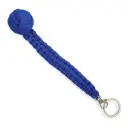
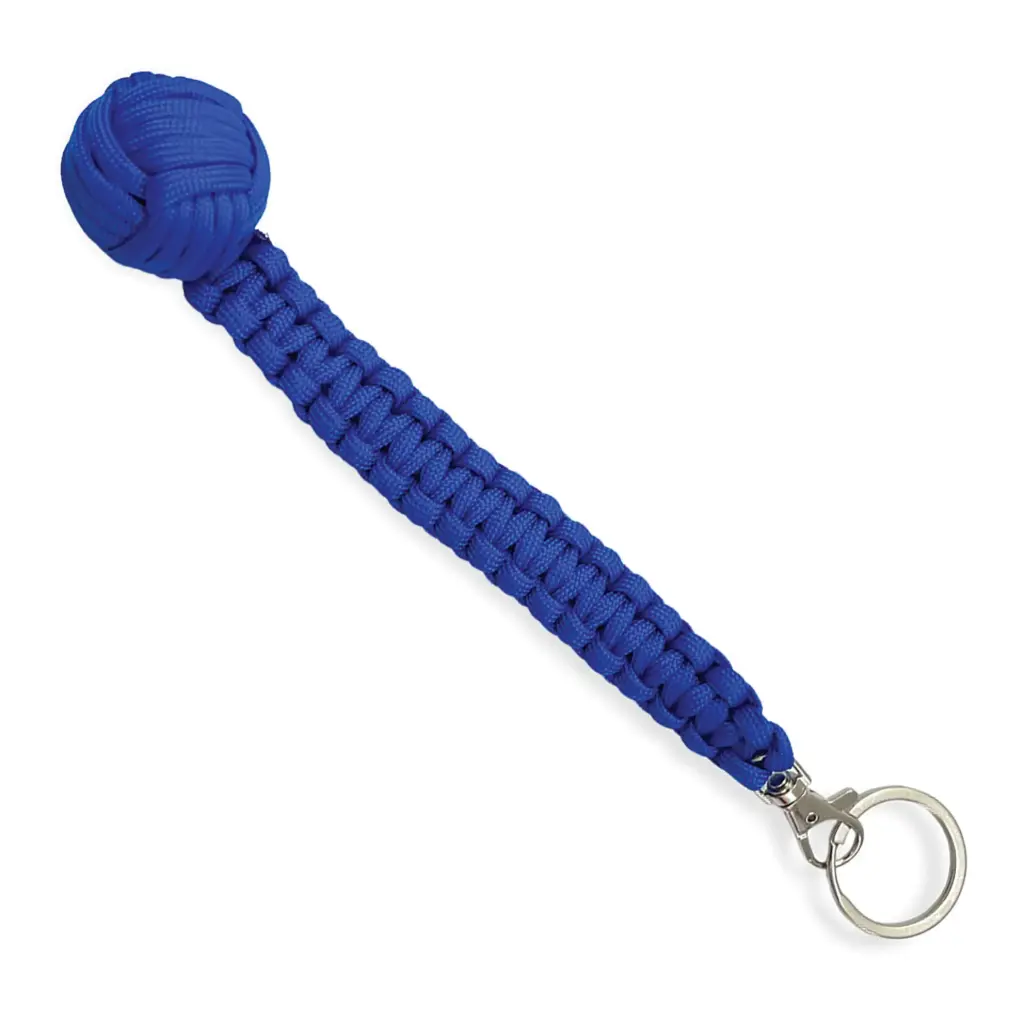
Mariner’s Fist Impact Glass-Breaker Keychain - Blue Paracord
12 sold in last 24 hours
You don’t carry this to make a statement—you carry it so you’re never empty-handed. The Mariner’s Fist Impact Glass-Breaker Keychain wraps bright blue paracord around a solid stainless steel core, giving you a compact, familiar monkey fist that hits with purpose. The braided strap and key ring keep it riding quietly with your keys until you need rapid, controlled impact or emergency glass-breaking capability on the street, in a vehicle, or on shift.
Everyday Defense, Nautical Roots: A Serious Impact Tool Disguised as a Keychain
The Mariner’s Fist Impact Glass-Breaker Keychain doesn’t rely on intimidation or gimmicks. It leans on physics, rope craft, and a stainless steel core wrapped in tight blue paracord. If you’re the kind of buyer who obsesses over action quality in an automatic knife and carries gear that actually works, this is the same mindset applied to a compact, purpose-built defense keychain.
Where a lot of “self-defense keychains” are plastic toys, this piece takes its lineage from the traditional monkey fist knot—a weighted rope tool used to throw lines at sea. Here, that maritime knot gets repurposed for controlled impact and emergency glass-breaking, tuned for real-world EDC.
Impact by Design: How the Monkey Fist Core Does the Work
The heart of this keychain is a stainless steel core locked inside a tight monkey fist knot. That dense, centered weight is what matters. Instead of relying on spikes or edges, you get a compact, repeatable impact point that carries momentum the way a good automatic knife blade rides its pivot—consistently, predictably, and under your control.
Weighted Core, Controlled Strikes
The one-inch stainless core concentrates force into a small surface area. Paired with the 8.5-inch overall length, you get enough swing radius to matter, without turning it into something clumsy or obvious. Think sap logic in a keychain footprint—small, dense, and deceptively effective when used with intent.
Braided Paracord: Grip, Alignment, and Retention
The cobra-style paracord handle isn’t just aesthetic. It adds structure and a consistent grip index so you can orient the knot by feel. Under stress, that matters. The flat braid keeps the strap from rolling in your hand, giving you a clear sense of direction when you need to deploy it fast—no fumbling, no guessing where the business end is.
Why Serious EDC Buyers Choose This Over Gimmicks
If you buy automatic knives for their engineering, you’ll recognize the same design discipline here. Nothing extra, nothing fragile, nothing that needs fine motor skills to work. Just a dense impact head, a reliable grip, and hardware that stays attached to your keys.
- Stainless steel core for consistent, repeatable impact and glass-breaking.
- Tight blue paracord wrap that won’t unravel under normal carry or training.
- Metal split ring and connector so it rides like a normal keychain until needed.
- Compact, linear profile that doesn’t print or snag in pockets or bags.
This is the opposite of a novelty spike or plastic "defense" trinket. It’s a quietly competent tool that feels familiar in hand, similar to how a well-tuned automatic knife disappears in your pocket until you hit the actuator.
EDC Reality: How This Defense Keychain Actually Carries
Real-world carry beats theory every time. This defense keychain is built to live on your keys full-time, not in a drawer.
Keychain Footprint, Full-Size Function
At roughly 8.5 inches overall, you get enough length for leverage without turning it into a flail. The monkey fist rides at one end, the key ring at the other, keeping the weight low and predictable. On a belt loop, bag, or in a pocket, it behaves like a normal keychain—no sharp edges, no awkward protrusions.
Non-Threatening, Purposeful Presence
The bright blue paracord and clean silver hardware give it a nautical, almost casual look. It reads as a stylish paracord key fob to anyone not paying attention, which is exactly the point. You’re not telegraphing anything, but you’re also not caught empty-handed walking to your car at midnight.
Glass-Breaking and Emergency Use: More Than Just Self-Defense
A good EDC tool earns its spot by doing more than one job. Here, the weighted stainless core doubles as an emergency glass breaker. That means vehicle egress, breaking tempered glass in a pinch, and giving first responders, security staff, or prepared civilians a way to solve a problem that bare hands can’t.
Unlike a tiny metal nub on a keychain that demands perfect angle and pressure, the monkey fist lets you strike with a natural motion. The weight does a lot of the work, and the paracord gives you enough distance from the glass to avoid eating every shard.
What Buyers Ask Before Purchasing an Automatic Knife
Are automatic knives legal?
In the U.S., automatic knife legality is a combination of federal rules and state law. Federally, the Switchblade Knife Act mainly restricts interstate commercial shipment of automatic knives (often casually called switchblades) with certain exceptions—for example, sales to military or law enforcement, or within the same state. The real deciding factor for carry is your specific state and sometimes local law. Some states allow automatic knives for everyday carry, some limit blade length or carry method, and others prohibit them outright. Before you buy or carry an automatic knife, check your state and local statutes, not just headlines or forum chatter. Laws change, and responsibility sits with the person carrying the knife.
What’s the difference between an automatic knife, OTF, and a switchblade?
Mechanically, an automatic knife is any knife where the blade deploys from a closed position using a spring or stored energy, triggered by a button, switch, or similar control—no wrist flick required. A classic side-opening automatic swings the blade out on a pivot, like a standard folder that opens itself when you hit the release.
An OTF (out-the-front) knife is a specific type of automatic where the blade travels along the handle’s long axis and exits the front. Double-action OTF automatics both deploy and retract with the same sliding control; single-action OTFs typically auto-deploy and require manual retraction.
“Switchblade” is the older legal and cultural term that usually refers to automatic knives in general, especially side-openers. In enthusiasts’ language, we tend to use “automatic knife” and then get more specific—side-opener, OTF, single-action, double-action—because the mechanics are what matter.
What makes this automatic knife worth buying?
Since this product is a defense keychain, not an automatic knife, the logic is similar but the mechanism is different. With a serious automatic knife, what makes it worth buying is the precision of the action, the lockup consistency, the steel selection, and how all of that comes together in real-world deployment. A good automatic opens the same way every time, under dirt, cold, or stress, without blade play or hesitation. You pay for tuned springs, clean machining, reliable safeties, and steel that holds an edge instead of just looking good. That same standard—function over flash—is exactly why this monkey fist glass-breaker keychain earns a place in a serious EDC kit.
Why This Mariner’s Fist Keychain Belongs in a Serious EDC Kit
You don’t have to be a sailor to appreciate the logic behind this build. Dense core, controlled impact, reliable carry. It’s the same mindset that makes someone choose a well-engineered automatic knife over a gas-station special—mechanics first, looks second, no dead weight in the design.
If your pockets already hold an automatic knife you trust, this keychain fills a different role: impact, glass-breaking, and a layer of quiet security that doesn’t scream for attention. It’s the kind of tool serious carriers appreciate—simple, effective, and built with more thought than it lets on.
For the enthusiast who chooses gear on purpose, not by accident, the Mariner’s Fist Impact Glass-Breaker Keychain is a small, smart upgrade that earns its spot every day.