Midnight Dojo Heritage Sai Set - Black Leather
5 sold in last 24 hours
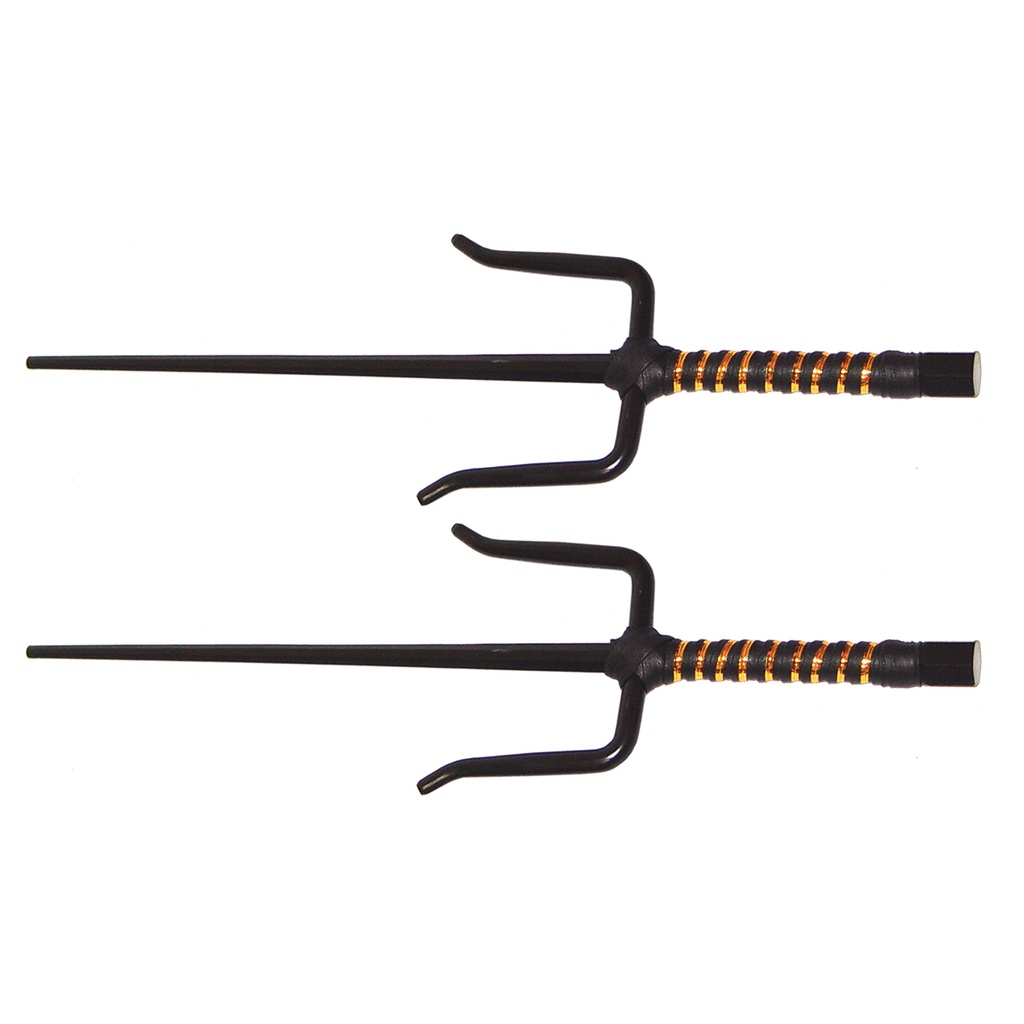
The Shinobi Heritage Sai Pair brings traditional Okinawan lines into a modern, blacked‑out profile. At 19.5 inches, each all‑metal sai carries real presence without feeling clumsy, with a leather‑wrapped handle and gold‑tone bands that lock into the hand and stand out on the rack. The compact side prongs and faceted pommels keep the look clean and controlled—equally at home in a kata-focused dojo or a serious martial arts display.
Shinobi Heritage Sai Pair - Black Leather: Traditional Form, Modern Intent
The Shinobi Heritage Sai Pair is what happens when you respect the original Okinawan weapon design, then strip the noise and lean into modern ninja minimalism. Full-length 19.5-inch sai, all metal, blacked out, with a leather-wrapped grip and gold‑tone bands that give you both control and a subtle ceremonial edge. These aren’t toy props. They read as real dojo tools that happen to look good enough for a collector’s wall.
Why This Sai Pair Belongs in a Serious Training Rack
Most mass-market sai feel like costume pieces the second you pick them up—poor balance, slick handles, and paint that flakes if you look at it wrong. This pair is cut from a different mindset. The straight central prong is long enough to give proper reach without going unwieldy, and the side prongs angle out just enough for realistic trapping and control work without catching on everything in the room.
The all‑metal construction gives you the weight you expect from a real training sai, not hollow tin. The leather-wrapped grip solves the classic problem of smooth metal handles: you get a tactile index point, secure purchase during spin transitions, and enough comfort for extended kata sessions. This is built to be run, not just photographed.
Design Details Serious Martial Artists Actually Notice
Look closely and the intent is obvious: this is a traditional weapon dressed in a contemporary language. Blacked‑out metal from pommel to prongs, then interrupted only by spiral gold‑tone bands over black leather. It’s a quiet flex—nothing gaudy, but enough visual contrast that a fellow practitioner notices the set immediately on the rack.
Balance, Length, and Practical Handling
At 19.5 inches overall, each sai hits the sweet spot for most adult practitioners: long enough to extend past the forearm for realistic blocking and striking drills, short enough to move quickly in close quarters. The central prong is straight and tapered, giving a precise line of impact and clear visual alignment during kata. The side prongs are compact and angled out with purpose—capable of trapping and redirecting without adding unnecessary weight or bulk.
The faceted pommel does double duty. It provides a defined stop for reverse or icepick-style grips and serves as a striking surface for butt-end techniques. You can transition between grips without hunting for orientation—the geometry tells your hand where you are.
Grip That Works Under Real Training Conditions
The leather wrap over the handle isn’t decoration; it’s the difference between a weapon you can actually train with and one that tries to leave your hand mid-combination. The leather adds friction without being tacky, and the gold‑tone bands function like mild indexing points—subtle tactile cues you can feel while spinning or reversing direction. When hands are sweaty, you still have control. When displayed, the grip looks like it belongs to a serious practitioner’s set, not a party store prop.
Collector Presence Without Losing Dojo Cred
Collectors know the line between “wall hanger” and “training weapon that photographs well.” This sai pair sits cleanly on the right side of that line. The all‑black finish creates a unified silhouette that reads as modern and intentional; the smooth, semi‑gloss surface catches light along the central prong without shouting for attention. Those gold‑tone grip bands pull the eye first, then lead it along the length of the weapon. Displayed as a pair, they present with symmetry and discipline, not clutter.
As a display set, the twin forms with matching wrap and accents tell a story instantly: someone in this room trains, or at least respects the martial language. As a practice pair, they give you repeatable handling characteristics you can rely on session after session.
Training, Demonstration, and Practical Use
These sai are built for kata, bunkai demonstration, and controlled partner work. The all‑metal build means the forms won’t flex or rattle, so your lines stay honest. The compact side prongs allow close trapping drills without adding awkward width, which matters when you’re working in a crowded dojo or tight demo space.
For instructors, the visual contrast of black metal and gold‑accented grips makes technique positions easy to see from the back of the room. For students, the consistent dimensions and weight help build muscle memory that actually transfers if you move on to custom or forged pieces later.
What Buyers Ask Before Purchasing an Automatic Knife
Automatic knives, OTFs, and switchblades are a different category entirely from this sai pair, but the same mindset applies: know the mechanism, know the intent, respect the law. If you’re the kind of buyer who cares about deployment, action, and steel in an automatic knife for sale, you’ll appreciate that this product is honest about what it is—traditional impact and control weapons, not folding blades or autos masquerading as something they’re not.
Are automatic knives legal?
Under U.S. federal law, automatic knives—often called autos or switchblades—are regulated by the Federal Switchblade Act, which mainly controls interstate commerce and importation. It doesn’t outright ban ownership, but it does limit how automatic knives can be shipped and sold across state lines. Real-world legality is determined at the state and sometimes local level: some states allow carry of an automatic knife, some allow ownership but restrict carry, and others heavily restrict both. Before you buy an automatic knife or switchblade online, you need to check your specific state and local laws on blade length, opening mechanism, and carry method. A sai pair like this is generally treated as a martial arts training weapon or impact weapon under local weapons codes, not as a knife or automatic opener—but you should still understand your local regulations if you plan to carry or transport them outside a dojo or home.
What’s the difference between an automatic knife, OTF, and a switchblade?
An automatic knife uses a spring-driven mechanism to deploy the blade with the press of a button, lever, or similar control. Most auto folders swing the blade out from the side on a pivot. An OTF (out-the-front) knife is a specific type of automatic where the blade travels linearly, straight out of the handle—single-action OTFs deploy automatically but must be manually retracted, while double-action OTFs both deploy and retract via the same control. “Switchblade” is the older legal and cultural term typically referring to automatic knives in general. All three live in the same mechanical family: spring-powered deployment triggered by an external control. This sai pair, by contrast, is a fixed traditional weapon—no folding, no spring, no automatic action at all.
What makes this automatic knife worth buying?
When you evaluate an automatic knife for sale, you look at three core elements: the action quality (how cleanly and reliably it fires and locks), the steel (edge retention, toughness, corrosion resistance), and the build (lockup, machining, overall fit and finish). That same discipline applies here. The Shinobi Heritage Sai Pair is worth buying for parallel reasons: consistent geometry, honest all‑metal construction, and a grip treatment that actually respects real-world use. It’s not pretending to be an automatic or an OTF; it’s doing one job—being a functional, visually disciplined sai set—and doing it cleanly.
For Buyers Who Care About Tools, Not Hype
If you’re the kind of buyer who reads action descriptions before you buy an automatic knife, you’re the kind of buyer who will notice the details on this sai pair—the balance point, the side‑prong profile, the way the leather wrap sits under the gold‑tone bands. This is gear for people who take training seriously and refuse to hang junk on their wall. Whether it ends up in regular dojo rotation or as the centerpiece of a martial arts collection, the Shinobi Heritage Sai Pair brings the same no‑nonsense mentality you’d demand from any serious blade.