Emberline Rapid-Rescue Spring-Assisted Knife - Black/Gold Titanium
15 sold in last 24 hours
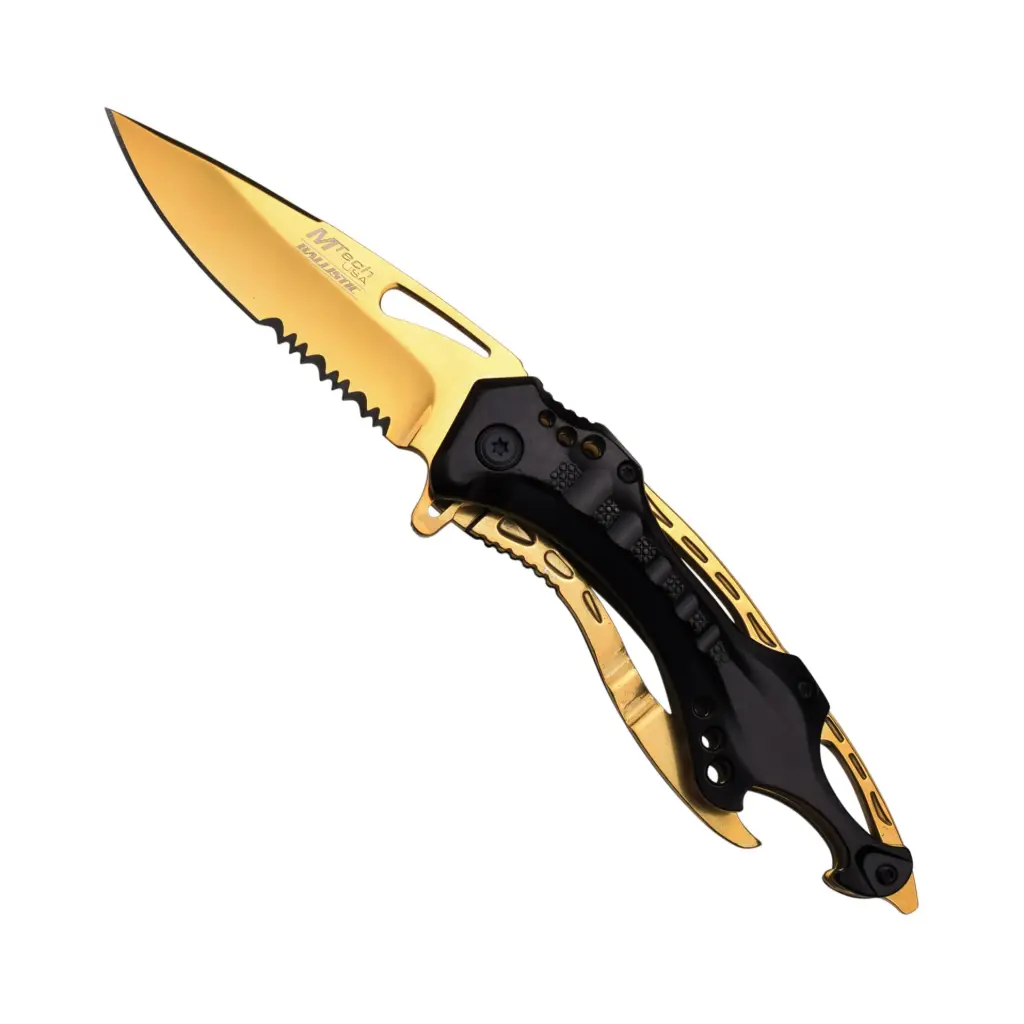
This is a spring-assisted rescue knife built to be used, not babied. The Emberline Rapid-Rescue rides deep at 4.5" closed, then snaps to work with a confident assisted action and liner lock. A gold titanium-coated, half-serrated clip point handles rope, webbing, and stubborn material without drama. Glass breaker, belt cutter, and bottle opener are integrated cleanly into the black-and-gold titanium-finished handle. It’s a modern tactical folder for buyers who care how a knife actually deploys and performs.
Spring-Assisted Rescue Knife for Buyers Who Care About the Action
The Emberline Rapid-Rescue Spring-Assisted Knife - Black/Gold Titanium is built for people who judge a knife first by its deployment, not by the paint job on the box. This isn’t an automatic knife for sale in the strict legal sense – it’s a spring-assisted folder – but it lives in the same world: fast, repeatable, one-handed opening with a mechanical feel you can trust under stress.
At 4.5 inches closed and 8 inches overall, it rides like a true EDC tactical folder but brings full rescue features: glass breaker, belt cutter, half-serrated edge, and a deep-carry pocket clip. The black-and-gold titanium finish is loud on purpose, but under the flash is a knife that understands why mechanism, lockup, and edge geometry matter.
Why Enthusiasts Still Look Here When They’re Ready to Buy an Automatic Knife
Serious buyers browsing automatic knives for sale aren’t just chasing legality or novelty – they’re looking for fast deployment that actually works when your hands are cold, wet, or shaking. That’s exactly where a well-executed spring-assisted mechanism earns its keep.
This spring-assisted knife uses a flipper tab as the primary deployment method. A modest nudge of the tab preloads the torsion spring; once you clear that initial resistance, the spring takes over and drives the 3.5-inch blade into lock with authority. There’s no hunting for a tiny button, no mushy half-deploys. You get a clear, tactile cue as the liner lock engages against the tang, so you know it’s ready before you put it to work.
Action Tuning: Where a Cheap Assisted Fails and This One Doesn’t
Most bargain-bin assisted folders make the same mistake: too much spring, not enough control. They slam the blade out so hard that the pivot eats itself or the lock can’t keep up. The Emberline Rapid-Rescue runs a more balanced setup – enough torsion to give you a fast, confident open, but not so violent that it feels like the knife wants to jump out of your hand.
The large flipper tab gives you leverage, which means the spring can be tuned slightly stiffer for reliability without requiring a gorilla thumb to start it. The thumb hole/slot on the blade gives you a manual backup opening option if you ever need to baby the mechanism or work around gloves.
Blade, Steel, and Edge: Why This Isn’t Just Shelf Candy
The blade is a titanium-coated, gold-finished clip point in stainless steel with a partial serration. No marketing games here – you’re getting a work-ready stainless tuned for real-world use, not a lab spec sheet. The straight section handles push cuts, slicing, and basic utility; the serrated portion is there for the jobs that actually fight back: seatbelts, zip ties, nylon webbing, thick cord, strapping.
The titanium coating does two things that matter to an enthusiast. First, it adds a bit of corrosion resistance – useful if this knife lives in a car, duty bag, or humid environment. Second, it changes the way the blade moves through material. Coated blades often show a slightly different drag profile than bare polished steel; once you know it, you feel it. This one strikes a good balance: enough slickness to move through cut mediums without feeling gummy, with a finish that hides use better than bright mirror polish.
Rescue Geometry: Why the Clip Point and Serrations Work Together
Clip points aren’t just about style. That lower tip line lets you index the point precisely when you’re working close to skin, fabric, or plastic. Paired with partial serrations set back from the tip, you get control for detail work at the front of the blade and tearing power in the midsection. It’s a rescue knife pattern with an EDC bias – capable of hard, dirty cuts without turning everything into a saw.
Handle, Carry, and Real-World Use
The handle is steel with a black-and-gold titanium finish, skeletonized to reduce some weight and give it that ember-through-the-frame look. Finger grooves and texturing anchor the knife in the hand so you’re not relying solely on grip strength when you’re wet or gloved up.
The glass breaker rides at the butt of the handle, in line with the spine, which is exactly where you want it when you’re indexing for controlled impact on tempered glass. The integrated belt cutter sits in a protected hook-style cutout – accessible when you need it, shielded enough that you’re not accidentally snagging gear or fingers.
A deep-carry black pocket clip keeps the knife low profile in the pocket or on a duty belt. At 4.5 inches closed, it disappears easily but still leaves enough handle to grab on the draw. The liner lock sits where your thumb expects it: easy to disengage one-handed without feeling flimsy or wafer-thin.
Function-First Extras: Bottle Opener and Skeletonized Frame
The bottle opener cut into the spine isn’t there to impress Instagram; it’s a simple, functional cut that uses the frame’s existing structure instead of gluing on some novelty gadget. The skeletonized sections do double duty – visual interest and weight relief – and give you inspection access if you’re the kind of owner who likes to clean and lube pivots properly.
Legal Context: Where a Spring-Assisted Knife Fits Beside an Automatic Knife for Sale
When buyers go looking to buy an automatic knife online, they invariably run into a wall of legal complexity. Federal law in the U.S. (the Switchblade Act) regulates interstate commerce of true automatic knives – those that open by a button, switch, or similar device in the handle that releases a spring-loaded blade fully automatically.
This Emberline is a spring-assisted folding knife, not a true automatic or switchblade under that federal definition. You initiate the opening by manually moving the blade via a flipper tab or thumb hole. Only after you start that movement does the internal spring assist and complete deployment. In many states, that puts assisted openers in a more permissive legal category than full automatics or OTF knives, especially for carry.
That said, state and local laws still vary widely. Some states don’t distinguish much between assisted and automatic; others do. If you’re shopping automatic knives for sale or assisted openers like this, the smart move is to check your state and local statutes before you clip it in your pocket or keep it in a duty bag.
What Buyers Ask Before Purchasing an Automatic Knife
Are automatic knives legal?
Under U.S. federal law, automatic knives (switchblades) are regulated primarily in interstate commerce. The law defines an automatic knife as one that opens automatically by a button, switch, or similar device in the handle, or by inertia/centrifugal force, with a spring or other mechanism doing the work.
Federal rules don’t directly dictate what you can carry day-to-day – that’s state and local territory. Some states allow automatic knives and OTF knives with few restrictions; others ban them outright or limit blade length, carry method, or who can possess them (e.g., law enforcement exemptions). Assisted-opening knives like this Emberline often sit in a different category because the user must start the blade manually, but that’s not universal. Always check your specific state and city laws before you buy or carry.
What’s the difference between an automatic knife, OTF, and a switchblade?
Strictly speaking, “switchblade” is the older legal term for what enthusiasts typically call an automatic knife: a folding blade that opens automatically from the handle when you press a button, lever, or switch. The spring does the work once you trigger it.
OTF (out-the-front) knives are a type of automatic where the blade travels straight out the front of the handle instead of pivoting from the side. Many OTF knives are double-action automatic: press the switch to deploy, press again to retract. Side-opening automatics deploy like a standard folder but are still automatic because the spring takes over once you press the release.
This Emberline is neither an OTF nor a true switchblade automatic. It’s a spring-assisted side-opening folder: you move the blade partway with a flipper tab or thumb hole, then the assist spring finishes the opening. Mechanically, it behaves like a bridge between pure manual folders and full automatics.
What makes this automatic-style knife worth buying?
Mechanically, the Emberline Rapid-Rescue gives you what people tend to look for when they buy an automatic knife: fast, one-handed deployment with a decisive lockup, but in a package that often fits more comfortably into everyday carry laws and policies.
The partial serrations and clip point make it more than a desk toy; it’s built to cut real material in ugly situations. The glass breaker and belt cutter are integrated along the handle’s natural lines instead of slapped on as afterthoughts. Add the deep-carry clip, bottle opener, and titanium-coated black-and-gold finish, and you end up with a knife that isn’t pretending to be a custom piece but still gives collectors and regular carriers something mechanically satisfying to fidget with and rely on.
For Enthusiasts Who Choose Their Gear on Purpose
If you’re the kind of buyer who scrolls past generic “tactical” listings and actually listens for how a blade snaps into lock, this spring-assisted rescue folder belongs in your short list next to every automatic knife for sale you’re considering. It’s built for people who care how the pivot feels, how the lock meets the tang, and whether the features are there for show or for work.
The Emberline Rapid-Rescue doesn’t pretend to be a high-end custom automatic knife. It’s honest about what it is: a fast-deploying, assisted-opening rescue tool with a black-and-gold titanium finish that looks like it came off a custom table, tuned for everyday carry and real-world use.