Monochrome Velocity Spring-Assisted EDC Knife - Chrome
9 sold in last 24 hours
This isn’t pretending to be something it’s not. The Monochrome Velocity Spring-Assisted EDC Knife is a clean, all-chrome workhorse with a decisive assisted action. A 3.5-inch stainless clip-point snaps out via flipper or thumb stud, locking with a solid liner lock. At 4.75 inches closed and 8.25 open, it carries slim but fills the hand. For the buyer who understands that a fast, reliable assisted mechanism and fully stainless build are what make a pocket knife earn its keep.
Spring-Assisted EDC Knife for Sale That Treats Action Seriously
If you’re looking to buy an assisted opening knife that doesn’t hide behind hype, the Monochrome Velocity Spring-Assisted EDC Knife - Chrome is exactly what it looks like: all steel, all business, with a spring-assisted action that’s tuned for real use, not table-top theatrics. It’s not an automatic knife in the legal sense, and it’s not an OTF or switchblade. It’s a modern spring-assisted folder built for people who care how a knife actually deploys and locks.
Why This Spring-Assisted Knife Belongs in a Serious EDC Rotation
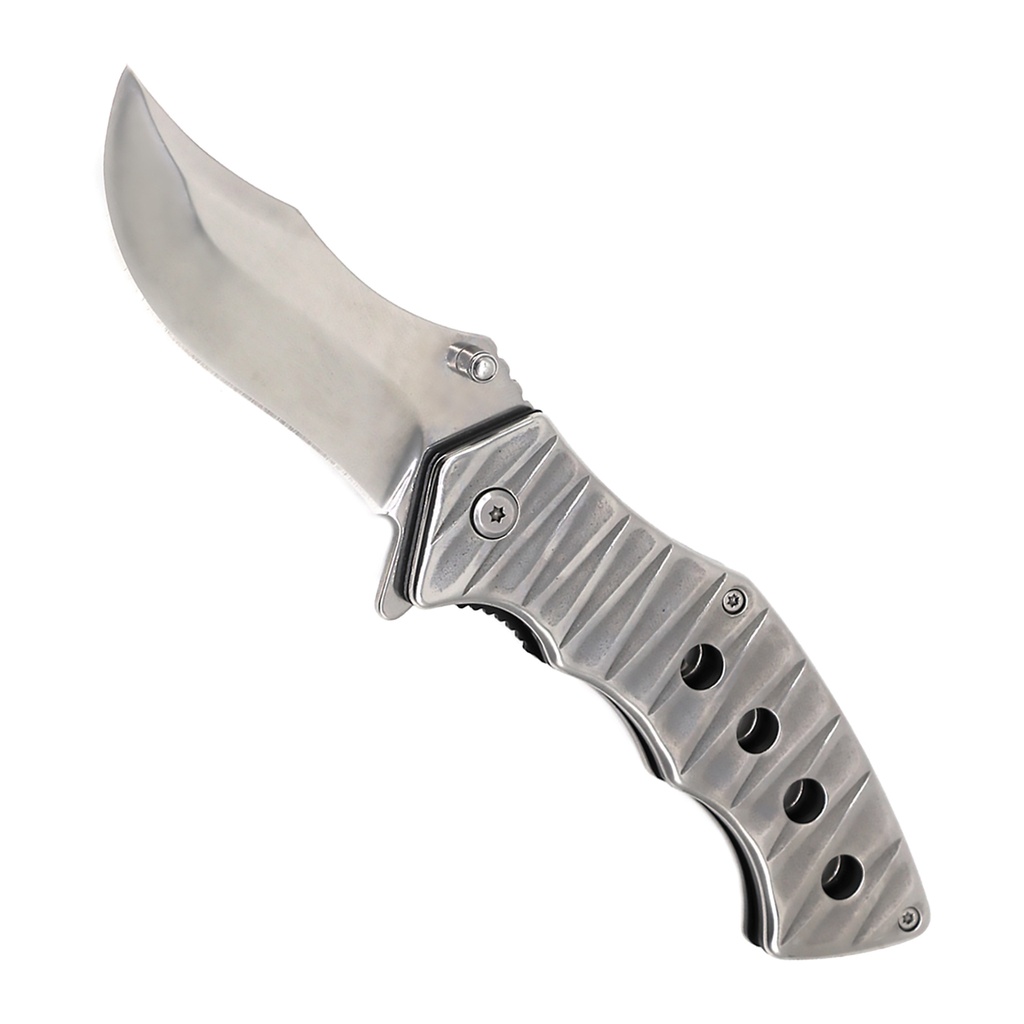
The design brief here reads like something you’d see at a custom table: stainless on stainless, mirror-bright chrome finish, and a deployment system that respects the mechanics. You get dual opening options — a flipper tab and a thumb stud — feeding a spring-assisted mechanism that finishes the stroke with a clean, confident snap. Closed, it sits at 4.75 inches, compact enough for front-pocket carry. Open, you’re at 8.25 inches overall with a 3.5-inch clip-point blade that’s long enough for real work without feeling unwieldy.
Everything is monochrome: blade, handle, hardware. That continuous chrome surface isn’t just a style move; it makes wear patterns honest. Scratches tell the story of use instead of competing with anodizing or coatings. For collectors, that means you can run this as a daily EDC and still enjoy how it ages in the tray next to higher-end pieces.
The Mechanics: How the Spring-Assisted Action Actually Works
In the assisted opening world, the difference between adequate and satisfying comes down to three things: detent, spring tuning, and lock engagement. This knife leans into all three.
Action, Detent, and Deployment Control
The blade starts closed with enough detent tension to keep it from ghost-opening in the pocket, but not so much that you have to fight it. Nudge the flipper tab or thumb stud past that break point and the internal spring takes over, driving the blade into lock-up with a single, smooth surge. There’s no double-clutching, no half-hearted glide — it’s a decisive assisted action that feels repeatable every time you cycle it.
The flipper tab is shaped so that, once open, it doubles as a finger guard. That may seem minor, but on a spring-assisted EDC, that extra indexing point can be the difference between a confident push cut and a grip that feels like it might ride forward under load.
Stainless Steel Blade and Edge Reality
The 3.5-inch stainless steel clip-point blade is ground for general-purpose EDC. You’re not getting exotic powder metallurgy here, but you are getting predictable sharpening behavior and enough corrosion resistance that you don’t have to baby it. For a daily-carry spring-assisted knife, that matters more than spec-sheet bragging rights. It will take an edge quickly, shrug off sweat and pocket humidity, and come back on a basic stone without a fight.
Liner Lock and Spine Jimping
Lock-up is handled by a steel liner lock, visible along the inside of the handle. When the blade snaps open, the liner moves positively under the tang. That full metal-on-metal interface offers a tactile confirmation you can feel every time you open it. Jimping along the spine near the handle gives your thumb a stable reference point, helping you control push cuts, package opening, or quick utility work without slippery guesswork.
Handle Geometry, Chrome Finish, and Real-World Carry
The handle is contoured stainless steel with a mirror-chrome finish. Diagonal grooves on the presentation side give your fingers something to index, while three circular cutouts pull a bit of weight out of the frame and break up the visual mass. It reads industrial and modern, not decorative.
In hand, the 8.25-inch open length gives you a full, four-finger grip without needing exaggerated curves or aggressive texturing. That’s worth calling out: a lot of budget EDC knives try to solve everything with rubbery inlays or overly sculpted scales. This one relies on shape, grooves, and jimping to keep things secure.
A pocket clip mounted on the reverse side keeps it ready for right-hand tip-down or tip-up carry (depending on configuration), and the smooth chrome handle makes for a fast, clean draw. In pocket, it reads as a slim, steel folder — more urban EDC than overt tactical showpiece.
Not an Automatic Knife, Not an OTF, Not a Switchblade — By Design
This is where terminology matters. If you’re shopping automatic knives for sale, you already know the difference between a true automatic knife, an OTF, and a spring-assisted folder like this. This piece is assisted opening: you initiate the movement manually via flipper or thumb stud, and the spring completes the opening after that deliberate action.
An automatic knife (often called a switchblade in legal codes) opens the blade fully with a single press of a button, lever, or similar device on the handle, without needing that initial blade movement. An OTF knife (out-the-front) is a subtype of automatic where the blade travels in line with the handle, in and out of the front. This knife is neither of those — it is a side-opening, spring-assisted folding knife.
Why does that matter? Because in many jurisdictions, spring-assisted knives are treated differently from automatic knives and OTF switchblades under the law. That can make this kind of assisted EDC a smarter, more practical choice for daily carry where full automatics are heavily restricted or banned.
Legal Context: Where an Assisted Knife Fits In
Legally, this knife is typically classified as an assisted opening folding knife, not an automatic knife or switchblade. Under U.S. federal law (specifically the Federal Switchblade Act), the strictest rules usually apply to knives that open automatically with a button or device in the handle, or OTF mechanisms. Spring-assisted folders that require the user to start opening the blade are generally outside that definition.
That said, state and local laws can vary widely. Some places lump assisted opening knives into the same category as automatic knives; others specifically allow them while restricting true switchblades and OTF automatics. If your primary concern is an automatic knife legal to carry, this assisted option is often easier to justify, but you should always confirm your local statutes before clipping it into your pocket.
What Buyers Ask Before Purchasing an Automatic Knife
Are automatic knives legal?
In the U.S., federal law (the Federal Switchblade Act) restricts the interstate sale and shipment of true automatic knives and switchblades, especially OTF and button-activated designs, but it doesn’t outright ban simple possession at the federal level. The real complexity is at the state and local level. Some states allow automatic knives with few limitations; others restrict blade length, carry method, or ownership entirely. Spring-assisted knives like this one are often treated more leniently, because they require manual initiation, but that isn’t universal. The responsible approach is straightforward: before you buy automatic knives or switchblades, check your state and municipal codes for definitions and exemptions specific to automatics, OTF knives, and assisted openers.
What’s the difference between an automatic knife, OTF, and a switchblade?
Mechanically, an automatic knife uses an internal spring to fully open the blade with a single activation of a button, lever, or similar control on the handle. A switchblade is the term most legal codes use for that same family of automatics. An OTF knife (out-the-front) is a specific style of automatic where the blade fires straight out of the end of the handle and often retracts the same way, usually via a slider. A spring-assisted knife like this one is different: you start the blade moving with a flipper or thumb stud, and only then does the spring take over to complete the deployment. That mechanical distinction is what separates assisted folders from true automatic knives in most enthusiast discussions and many laws.
What makes this spring-assisted knife worth buying?
It earns its spot on the table with honest mechanics and a clear design language. The assisted action is snappy without being twitchy, the liner lock engages with predictable, repeatable lock-up, and the all-stainless construction handles daily carry abuse without drama. The monochrome chrome finish looks like something from a modern industrial design catalog, and the balance of a 3.5-inch blade in an 8.25-inch profile hits a sweet spot many EDC users prefer. For collectors, it’s a clean, affordable assisted opener that showcases why deployment tuning and handle geometry matter, making it a solid contrast piece next to higher-end automatics and OTF switchblades.
For the Enthusiast Who Chooses Mechanism First
If you’re the kind of buyer who inspects detent strength, feels for lock rock, and pays attention to how a spring-assisted blade tracks through its arc, this knife is speaking your language. The Monochrome Velocity Spring-Assisted EDC Knife - Chrome offers a clear, honest look at what assisted opening can do when it’s tuned for real-world EDC. Whether you’re deep into automatic knives for sale, OTF collectibles, or simply want a reliable assisted folder that respects the mechanics, this piece fits seamlessly into a rotation built on function, not flash.
| Blade Length (inches) | 3.5 |
| Overall Length (inches) | 8.25 |
| Closed Length (inches) | 4.75 |
| Blade Color | Silver |
| Blade Finish | Chrome |
| Blade Style | Clip Point |
| Blade Edge | Plain |
| Blade Material | Stainless Steel |
| Handle Finish | Chrome |
| Handle Material | Stainless Steel |
| Theme | None |
| Safety | Liner Lock |
| Pocket Clip | Yes |
| Deployment Method | Spring-assisted |
| Lock Type | Liner lock |