Outlast Ridgeback Survival Knife System - Matte Steel
3 sold in last 24 hours
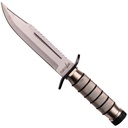
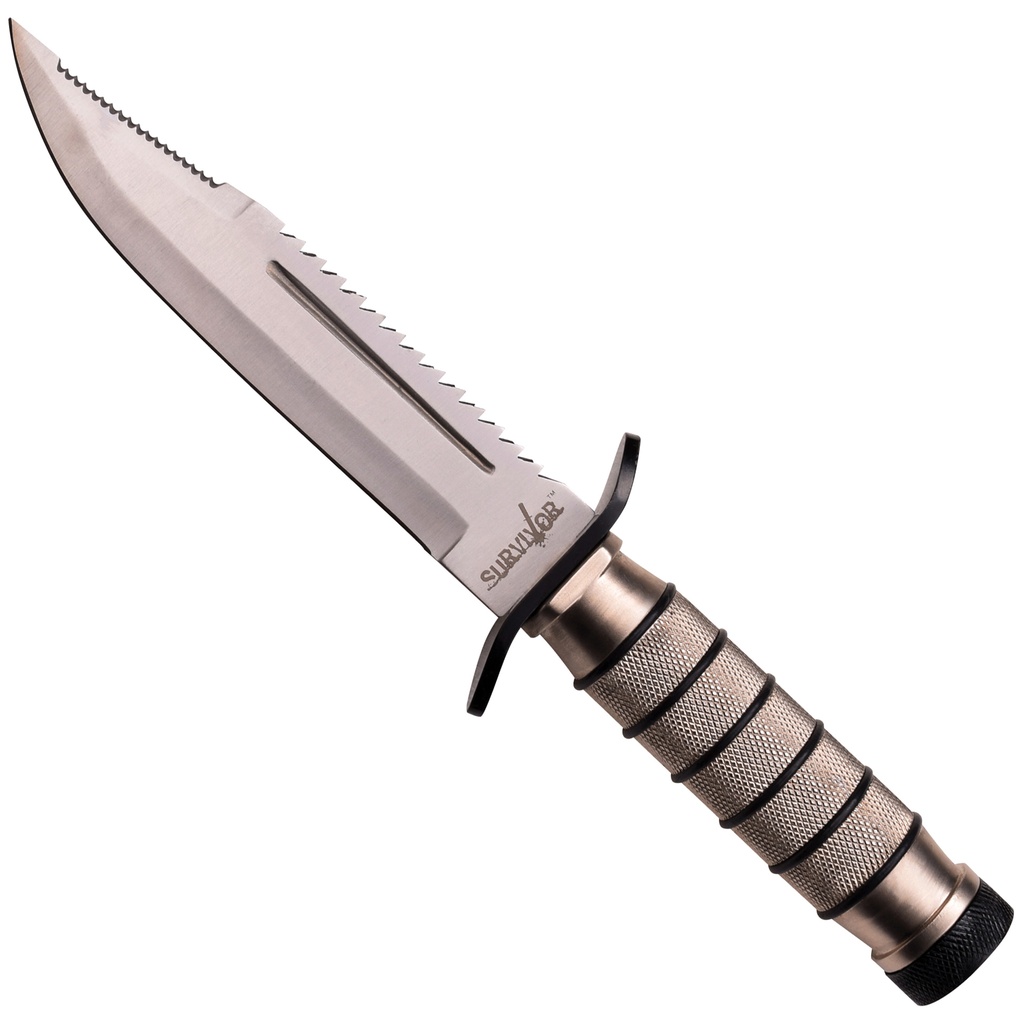
This is not a wall-hanger. The Outlast Ridgeback Survival Knife System - Matte Steel is a full‑tang fixed blade built for field reality, not brochure camping. A 5-inch clip point with partial serrations and sawback spine handles wood, cord, and emergency cutting without drama. The knurled metal handle stays honest in wet, cold hands, while the sheath carries matches, thread, fishing line, hook, and a compass. If your plans change with the weather, this is the knife you want already on your belt.
Automatic Knives For Sale vs. Serious Fixed Blades: Why This Survival Knife Still Belongs in the Conversation
If you're hunting for an automatic knife for sale, you already care about one thing above all: deployment on demand. Press, fire, cut. But anyone who’s done real time in the backcountry, on the job, or off the grid knows there’s another question that matters just as much: What happens after the blade is out? That’s where a purpose-built survival fixed blade like the Outlast Ridgeback Survival Knife System - Matte Steel earns its place alongside your favorite OTF or switchblade.
This isn’t a toy. It’s a full-tang survival knife with a 5-inch clip point, partial serrations, and a sawback spine, bundled with a compact field kit in the sheath. The automatic crowd talks about action. Here, the "action" is everything that happens once steel meets reality: wood, cord, fabric, and the kind of "this just got serious" moments where a folding or automatic knife isn’t your first choice.
Why Fixed Survival Steel Still Matters When You Buy Automatic Knife Gear
Automatic knives for sale dominate the EDC conversation, and they should — fast deployment is addicting and brutally efficient. But when you buy automatic knife gear for a complete setup, you’re building a system, not a shrine. A serious kit pairs a good auto or OTF with a fixed survival knife that can take the abuse your button-fired blade shouldn’t.
The Outlast Ridgeback is that abuse-taker. At 9.5 inches overall and 10.56 ounces, it has the mass and leverage your double-action automatic just doesn’t. Full-tang construction means the steel runs from tip to pommel, giving you predictable strength for batoning small wood, notching, prying light material, or driving the point when finesse stops working.
Mechanics That Matter: Steel, Serrations, and Survival Geometry
Collectors obsess over action quality on an automatic knife — lockup, blade play, spring tension. On a survival fixed blade, the conversation shifts to geometry and grip. That’s where the Outlast Ridgeback earns its keep.
Clip Point Plus Sawback: Purpose-Built Edges
The 5-inch clip point profile gives you a strong tip with enough finesse for detail work: feather sticks, notches, precise punctures. The partial serrated edge near the handle chews through rope, webbing, and fibrous material that a plain edge will skate on when dulled. Up top, the sawback spine isn’t a gimmick — it’s there for scoring, light notching, and emergency material removal when you don’t want to burn out your primary edge.
Full-Tang Confidence and Knurled Metal Control
Automatic, OTF, and switchblade mechanisms all introduce one variable: moving parts. A survival fixed blade like this strips that away. Full-tang steel and a knurled metal handle give you direct, honest feedback from blade to bone. The segmented grip rings bite into your hand with or without gloves, and the matte metal laughs at sweat, rain, or snow. The flat pommel cap gives you a stable surface for light hammering or controlled pressure without introducing hot spots.
Beyond the Blade: A Survival Knife That Carries Its Own Field Kit
Most automatic knives for sale sell you on the blade alone. This system sells you on what happens when you’re stuck with only what’s on you. The nylon sheath doesn’t just hold the knife — it carries a compact survival kit: matches, needle and thread, fishing hook and line, and a compass.
Why That Kit Actually Matters
Serious buyers know: weight in your pack has to justify itself. This kit does. Matches mean controlled fire without a ferro rod learning curve. Needle and thread repair torn gear before it becomes a failure. Fishing hook and line give you passive food options in water country. A simple compass is insurance against dead batteries and wet electronics. None of this is sexy in an Instagram sense; all of it is the difference between a story and a SAR report.
Legal Reality Check: Automatic Knife Legal to Carry vs. Fixed-Blade Survival
When you’re shopping automatic knives for sale, the legal rabbit hole is half the battle. Federal law in the U.S. restricts interstate commerce and shipping of certain automatic and switchblade designs, and state and local laws pile on with blade length limits, opening mechanism bans, and carry restrictions. OTF automatics and traditional switchblades often get the strictest treatment.
A fixed-blade survival knife like the Outlast Ridgeback usually lives under a different set of rules. Many jurisdictions that choke down on automatic knife carry are more forgiving with fixed blades, especially when they’re clearly intended for camping, hunting, or survival use and riding on a belt in the open. That said, some cities and states impose length limits or outright bans on certain fixed blades as well. Translation: this knife often threads the legal needle more easily than an auto, but you still need to check your local and state laws before you strap it on.
What Buyers Ask Before Purchasing an Automatic Knife
Are automatic knives legal?
In the U.S., automatic knives and switchblades are regulated primarily at two levels. Federally, the Switchblade Knife Act restricts interstate commerce and shipping of many automatic and OTF designs, with some exemptions for military, law enforcement, and certain one-armed users. That law doesn’t directly tell you what you can carry day to day — that’s where state and local law takes over. Some states are wide open on automatic knife carry, others allow possession but restrict concealed carry or blade length, and a few still ban switchblades and certain OTF automatics outright.
The Outlast Ridgeback itself is not an automatic knife — it’s a fixed-blade survival knife with no spring or button mechanism. In most regions it will be treated differently (and often more leniently) than an auto or switchblade, but you must verify your own jurisdiction’s rules on fixed blades, hunting/survival knives, and belt carry before relying on it as your primary tool.
What's the difference between an automatic knife, OTF, and a switchblade?
Mechanically, terminology matters:
- Automatic knife: A knife that opens by pressing a button, switch, or similar control. The spring does the work once you activate it. This includes side-opening autos and many OTF designs.
- OTF (out-the-front): A subtype of automatic knife where the blade deploys straight out of the front of the handle. Double-action OTFs both open and retract via the same sliding control; single-action OTFs typically auto-open and require manual retraction.
- Switchblade: In common U.S. legal language, "switchblade" usually overlaps with "automatic knife" — a blade that opens automatically by a button, switch, or similar device. It can be side-opening or OTF depending on the law’s wording.
The Outlast Ridgeback isn’t any of these. It’s a fixed-blade survival knife: the blade is permanently fixed in the open position, with no spring and no button. You draw it from the sheath and it’s working at full strength instantly — no deployment, no lock to fail, just steel and leverage.
What makes this survival knife worth buying?
For an enthusiast who already owns an automatic knife or two, this survival fixed blade fills the one gap your button-fired collection can’t: hard-use, non-negotiable reliability when conditions turn against you. You’re getting a 5-inch full-tang clip point with partial serrations and a sawback spine, built on a knurled metal handle that stays honest in wet or gloved hands. At 9.5 inches overall and 10.56 ounces, it has enough mass to actually process wood and enough control for camp chores.
The integrated field kit — matches, needle and thread, fishing line and hook, compass — earns its weight in any pack. It’s the knife you reach for when your automatic stays clipped in your pocket, because this is the blade you’re willing to beat on without wincing. In a collection, it’s the piece that says you don’t just admire mechanisms — you prepare for reality.
Build a Serious Kit: Pair Your Automatic Knife For Sale With a Fixed Survival Workhorse
Collectors and serious users don’t choose between an automatic knife for sale and a fixed-blade survival knife — they build systems where each tool covers the other’s weak spots. Your favorite OTF or switchblade gives you instant deployment; the Outlast Ridgeback Survival Knife System - Matte Steel gives you the hard-use backbone, the field kit, and the confidence that nothing in it depends on a spring, a button, or a good day.
If you see knives as more than accessories — as tools that might someday be the only technology you have left that still works — this survival knife earns its place next to your best automatic. Not because it’s flashy, but because when things go wrong, simple steel and honest design are what you reach for first.
| Blade Length (inches) | 5 |
| Overall Length (inches) | 9.5 |
| Weight (oz.) | 10.56 |
| Blade Color | Silver |
| Blade Finish | Matte |
| Blade Style | Clip Point |
| Blade Edge | Partial-Serrated |
| Blade Material | Steel |
| Handle Finish | Matte |
| Handle Material | Metal |
| Theme | Survival |
| Handle Length (inches) | 4.5 |
| Tang Type | Full Tang |
| Pommel/Butt Cap | Flat |
| Carry Method | Belt Carry |
| Sheath/Holster | Nylon Sheath |