

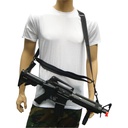
Patrol-Grade Stability Three Point Rifle Sling - Coyote
5 sold in last 24 hours
There’s a moment when you need both hands and still can’t afford to lose control of your rifle. This patrol‑grade, three point rifle sling locks the gun to your body, not just your shoulder. Adjustable for fixed or collapsible stocks, it lets you drop the rifle, manage tasks, and snap back on target without fishing for your sling. The coyote color disappears into dust, brush, and urban shadows, turning secure retention and fast transitions into muscle memory.
Patrol-Grade Stability Three Point Rifle Sling - Coyote
Serious rifle work isn’t about looking tactical in photos. It’s about control when you’re tired, moving, and already solving three other problems with your hands. That’s where a three point rifle sling earns its place. This patrol-grade stability sling in coyote is built for exactly that moment: when you have to let go of the rifle, but you can’t afford to lose it.
Why a Three Point Rifle Sling Beats the Cheap Straps
A basic carry strap holds weight on your shoulder. A three point rifle sling manages the rifle in relation to your body. That extra connection point is the difference between a muzzle that swings and bangs into everything, and a carbine that stays pinned where you want it while you move, kneel, climb, or work.
This sling routes around your torso and anchors the rifle in a controlled, repeatable position. You can drop the gun to go hands-on, then bring it back up without swimming through loose webbing. The geometry matters: the third point keeps the rifle oriented, not just hanging.
Adjustable for Fixed or Collapsible Stocks
Most slings pretend every rifle is the same. This one doesn’t. The adjustment range and hardware layout are tuned so you can run it on fixed stocks or modern collapsible setups without ending up with a webbing mess. Dial in length once, then refine on-body tension to match plate carriers, soft armor, or just a T-shirt.
Controlled Drop, Instant Retrieval
With a properly set three point sling, you don’t just "let go" of the rifle; you guide it down and it stays where it should. This design keeps the muzzle from whipping into your knees or slamming into the deck. Release, transition to secondary or hands-on tasks, then drive the stock right back to your shoulder from a predictable, repeatable hang position.
Coyote Colorway: Built to Disappear in the Real World
The coyote finish isn’t a fashion choice; it’s a working color. In bright dust, dead grass, brush, or concrete shadows, loud black webbing prints harder than people admit. Coyote breaks up the outline and rides quieter visually across most field and urban backgrounds.
On patrol, at the range, or moving between vehicles and structures, this colorway reflects what actual users have learned over time: earth tones blend more consistently than jet black. This sling is meant to disappear into your kit, not scream for attention.
Mechanics of a Reliable Three Point Rifle Sling
With slings, the "mechanism" is webbing, hardware, and how they interact under load. If any of that fails, you’re not inconvenienced, you’re suddenly holding a bare rifle with webbing flailing around it.
Webbing Tension and Adjustability Done Right
The core of this sling is its tension system. The adjustment isn’t a gimmick pull-tab that only works on Instagram. It’s laid out so you can set a base length for your rifle and body type, then fine-tune on the fly. Shorten it to lock the rifle higher across your chest for tight spaces or vehicle work; loosen it slightly when you need more reach for unconventional shooting positions.
Three Point Layout for Stability, Not Complexity
Bad three point designs turn into a harness you fight against. A good one, like this, gives you a clear front connection near the forend, a rear connection at or near the stock, and a body loop that doesn’t twist itself into knots. Once adjusted, the sling keeps the rifle indexed in front of you or slightly to the side, stable enough that you’re not constantly catching the muzzle on gear, doors, or your own legs.
Carry Reality: How This Sling Works in Motion
On a square range, almost any sling looks fine. Start moving, and the difference shows. This three point rifle sling is designed for real movement—turning, bending, kneeling, climbing, working hands-on with doors or detainees—without the rifle becoming a liability.
In a high, chest-centered ride, it keeps the gun tight enough that you can run or climb ladders without the muzzle swinging wide. Drop it lower and loosen slightly, and it rides more like a traditional carry sling but with more control when you let go. That’s the three point advantage: you choose the working position and the sling holds it there.
What Buyers Ask Before Purchasing an Automatic Knife
This product is a patrol-grade three point rifle sling, not an automatic knife. But if you’re here because you’re building out a full-duty setup—rifle plus sidearm plus blade—you’re probably thinking about the blade, too. These are the questions automatic knife buyers bring up alongside sling and rifle choices.
Are automatic knives legal?
In the United States, automatic knives (often called autos, and sometimes loosely referred to as switchblades) are regulated at both the federal and state levels. Federal law mainly restricts interstate commerce—shipping automatic knives across state lines for retail sale comes with rules and exceptions, especially for military, law enforcement, and certain occupational uses.
State law is where your real carry reality lives. Some states allow automatic knives for general ownership and everyday carry, some allow possession but limit blade length or carry method, and others heavily restrict or ban them outright. City and county ordinances can add another layer. Before you buy or carry an automatic knife to pair with your rifle setup, you need to confirm the laws in your state and locality—there is no one-size-fits-all answer, and "but they sold it to me" is not a legal defense.
What’s the difference between an automatic knife, OTF, and a switchblade?
Mechanically, an automatic knife is any knife whose blade deploys using a built-in spring or stored energy, activated by a button, lever, or similar control—once you hit that control, the knife finishes the opening for you. A side-opening automatic swings the blade out of the handle on a pivot, like a folder that opens itself.
An OTF (out-the-front) automatic is a specific subtype where the blade travels linearly out the front of the handle. Double-action OTF autos use the same control to deploy and retract the blade, while single-action OTFs automatically deploy but must be manually reset.
"Switchblade" is a legacy legal and cultural term that, in many statutes, covers automatic knives in general—including both side-opening autos and OTFs. Enthusiasts tend to use "automatic" or "OTF" for mechanical clarity, and reserve "switchblade" for talking about laws or older styles.
What makes this automatic knife worth buying?
Applied to the blade you pair with this sling and rifle, the answer is the same as with slings: mechanism and control. A worthwhile automatic knife will have a consistent, authoritative deployment with minimal play, lock up solid under real grip pressure, and use steel that matches your actual use—edge retention, toughness, and corrosion resistance in balance, not just a fancy steel name.
Buy the automatic knife whose mechanics you trust one-handed, under stress, in gloves or cold. Just like you choose a three point rifle sling that controls the rifle instead of just hanging it from your shoulder, you choose an auto whose action and lock you don’t have to second-guess.
Why This Sling Belongs on a Serious Rifle Setup
If you build rifles for more than bench shooting, you already know: support gear separates a functional weapon from a complete system. This three point rifle sling exists for that system-level thinking. It stabilizes the gun when you need both hands, manages muzzle direction through movement, and lets you transition cleanly without fighting your own equipment.
Whether you’re pairing it with a duty pistol and an automatic knife for a fully sorted patrol rig, or just tightening up your range carbine so it runs like the ones you see in serious classes, this sling earns its place. It’s not decoration. It’s control, on demand, in a coyote colorway that works where you actually train and work.