
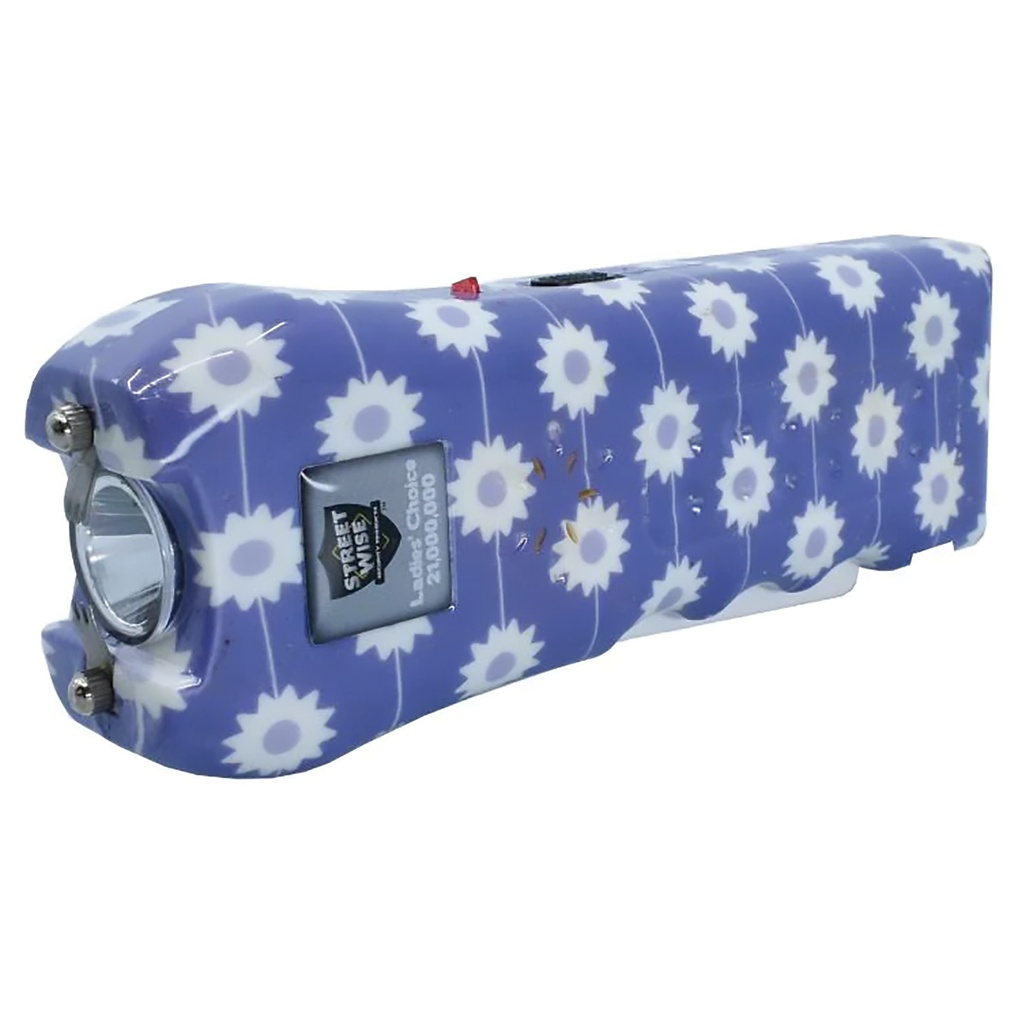


Petal Shield Triple-Defense Stun Gun - Daisy Purple
9 sold in last 24 hours
Night walks feel different when protection fits your hand as naturally as this floral stun gun. The Garden Guardian Triple-Defense Stun Gun layers a bright LED flashlight, piercing alarm, and high-voltage stun into a compact, daisy-patterned body that disappears into a purse. Finger grooves lock your grip, while the disable pin keeps control with you if someone tries to grab it. Rechargeable with a slide-out plug and holster-ready, it’s friendly on the outside, all business when it matters.
Garden Guardian Triple-Defense Stun Gun - Daisy Purple
Not every self-defense tool needs to look like tactical hardware. The Garden Guardian Triple-Defense Stun Gun in Daisy Purple is built for people who want real stopping power, a clear plan, and gear that doesn’t scream “weapon” every time they open a purse or bag. Floral on the outside, fully capable on the inside, this is a compact defensive tool designed around how you actually move through the world.
Triple-Defense Stun Gun for Sale: Stun, Alarm, and Light Working Together
This isn’t just a stun gun painted a different color. The Garden Guardian earns its “triple-defense” name the right way:
- High-voltage stun function at the front with twin contact probes for a visible, audible deterrent and immediate close-range defense.
- Loud built-in alarm that draws attention fast and can stop a situation from escalating before it becomes hands-on.
- Integrated LED flashlight that covers the real-world problem: seeing who and what is in front of you in the dark.
Those three layers work the way good gear should: first as a warning (light and alarm), then as decisive force (stun) when you have no other choice.
Designed to Be Carried, Not Left at Home
The best self-defense tool is the one you actually carry. The Daisy Purple design leans into that reality. The purple body and white daisy print make it look more like an accessory than equipment, which means it blends easily into daily life—purse, tote, glovebox, or bedside. But the form factor is pure function once it’s in your hand.
- Compact rectangular body sits naturally in the palm—no awkward angles, no fighting for a grip under stress.
- Finger grooves on the underside cue your hand into the right orientation without having to look.
- Holster included for those who prefer a consistent, repeatable carry position inside a bag or on a belt.
Visually friendly, mechanically serious—that’s the point.
Mechanics of Confidence: How This Stun Gun Is Built to Be Used
With defensive tools, control is everything. This design focuses on making sure you stay in control before, during, and after an incident.
Disable Pin: The Underappreciated Safety Mechanism
The silver port on the rear underside houses the disable pin—a critical feature that separates this model from commodity stun guns. You attach the lanyard to your wrist; if someone manages to yank the unit away, the pin pulls free and kills the stun function.
That means if an attacker gets hold of the device, they don’t get to turn it against you. The light and alarm can still be useful, but the shock function is dead without the pin seated. It’s a small piece of hardware with outsized real-world consequences, especially for close-quarters grabs.
Rechargeable Power with a Slide-Out Plug
No searching for cords, no guessing battery levels. The Garden Guardian uses a slide-out AC plug built directly into the body. Slide, plug into a wall outlet, and it’s charging—simple enough that you’ll actually keep it topped off instead of letting it ride on half-dead batteries for months.
Rechargeable power isn’t about convenience alone; it’s about reliability. A defensive tool that fails because you never replaced the batteries isn’t gear—it’s dead weight. Built-in recharging makes regular maintenance realistic.
Visual Discretion, Functional Clarity
On first glance, you see purple and daisies. Look again and you see exactly what you need to see when it matters:
- Front-mounted flashlight lens tells you immediately which end faces forward.
- Twin metal stun probes at the corners mark the contact points—easy to identify even in low light.
- Red LED indicator on top gives you a visual confirmation that you’re live and ready.
- Black slider switch is positioned for thumb control, so you’re not fumbling for mode changes.
The daisy pattern softens the look, but it doesn’t hide the reality: this is a purpose-built self-defense tool.
What Buyers Ask Before Purchasing an Automatic Knife
You came here for a stun gun, but if you’re building a complete personal-defense setup, you’re probably also looking at an automatic knife for sale, maybe an OTF or a side-opening auto for EDC. The same mindset applies: know the mechanism, know the law, and choose gear that fits how you actually live.
Are automatic knives legal?
Under U.S. federal law, automatic knives (often called autos or switchblades) are regulated primarily under the Federal Switchblade Act. Federal law restricts interstate commerce and shipping of automatic knives in certain circumstances, especially across state lines, to federal jurisdictions, and into places like federal buildings and some tribal lands. Exceptions exist for law enforcement, military, and certain occupational uses.
State laws are where the real variation lives. Some states allow automatic knives and switchblades for general carry, some allow possession but restrict concealed carry, others limit blade length, and a few still prohibit autos entirely. City and county ordinances can be stricter than state law.
The correct move: before you buy an automatic knife, or decide to carry one daily, check current statutes in your state and any local ordinances where you live, work, and travel. Laws change—reputable dealers and knife-rights organizations often track updates, but final responsibility always lands with the carrier.
What’s the difference between an automatic knife, OTF, and a switchblade?
Serious buyers use these terms precisely, and they’re not all interchangeable:
- Automatic knife (auto): A knife whose blade deploys from a closed position using stored spring energy when you press a button, switch, or lever. Most common are side-opening autos, where the blade pivots out from the handle like a conventional folder, just under spring power instead of your thumb.
- OTF (out-the-front) knife: A specific type of automatic knife where the blade travels linearly out of the front of the handle. Many OTFs are double-action, meaning the same slider deploys and retracts the blade under spring tension; some are single-action, where spring drives deployment and you manually reset the blade.
- Switchblade: In most legal and collector discussions, this is basically the same category as “automatic knife”—a spring-activated knife that opens with a button or switch. The term shows up in legal codes more often; enthusiasts tend to say “auto” or describe the exact mechanism (side-opening auto, double-action OTF, etc.).
If a blade needs your thumb on a stud or a flipper tab without spring assist, it’s not an automatic. If it snaps open with a button and stored spring energy, it lives in the automatic/switchblade family. OTF is the subset where the blade travels out the front instead of pivoting from the side.
What makes this automatic knife worth buying?
Applied to autos in general, not this stun gun: a serious automatic knife is worth buying when the lockup is solid, the action is repeatably crisp, and the steel matches the way you cut. A good side-opening automatic will have minimal blade play, a reliable safety (if equipped), and a spring tuned so it fires hard without beating itself to death. On OTFs, internal track geometry, tolerances, and debris management separate quality pieces from rattle-prone toys.
For the Garden Guardian stun gun specifically, what makes it worth owning is similar thinking: smart safety engineering (disable pin), real-world usability (slide-out plug, alarm, and light), and a design that you won’t mind carrying every single day.
Building a Real-World Everyday Defense Setup
A lot of buyers pair an automatic knife for EDC with a compact stun gun like this one. The logic is straightforward: the stun gun and alarm are about deterrence and disengagement, while a knife—automatic or otherwise—is a cutting tool first, last-resort defensive option second. Both deserve the same approach: understand the mechanism, respect the tool, and choose gear you’re willing to train with and actually carry.
The Garden Guardian Triple-Defense Stun Gun - Daisy Purple fits into that mindset cleanly. It’s discreet enough that you won’t talk yourself out of bringing it. It’s mechanically thought-out enough that you can trust it when you need it. And it’s built around a simple idea: protection should be within reach, not buried in a drawer at home.
If you’re the kind of buyer who reads knife specs, debates OTF versus side-opening autos, and pays attention to lock geometry, you already know the value of good engineering in stressful moments. This floral stun gun carries that same respect for design into a different corner of your kit—quietly, confidently, and ready when you are.