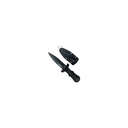
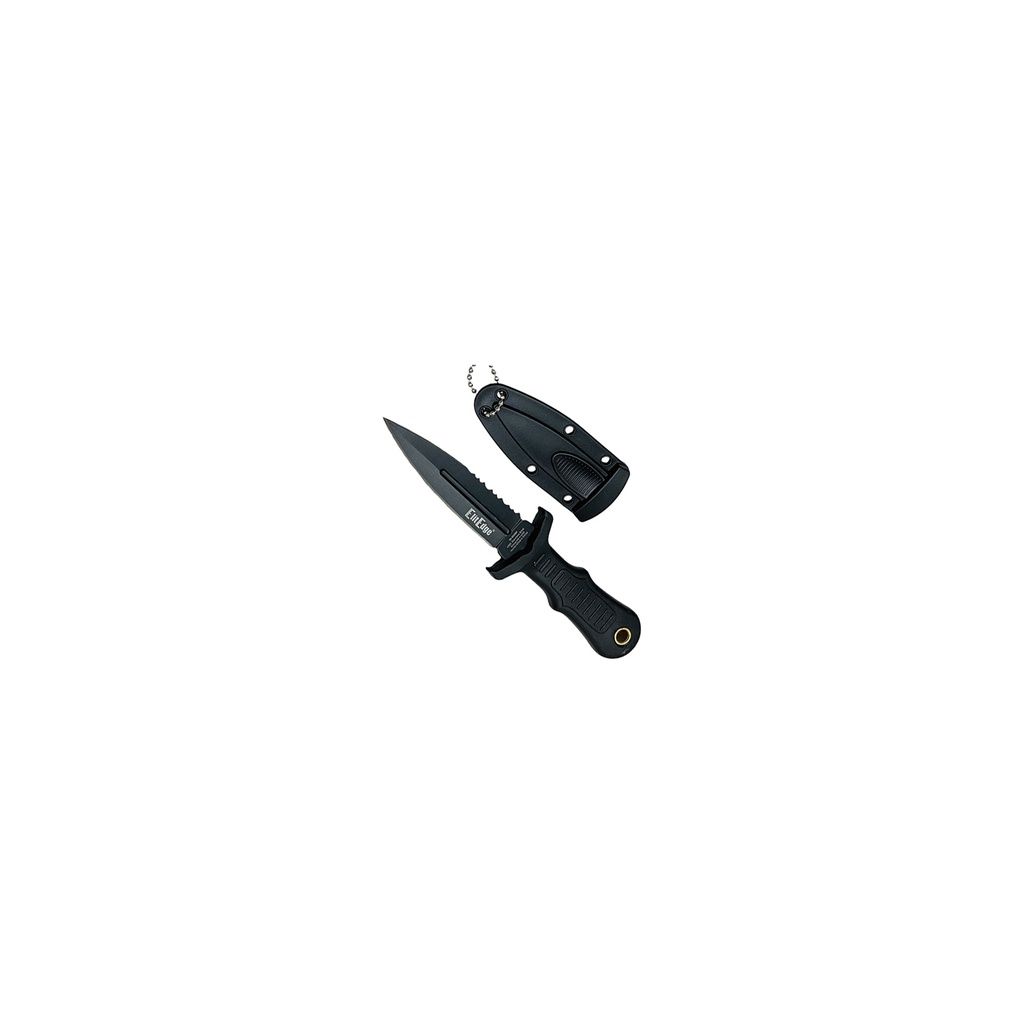
Silent Phantom Stealth Neck Dagger - Matte Black
12 sold in last 24 hours
Phantom’s Whisper is a compact neck dagger built for quick defensive access, not desk-drawer decoration. This 5-inch fixed blade rides in a molded ABS sheath on a ball chain, disappearing under a shirt until it’s time to work. A double-edged, spear-point profile with partial serrations gives you both clean penetration and aggressive material biting. Textured handle grooves and a proper guard lock the knife into your hand when it matters. For EDC carriers who understand purpose-built neck blades, this one ticks the right boxes.
Automatic Knives for Sale vs. Purpose-Built Neck Blades
If you’re hunting for an automatic knife for sale, you’re usually chasing that rapid, one-handed deployment. Phantom’s Whisper plays a different game. This is a fixed-blade neck dagger — no springs, no button, no OTF track to clog. The action is you. The speed comes from how fast you can clear the sheath and put a real edge to work.
For buyers who already own their share of automatic knives and OTFs, a compact neck knife like this fills a different role: last-ditch defensive use, fast access in tight spaces, and carry options where a clipped folder or switchblade simply prints too much.
Automatic Knife for Sale: Why Neck Carry Still Matters
Scroll any page of automatic knives for sale and you’ll see the same pitch: fast deployment, one-hand opening, tactical styling. Neck knives like Phantom’s Whisper solve a problem those autos can’t: true deep concealment with full fixed-blade reliability. No lock to fail, no button to foul, no spring to get lazy.
When you hang a dedicated neck blade on a ball chain, you’re choosing a constant orientation and a consistent draw stroke. In a vehicle, under a jacket, or when seated, that can be faster in the real world than fishing a switchblade or OTF from a pocket.
Mechanics Over Hype: The Dagger Profile and Carry System
This isn’t a showpiece; it’s a purpose-driven neck dagger built around three mechanical truths: edge geometry, retention, and access.
Double-Edged Spear Point with Real-World Bite
The blade is a compact spear-point, double-edged, with partial serrations on one side. That geometry matters:
- Double edge: Cuts on both sides of the thrust, which is what a defensive neck knife is actually for.
- Spear-point symmetry: Centerline tip gives predictable penetration and control in tight, close-in work.
- Partial serrations: The serrated section adds aggressive bite on fibrous material — cord, webbing, light strap — where a plain edge can skate.
The matte black finish kills reflection — not for cosplay, but because you don’t need a mirror signal on a defensive tool that lives under a shirt.
Sheath Retention and Neck Carry Reality
The molded ABS sheath is friction-fit, shaped precisely to the blade profile. That friction retention is the entire difference between a neck knife that’s worth carrying and one that’s a liability. When tuned correctly, it does two things:
- Positive lock: Knife stays put when you’re moving, running, or bending. No rattle, no accidental drop.
- Clean draw: A deliberate pull releases the blade without a wrestling match. That’s your real "deployment mechanism" here.
The silver ball chain is simple and effective. Breakaway by design, it’s meant to fail before your neck does if it ever gets caught or grabbed. It also lets you adjust ride height quickly — over a T-shirt or under heavier layers.
How It Fits Beside Your Automatic and OTF Knives
If you already buy automatic knives for sale regularly, you’re used to thinking in terms of deployment: button, slide, flipper, spring. A neck knife like this complements, rather than replaces, those mechanisms.
- Automatic knife: Fast, one-hand opening folder. Good for EDC, utility, and as a primary cutting tool.
- OTF (out-the-front): Blade rides inside the handle and deploys straight out under spring tension — great for precise, controlled piercing and one-hand use.
- Fixed neck dagger: Always deployed once it’s out of the sheath. No moving parts, no lock failure, no pivot to gunk up.
Where an automatic knife still needs space to clear the handle and lock, this fixed neck blade is simply out or in. That binary simplicity is why experienced carriers pair a neck knife with their favorite switchblade or OTF — each tool has a lane, and this one is clearly defensive and last-resort.
What Buyers Ask Before Purchasing an Automatic Knife
Are automatic knives legal?
Under U.S. federal law, automatic knives (what most people casually call switchblades) are regulated primarily by the Federal Switchblade Act. It focuses on interstate commerce and shipping, not day-to-day pocket carry. The real deciding factor is state and local law. Some states allow automatic knives and OTFs with few restrictions, others limit blade length, and a handful still restrict possession or carry outright.
This particular knife is not an automatic knife. It’s a compact fixed-blade neck dagger with no spring, button, or mechanical deployment. That usually puts it under fixed-blade or "dagger" sections of local codes, not switchblade laws. You still need to check your state and city regulations — many jurisdictions have specific rules for double-edged or concealed blades, including neck carry. When in doubt, verify with your local statutes before making it part of your EDC rotation.
What’s the difference between an automatic knife, OTF, and a switchblade?
Enthusiasts draw cleaner lines than the marketing copy usually does:
- Automatic knife: A folding knife that opens via a spring when you press a button, lever, or hidden release. The blade is fully enclosed in the handle when closed.
- Switchblade: Legally, in U.S. code, that’s basically the same as an automatic knife — a spring-driven blade that opens automatically when activated.
- OTF knife: A type of automatic where the blade slides straight out the front of the handle, rather than swinging out on a side pivot. Can be single-action (deploys automatically, manually reset) or double-action (button or slider for both in and out).
Phantom’s Whisper is none of those. It’s a fixed-blade neck dagger — always locked open, no spring, no mechanical assist. Your "mechanism" here is sheath retention and the repeatable motion of your draw stroke.
What makes this automatic knife worth buying?
Strictly speaking, this isn’t an automatic knife, but the same standards serious automatic buyers use still apply: purpose, mechanics, and carry reality.
- Purpose: This is unapologetically a defensive, last-ditch tool — a compact double-edged spear-point optimized for close-quarters use.
- Mechanics: Friction-fit molded ABS sheath, clean spear-point grind, and partial serrations on one side give it versatility beyond just a needle point.
- Carry: Neck carry with a breakaway ball chain lets you stage the blade where pocket autos can’t live — under a shirt, centered, and consistent.
- Control: Textured synthetic handle with a double guard and lanyard hole gives you secure indexing even under stress.
If your kit already includes a solid double-action automatic knife for everyday cutting, this piece is the backup blade that stays out of the way until the situation gets serious.
Collector Details That Separate It from Commodity Neck Knives
Collectors don’t obsess over neck knives because they’re flashy — they track the ones that get the basics right at a working size. The Phantom’s Whisper checks those boxes with its double guard for hand security, lanyard-ready pommel, and a sheath that’s contoured, not generic. That means cleaner retention, less rattle, and a draw stroke you can actually train.
The partial serration placement — on one edge, near the spine side — also shows some thought. You keep one primary edge clean for controlled thrusts and finer cuts, while the serrated section is there when you need to tear through tougher material. That’s a smarter layout than just chewing up both sides indiscriminately.
For Enthusiasts Who Already Own Their Favorite Automatic Knife
If you’re the buyer who can already tell the difference between a lazy coil spring and a well-tuned double-action OTF, this neck dagger isn’t trying to replace your primary automatic knife for sale — it’s there to complement it. You carry the automatic for day-to-day cutting, utility, and the satisfaction of a crisp deployment. You carry Phantom’s Whisper for the moments when a fixed, double-edged blade on a reliable neck rig is the right answer.
Own it because you understand that not every problem is solved with a button or a slider. Sometimes the best mechanism is no mechanism at all — just good geometry, solid retention, and a blade that’s exactly where you expect it to be when you reach for it.