Prismatic Snap EDC Spring-Assisted Knife - Rainbow Blade/Black Handle
9 sold in last 24 hours
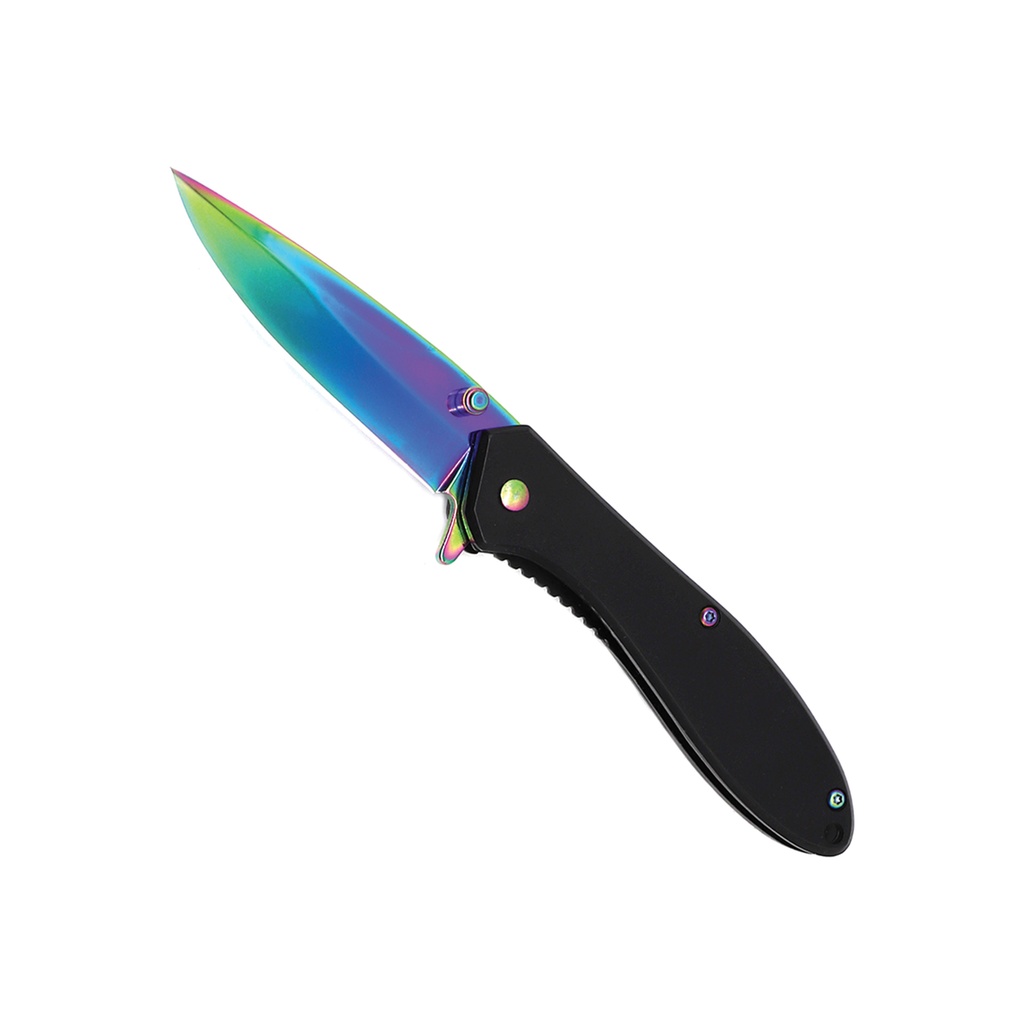
This isn’t a toy rainbow knife; it’s a tuned spring-assisted EDC that just happens to look loud. A 3-inch stainless drop point snaps open via flipper or thumb stud, locking solid on a liner lock. At 4 inches closed with a deep-carry clip, it disappears in pocket until you need it. The iridescent blade and hardware give collector-level visual pop, while the black steel handle keeps it grounded as a real working cutter.
Automatic Knives for Sale Start with One Question: How Does It Actually Deploy?
When you’re browsing automatic knives for sale or any fast-deploy folder, the real story isn’t the color, it’s the action. This Prismatic Snap EDC Spring-Assisted Knife – Rainbow Blade/Black Handle answers that with a tuned spring-assisted mechanism that’s built for repeatable, confident deployment, not desk-drawer novelty.
Mechanically, this is a spring-assisted folding knife, not a true automatic knife or OTF switchblade. You start the motion with the flipper tab or thumb stud; the internal spring takes over and drives the 3-inch stainless drop point into lock-up. That distinction matters to collectors and to anyone thinking about everyday carry legality.
Why This Spring-Assisted Knife Belongs Next to Any Automatic Knife for Sale
Serious buyers don’t just buy color. They buy mechanics that hold up over hundreds of cycles. Here, the geometry is classic EDC: 3-inch plain-edge drop point, 7 inches overall, 4 inches closed. That’s the sweet spot where you get real cutting ability without turning your pocket into a sheath.
The spring-assisted action is tuned for a positive, decisive snap, not a jittery slap. You get two deployment paths:
- Flipper tab: The primary method – a light, consistent press that rolls the blade past detent and lets the spring finish the work.
- Thumb stud: A backup deployment option that still benefits from the assist, useful when your grip or orientation changes.
Lock-up is handled by a liner lock, with exposed, jimped liners providing tactile feedback as you disengage. It’s the same basic mechanical language you’ll see on far more expensive assisted and automatic knife options, just executed in a stripped-down, honest package.
Action, Steel, and Real-World Use: Mechanism First, Finish Second
If you’re used to browsing every automatic knife for sale you can find, you already know: a flashy finish doesn’t fix sloppy tolerances. This piece earns its pocket time on mechanics first, looks second.
Spring-Assisted Action You Can Actually Live With
The assist is tuned on the practical side of snappy. That means:
- Enough spring tension to drive the blade fully into lock without wrist flick theatrics.
- A detent that holds closed in pocket, so casual bumps don’t start the blade moving.
- A flipper tab shape that gives you purchase without turning into a pocket shredder.
That combination is what separates a carryable assisted folder from the throwaway tier that gives budget knives a bad name.
Stainless Steel Blade with Honest EDC Expectations
The blade is stainless steel with an iridescent, rainbow finish. No one’s pretending this is exotic powdered metallurgy — and that’s fine. In this price and category, what matters is predictable behavior:
- Edge holding: Good enough for everyday tasks — boxes, light cord, packaging — with quick touch-ups on a basic stone or pocket sharpener.
- Corrosion resistance: The stainless base steel plus the rainbow finish give it extra insurance against sweat, humidity, and pocket carry.
- Grind and profile: A straightforward drop point with a plain edge, which is what you want for controlled slicing and easy resharpening.
The rainbow coating isn’t just for show; it also adds a light protective barrier, which any user who’s actually carried coated blades in wet environments will appreciate.
Buying an Automatic Knife for Sale vs. This Spring-Assisted EDC
Collectors shopping automatic knives for sale and OTF switchblades know there’s a spectrum: manual, assisted, side-opening automatic, OTF. This Prismatic Snap rides the line where you get near-automatic deployment feel with a more relaxed legal status in many jurisdictions.
The handle is matte black steel, which does two things:
- Balances the blade visually: The handle keeps the overall package from drifting into toy territory — the black grounds the rainbow.
- Adds heft and durability: Steel scales give this small knife a planted feel in hand; you’re not dealing with flimsy flex.
Deep-carry pocket clip placement along the spine means it rides low, with minimal print. For an EDC that looks this loud when open, it stays surprisingly discreet in pocket.
Collector Value: Why This Isn’t Just Another Rainbow Knife
Most rainbow-finish folders are all show and no thought. Here, the details lean toward collector sensibility:
- Matched hardware: The torx fasteners pick up the iridescent tone, tying the blade and handle together in a way you usually only see on mid-tier customs.
- Consistent theme: Rainbow blade, rainbow screws, black handle — not a random mix of colors and textures.
- Usable ergonomics: No extreme finger grooves or gimmick shapes; a straightforward handle profile that lets different hand sizes find a grip.
If you’ve got a tray of automatics, OTFs, and switchblades already, this is the kind of spring-assisted EDC you drop in front of someone when they say, “Okay, but can a budget piece still feel dialed in?” It’s a yes, with color.
Legal Context: Where a Spring-Assisted Knife Fits in the Automatic/Switchblade Conversation
Any time you’re looking to buy an automatic knife, carry questions come next. Under U.S. federal law, “switchblades” and true automatic knives are defined as blades that open automatically by a button, spring, or other device in the handle. Most spring-assisted knives, including this one, require the user to start the opening via a flipper or thumb stud on the blade — the assist only completes the motion.
That’s a key distinction. In many states and cities, assisted-opening knives are treated differently than full automatics or OTF switchblades. But knife law is wildly inconsistent. Before you clip this in and call it your best automatic knife for EDC stand-in, check your specific state and local regulations. Retailers can’t give you individualized legal advice, but you can avoid problems by knowing whether your jurisdiction lumps assisted knives in with automatics or not.
What Buyers Ask Before Purchasing an Automatic Knife
Are automatic knives legal?
In the U.S., federal law (the Switchblade Knife Act) mainly targets interstate commerce and shipping of automatic knives and switchblades, with carve-outs for military, law enforcement, and certain uses. Day-to-day carry is mostly controlled by state and local law, which varies dramatically. Some states allow automatic knives and OTFs with few restrictions; others ban them outright or limit blade length, opening mechanism, or carry method.
This knife is spring-assisted, not a true automatic, which often places it under a different set of rules. Still, treat it like any serious edged tool: verify your local laws on automatic knives, switchblades, and assisted-openers before carrying.
What’s the difference between an automatic knife, OTF, and a switchblade?
Mechanically, here’s the breakdown:
- Automatic knife (side-opening): Blade is held closed under spring tension and opens fully when you press a button or lever in the handle. Classic “push-button” autos.
- OTF (Out-The-Front): The blade travels linearly out of the front of the handle. Single-action OTFs deploy automatically but require manual retraction; double-action OTFs use the same control to fire and retract the blade.
- Switchblade: In U.S. legal language, this is the umbrella term that usually covers automatic knives, including many OTFs, when they open by a button or similar device in the handle.
- Spring-assisted (this knife): You start the blade moving with a flipper or thumb stud on the blade itself; a spring takes over and snaps it open. Not a true automatic by most statutes.
If you’re building a collection, you want examples of all four types on the table so you can feel the mechanical differences firsthand.
What makes this automatic knife worth buying?
Strictly speaking, this is an assisted opener, but it targets the same buyer who’s shopping an automatic knife for sale and cares about action and personality. It’s worth buying because it combines:
- A legitimately snappy spring-assisted action with dual deployment (flipper and thumb stud).
- A practical, 3-inch stainless drop point that’s easy to keep sharp.
- A deep-carry clip and 4-inch closed length that make it a real EDC option, not just a display piece.
- A cohesive rainbow/black aesthetic that reads as intentional, not cheap gimmick.
If you’re an enthusiast who already owns full automatics and OTF switchblades, this is the kind of budget-friendly assisted knife you toss into rotation when you want something that still clicks the mechanical satisfaction box but isn’t precious.
For the Enthusiast Who Knows Why Action Matters in Any Automatic Knife for Sale
Whether you’re deep into automatic knives for sale, comparing OTFs and side-opening autos, or just want an assisted EDC with attitude, this Prismatic Snap earns its place. It’s a spring-assisted knife that respects the same priorities serious buyers bring to automatics: clean deployment, honest steel, coherent design. If you carry it, it’s because you understand that equipment matters — and you chose a knife that gets the mechanics right first, then has some fun with the finish.
| Blade Length (inches) | 3 |
| Overall Length (inches) | 7 |
| Closed Length (inches) | 4 |
| Blade Color | Rainbow |
| Blade Finish | Iridescent |
| Blade Style | Drop Point |
| Blade Edge | Plain |
| Blade Material | Steel |
| Handle Finish | Matte |
| Handle Material | Steel |
| Theme | Rainbow |
| Pocket Clip | Yes |
| Deployment Method | Spring-assisted |
| Lock Type | Liner lock |