Psychedelic Velocity Assisted Flipper Knife - Tie Dye Purple
5 sold in last 24 hours
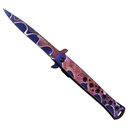
This isn’t your average assisted opener. The Psychedelic Velocity Assisted Flipper Knife - Tie Dye Purple pairs a slim spear-point blade with fast, positive spring-assisted deployment off a flipper tab. The matching tie-dye aluminum handle keeps weight down while the liner lock and deep pocket clip make this a real EDC candidate, not just a novelty. It’s the knife you carry when you care as much about how clean the action feels as how loud the finish looks.
Automatic Knives for Sale vs. True Assisted Action: Where This Knife Fits
If you’re looking for an automatic knife for sale and you actually care how the mechanism works, let’s start with the truth: this is a spring-assisted flipper, not a button-fired automatic. That distinction matters. An automatic knife uses a button or switch to release a fully spring-driven blade. This Psychedelic Velocity runs a torsion-assisted system that needs an initial nudge from your finger on the flipper tab, then snaps the rest of the way on a tuned spring.
Why should you care? Because a serious buyer doesn’t just search “automatic knives for sale” and call it a day. You’re deciding between button-lock automatics, OTF designs, and assisted openers like this one that live right on the edge of that category line in a lot of jurisdictions. Mechanism first, marketing later.
Buy Automatic Knife Performance in a Spring-Assisted Package
Functionally, this knife gives you the same quick deployment most people are really looking for when they go to buy automatic knife models, without the full electronic-gate-opening drama of a switchblade. The 4-inch spear-point blade rides on a pivot tuned to work with the assist spring: light pressure on the flipper, a clean break, then a quick, decisive snap into lockup.
The liner lock engages across the tang with enough bite that you don’t get that vague, mushy feel you find on gas-station specials. Combined with the long, straight handle, you get a surprisingly confident grip for a knife that looks like it should be hanging off a festival lanyard instead of riding in a work jeans pocket.
Flipper Tab and Spring Assist: Why the Action Works
The key to a good assisted-opening knife is timing between detent, pivot tension, and spring strength. Too much detent and the flipper feels like work; too little and the blade rattles or half-opens in pocket. This tie-dye flipper sits in that sweet middle ground: a defined break on the tab, then the assist takes over and finishes the throw with authority. It’s not a double action automatic knife, and it doesn’t pretend to be, but in hand the action scratches the same itch — fast, repeatable deployment with one finger and no wrist flick.
Automatic Knife for Sale Aesthetics: Tie Dye Done with Intent
Automatic knives for sale tend to fall into two visual camps: tactical blackout and over-designed fantasy. This one takes a different lane entirely. The continuous tie-dye finish from blade tip through the aluminum handle scales is the whole point — a psychedelic, festival-ready colorway laid over a straightforward, functional assisted folder.
The circular cutouts in the handle aren’t just decoration. They shave a bit of weight and break up the color, letting the black hardware and pocket clip give your eye a reference line along the handle. The result is a knife that looks loud at a glance but still reads as a real tool once you’re paying attention to the details: spear-point geometry, flipper tab placed for leverage, jimped thumb ramp for forward control.
Collector Angle: Why This Isn’t Just a Novelty Finish
Collectors of automatic and assisted knives end up with a sea of black and stonewash. A dedicated color piece like this becomes a category marker in a collection: “the tie-dye assisted flipper” that people remember. It’s the kind of knife you throw down on the table at a meet or show when everyone else has already seen six Microtech clones and three generic button-lock autos. Mechanically simple, visually unmistakable.
Mechanics, Steel, and Real EDC Use
Under the tie-dye, you’re working with a straightforward stainless steel blade in a 4-inch spear-point profile. The geometry is what matters here: a central tip line for piercing, with enough belly toward the front half of the edge for slicing tasks. No recurve nonsense, no aggressive sawback to complicate sharpening — just a plain edge you can bring back on a stone or ceramic rod in a few minutes.
The 5-inch closed length and aluminum handle keep things pocketable. Aluminum gives you a rigid frame for the liner lock to work against without adding bulk. The black pocket clip is set for tip-down carry, riding the length of the handle, giving you a consistent draw orientation every time. It’s the kind of EDC knife you can actually live with day to day: long enough to be useful, slim enough that it doesn’t print like a brick in your pocket.
Action Feel vs. True Automatic Knives
Compared to a full automatic knife or OTF, the assisted action here gives you more control on deployment. With a button-fired switchblade, once you commit, the mechanism does everything. With an OTF double action automatic knife, the thumb slide manages both fire and retract. On this assisted flipper, the flipper tab and spring work together: you get a moment of tactile feedback on the detent break, then the blade snaps open. It’s a more analog feel — and for a lot of enthusiasts, more satisfying in daily use.
Legal Realities: Automatic Knife Legal to Carry vs. Assisted Opener
When people search for an automatic knife legal to carry, they’re usually bumping up against the messy overlap between federal law, state statutes, and how local cops or judges treat anything that opens quickly. Here’s the legal reality in plain language, not marketing gloss.
Under U.S. federal law, a true automatic knife (what the statute calls a switchblade) is defined as a knife that opens automatically by pressing a button or other device in the handle, or by gravity or inertia alone. This Psychedelic Velocity uses a flipper tab as part of the blade, not a handle button, and requires manual pressure to start the open — that’s the classic assisted-opening design distinction many states recognize.
However, state laws vary dramatically. Some states lump assisted openers in with switchblades; others specifically exempt them. Local ordinances can add another layer. Before you carry this or any fast-deploy knife, check your state and local laws, not just federal rules. Nothing here is legal advice, and you’re responsible for knowing what’s allowed where you live.
What Buyers Ask Before Purchasing an Automatic Knife
Are automatic knives legal?
Federally, automatic knives (switchblades) are restricted mainly in terms of interstate commerce and specific locations like federal buildings, not outright banned for all possession. The bigger issue is state law. Some states fully allow automatic knives for sale and carry, some allow ownership but limit carry, and some ban them outright. Assisted-opening knives like this one are treated differently in many jurisdictions because they require manual initiation on the blade, not a handle button — but not everywhere. Always verify your state and local statutes before buying or carrying, and remember that nothing here substitutes for actual legal counsel.
What's the difference between an automatic knife, OTF, and a switchblade?
"Switchblade" is the older legal term; "automatic knife" is the modern enthusiast term. Both describe a knife that opens automatically when you activate a button, lever, or similar device in the handle. An OTF (out-the-front) is a specific type of automatic where the blade travels straight out the front of the handle, using a track and usually a thumb slide. This Psychedelic Velocity is neither of those: it’s a folding, side-opening, spring-assisted knife. You start the action with a flipper tab on the blade itself, and a spring helps complete the opening — no handle button, no OTF track, and not a traditional switchblade under most definitions.
What makes this automatic-style knife worth buying?
You’re not buying this the way you’d buy a high-end custom auto; you’re buying it because you want fast, one-handed action and a finish that doesn’t disappear into the pile. The assist mechanism delivers a clean, snappy deployment that feels closer to an automatic knife than most budget folders. The 4-inch spear-point blade gives you real cutting length, not toy dimensions. The tie-dye aluminum handle keeps weight down, carries slim, and actually feels good in hand. And as a collector piece, it stands out — everyone remembers “the psychedelic assisted flipper” when they’ve forgotten the fifth black tactical clone on the table.
Carry It Because You Chose It, Not Because It Was There
In a market flooded with generic automatic knives for sale and forgettable assisted openers, this tie-dye flipper earns its pocket time by being honest about what it is: a fast, spring-assisted folding knife with a loud, unapologetic finish and a mechanically satisfying action. You’re not buying a label; you’re buying a specific feel in the hand, a specific snap on deployment, and a look that doesn’t blend into the background of your collection. That’s what serious enthusiasts do: they pick tools with intent.
| Blade Length (inches) | 4 |
| Overall Length (inches) | 9 |
| Closed Length (inches) | 5 |
| Blade Color | Purple |
| Blade Finish | Glossy |
| Blade Style | Spear Point |
| Blade Edge | Plain |
| Blade Material | Steel |
| Handle Finish | Glossy |
| Handle Material | Aluminum |
| Theme | Tie dye |
| Pocket Clip | Yes |
| Deployment Method | Flipper tab |
| Lock Type | Liner lock |