Rapid Grip Dual-Stage Knife Sharpener - Black ABS
14 sold in last 24 hours
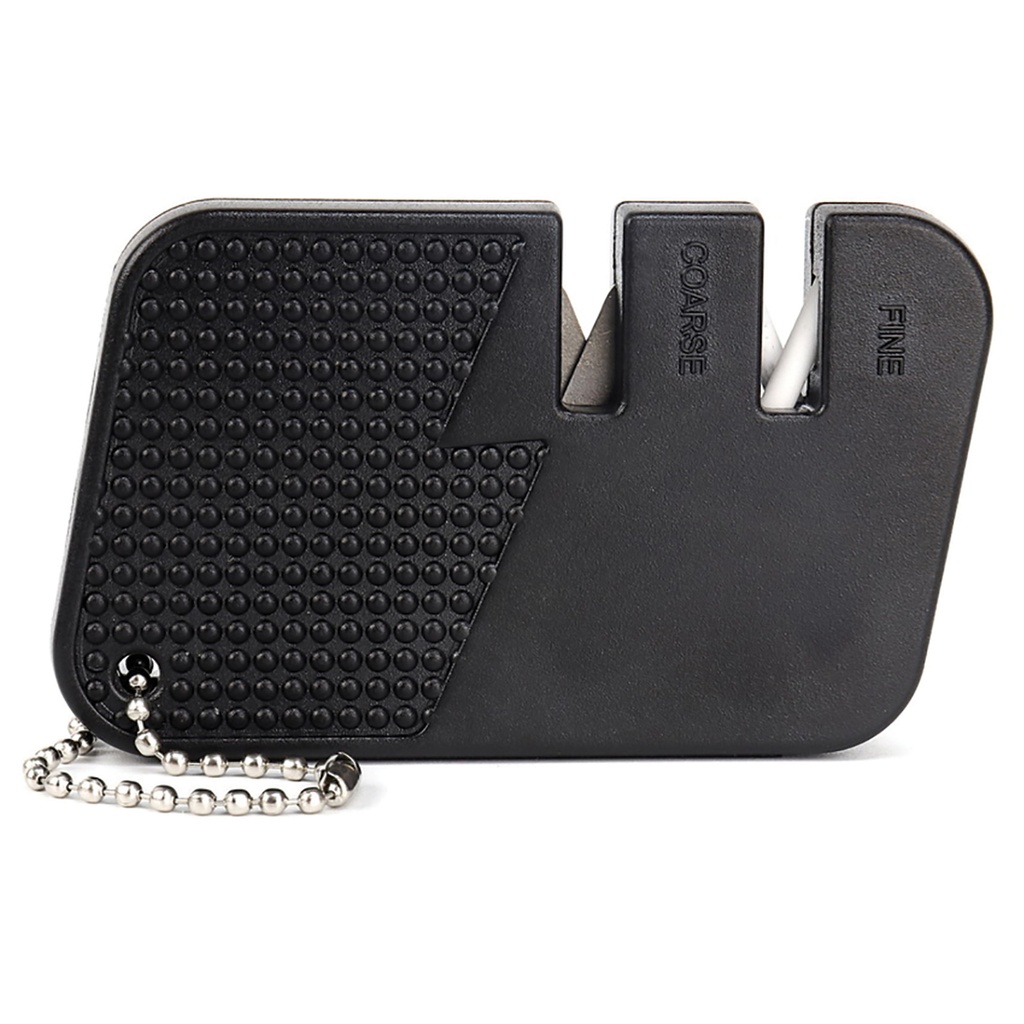
For the buyer who actually puts steel to work, this compact dual-stage knife sharpener earns its space. A tungsten carbide coarse slot resets tired edges fast; ceramic fine rods clean them up for real cutting. The textured black ABS body locks into your hand or on the counter, while the ball chain makes it easy to clip to a range bag or key setup. It’s the sharpener you keep where decisions happen—by the knives, on the line, or at the bench.
Why This Dual-Stage Knife Sharpener Belongs Next to Every Automatic Knife for Sale
If you sell, carry, or collect serious blades, you already know one truth: a dull edge makes even the best automatic knife feel cheap. That’s where this Rapid Grip Dual-Stage Knife Sharpener earns its keep. It’s a compact, black ABS workhorse built for fast decisions—on the line, at the bench, or right next to your automatic knives for sale.
Two clearly labeled slots—COARSE and FINE—take the guesswork out of touch-ups. Tungsten carbide bites just enough to pull a working edge back from the dead; ceramic rods refine it into something you actually want to cut with. It’s not pretending to be a full sharpening system. It’s a purpose-built tool for the real world of quick maintenance on knives that see use, not just display time.
Mechanics That Match the Mindset of Serious Knife Buyers
The same buyer who compares detent strength, lock geometry, and spring timing on an automatic knife will notice the mechanical decisions here. This is not a gimmick pull-through with mystery abrasives. The coarse stage uses tungsten carbide inserts—a hard, aggressive material chosen for rapid material removal on tired edges or softer steels. One or two controlled passes re-establish a bevel you can work with.
The fine stage shifts to white ceramic rods. Ceramic is harder than most blade steels and ideal for deburring and refining. After the carbide has done the heavy lifting, the ceramic slot smooths the edge, aligning and cleaning it up so your automatic, OTF, or manual EDC actually bites into material instead of skating over it.
Textured Grip That Keeps the Angle Honest
The raised-dot texture on the black ABS body isn’t decoration; it’s a stability feature. With compact sharpeners, the real risk is wobble—if the tool moves, your edge angle follows. The broad, textured grip panel locks into your fingers whether you’re on a truck tailgate or a stainless counter. That stability lets you focus on consistent, straight-through passes, which is where predictable edges come from.
Countertop or Field Use: One Form, Two Personas
Flat base means it sits solidly on a counter for retail or kitchen use. The ball chain turns it into a field piece—clip it to a range bag, hunting pack, or key setup. For dealers merchandising automatic knives for sale, that dual identity is gold: it merchandises cleanly by the register, but it also looks at home in an EDC photo next to a double-action OTF and a light.
How This Sharpener Supports Every Automatic Knife You Sell or Carry
If you buy automatic knives, OTFs, or traditional side-opening switchblades, you already speak steel: edge retention, toughness, corrosion resistance. But steel only delivers if you maintain it. This dual-stage sharpener is tuned for fast maintenance, not slow ritual.
For AUS-8, 8Cr, and similar mid-range steels, the tungsten carbide stage quickly resets rolled or flattened edges. For higher-end steels—S35VN, M390, 154CM—you can rely more on the ceramic slot for light touch-ups, using carbide sparingly to avoid over-grinding. Either way, it’s the tool you reach for when your automatic knife stops slicing cleanly through cardboard, strap, or food prep, and you don’t have time to break out stones.
Real-World Edge Behavior
Pull-through sharpeners get a bad reputation when they’re treated like precision systems. Use this one for what it is—a fast field and counter sharpener—and it shines. Light, consistent passes, let the abrasives work, and you get a reliable working edge. For an automatic knife that lives in a pocket, vehicle, or duty belt, that’s exactly the right level of aggression.
Where the Legal Conversation Comes In
Automatic knife laws are a minefield: federal rules about interstate commerce, state-by-state restrictions on possession and carry, and local ordinances that change at city limits. This sharpener sidesteps all of that. It’s a legal, unregulated accessory in virtually every jurisdiction, which makes it an ideal upsell for dealers who have to carefully message their automatic knives for sale.
You can ship this where you can’t always ship a switchblade. You can put it at the front counter, next to OTF displays or manual folders, without inviting the same legal scrutiny. And for the buyer who’s just purchased their first automatic knife that’s legal to carry in their state, offering a compact, no-nonsense sharpener is a subtle way of saying: “You bought a real tool—keep it that way.”
What Buyers Ask Before Purchasing an Automatic Knife
Are automatic knives legal?
In the U.S., automatic knife legality is a federal and state conversation. Federally, the Switchblade Knife Act restricts interstate commerce of automatic knives (what many casually call “switchblades”) with certain exceptions—for military, law enforcement, and some one-armed users. But day-to-day legality is mostly determined by state and local law: some states allow automatic knives for EDC with blade length limits, others restrict carry but allow home ownership, and a few heavily restrict or ban them.
Before you buy an automatic knife, OTF, or traditional switchblade, you check your state and local regulations—possession, open vs. concealed carry, and blade length. This sharpener, by contrast, is generally legal everywhere and is the one piece of kit you can safely add to any order.
What’s the difference between an automatic knife, OTF, and a switchblade?
Mechanically, an automatic knife is any knife where the blade opens via a spring or stored energy when you activate a button, lever, or switch. Most side-opening automatics pivot open from the handle like a standard folder, they just use a spring to do the work.
OTF (out-the-front) knives are a subtype of automatic knives where the blade travels linearly out of the front of the handle. Many OTFs are double-action: you push the switch forward to deploy and pull it back to retract, both powered by internal springs. Single-action OTFs typically auto-deploy but require manual retraction.
“Switchblade” is more of a legal and cultural term than a mechanical distinction. In U.S. law, it generally refers to automatic knives—both side-opening and OTF—that open by pressing a button or similar device. Enthusiasts tend to use “automatic,” “OTF,” and the specific mechanism type; legislators and the public often default to “switchblade.”
What makes this automatic knife sharpener worth buying?
Three details: known abrasive pairing, grip geometry, and real-world placement. The tungsten carbide / ceramic combo is proven—coarse to reset, fine to refine—so you’re not guessing what’s inside. The textured black ABS body gives you a stable hold, which matters more than most people admit when you’re trying not to destroy your bevel in three passes. And its physical form—flat base, compact footprint, ball chain—means it can live where it’s most useful: next to your automatic knives, at the checkout counter, in a gear drawer, or clipped to a bag.
For dealers, it’s a low-friction add-on that actually respects the buyer’s intelligence. For users, it’s the maintenance tool that keeps your automatic, OTF, or manual EDC in the “cuts like it should” category far longer between full sharpenings.
For the Enthusiast Who Knows Gear Matters
If you’re the kind of buyer who can feel the difference between a lazy spring and a properly tuned automatic knife, you already know this: the story doesn’t end when the blade snaps open. Edge maintenance is part of the equation. This Rapid Grip Dual-Stage Knife Sharpener slots cleanly into that story—a compact, serious tool that keeps your automatic knives for sale, carry, or collection cutting like they’re supposed to.
It’s not flashy, and it doesn’t need to be. It’s the right piece of equipment for people who run their knives hard and expect them to perform every time.