
Rebel Signal Assisted Opening Knife - Southern Pride Red
3 sold in last 24 hours
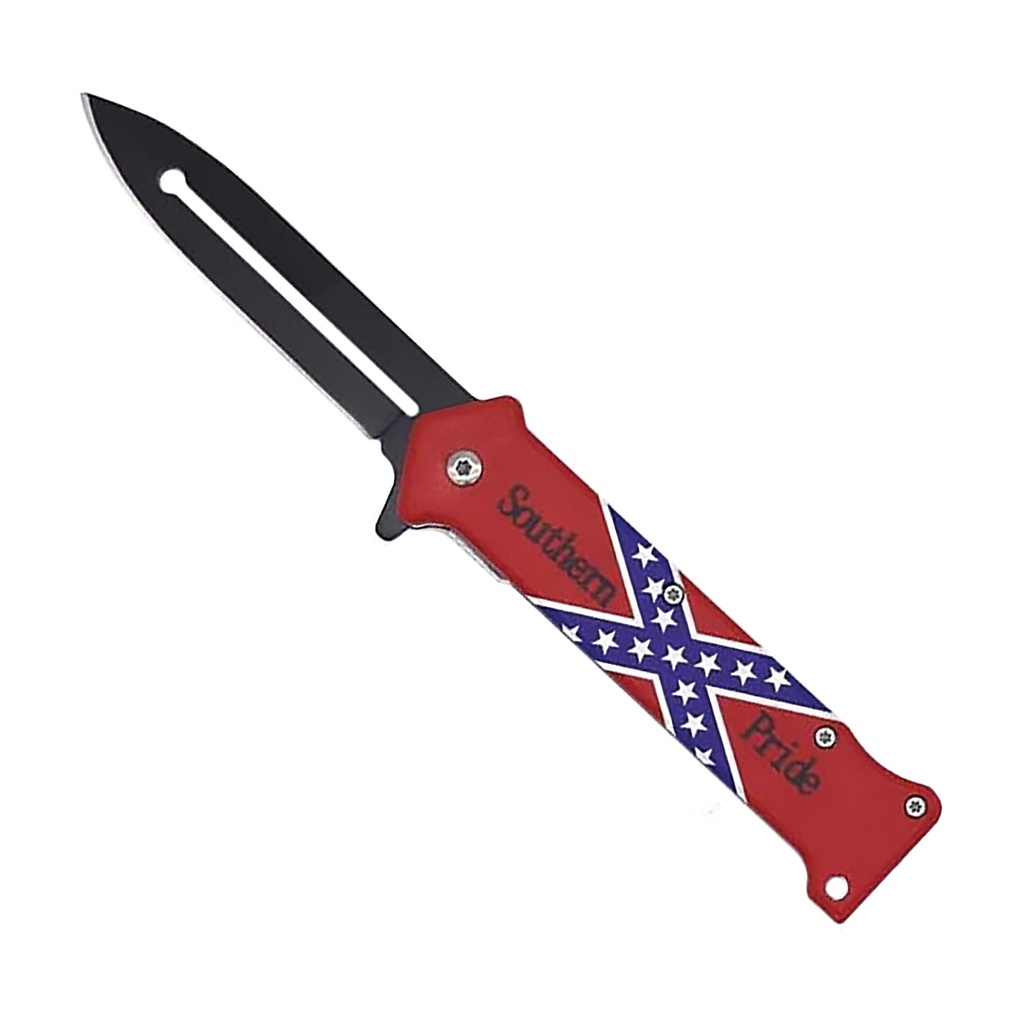
This is an assisted-opening flipper built for the buyer who wants their knife to say exactly where they’re from. The Rebel Signal Assisted Opening Knife snaps to attention with a liner lock and slim, stiletto-inspired profile, giving you fast, one-handed deployment and pocketable carry. The Confederate flag “Southern Pride” aluminum handle isn’t subtle—it’s a statement. If you’re after a budget-friendly assisted folder that opens reliably and wears its regional identity on its sleeve, this one does exactly that.
Rebel Signal Assisted Opening Knife for Sale – Southern Pride Red Statement Piece
The Rebel Signal Assisted Opening Knife - Southern Pride Red is not pretending to be neutral. It’s a slim, stiletto-inspired assisted folder that wears its Confederate flag "Southern Pride" handle like a billboard. Mechanically, it’s a spring-assisted flipper with a liner lock and pocket clip. Visually, it’s built for buyers who want their knife to make a loud regional statement every time they pull it from their pocket.
Why This Assisted Knife Exists in a World of Automatic Knives for Sale
If you’re browsing automatic knives for sale, you already know the spectrum: true automatics, OTFs, and assisted openers. This knife lives in that last category. It’s not a push-button automatic knife, and it’s not a double-action OTF. Instead, you start the opening with the flipper tab, and the internal spring takes over to drive the blade into lockup. For some buyers, that’s exactly the balance they want—fast, one-handed deployment without crossing into full automatic territory.
At 3.5 inches of matte black spear point steel and an overall length just over 8 inches, the Rebel Signal sits in classic pocket knife territory. It’s sized for everyday carry, light utility, and as a backup blade, not as a hard-use field tool. You’re buying this for the statement, the assisted action, and the look.
Mechanics First: How the Assisted Action and Liner Lock Work
This knife is a spring-assisted flipper, not a switchblade. The distinction matters. You put finger pressure on the flipper tab; that motion starts the blade moving. Once it passes a set point in the arc, a torsion spring (or similar assist mechanism) kicks in and drives the blade the rest of the way into battery. That gives you a fast, almost "automatic" feel while still requiring deliberate input to deploy.
Action and Deployment Details
The deployment system uses a flipper tab and a simple pivot construction, visible at the handle. There’s no button, no slide, and no hidden track—just a straightforward assisted-opening mechanism familiar to anyone who’s carried budget EDC folders. When tuned decently, this setup gives you:
- Consistent, spring-boosted opening with a firm snap
- One-handed use using only the flipper and your thumb/fingers
- Predictable break-in as the pivot wears in with use
Lockup is handled by a liner lock: a cut portion of the internal liner that cams over behind the tang of the blade once opened. It’s a time-tested, simple lock type: easy to understand, easy to disengage with one hand, and familiar to anyone already into folding knives.
Blade, Steel, and Realistic Expectations
The blade is a plain-edge spear point with a matte black finish. At this price point, you’re not getting premium powder steel, and it would be dishonest to pretend otherwise. Expect a basic stainless formulation—good enough for opening boxes, light utility, and casual carry. Edge retention will be serviceable with regular touch-ups, not legendary.
The spear point profile gives you a decent blend of piercing ability and usable cutting edge. The long oval cutout is primarily aesthetic here rather than a primary opening method, but it lightens the blade slightly and echoes the stiletto look the handle suggests.
Design and Collector Context in an Assisted Knife Market
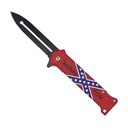
From a collector’s standpoint, this knife sits in the "theme-driven" side of the assisted opening knife world. The defining feature isn’t a custom grind or exotic steel; it’s the art. The handle is red aluminum, matte finished, overlaid with a bold Confederate flag graphic and the words "Southern Pride" in large type. No one is going to mistake this for a discreet gentleman’s folder.
That makes it a niche piece for a very specific buyer: someone who wants their knife to be an expression of Southern identity. In a collection full of automatics, OTF knives, and high-end switchblades, this works as a conversation piece—more about the cultural signal than the engineering bragging rights.
Size, Carry, and Pocket Reality
Specs matter when you actually carry a knife:
- Blade length: 3.5 inches
- Closed length: 4.5 inches
- Overall length: 8.125 inches
- Weight: 3.43 oz.
Those numbers put it squarely in the everyday carry lane: long enough to be useful, light enough not to drag your pocket down. The pocket clip is set up for straightforward pocket carry, and the slender, stiletto-inspired handle profile slides in and out of the pocket cleanly. A lanyard hole at the butt gives you the option to add cord or fob if you like extra retrieval grip.
Legal Context: Assisted Opening vs Automatic Knife Legal to Carry
If you’re researching whether an automatic knife is legal to carry, you’ve already run into the mess: federal import/export rules, state-by-state switchblade laws, and local ordinances that treat automatic knives, OTF knives, and assisted openers very differently.
This knife is an assisted-opening folder. It does not deploy via a button in the handle, and it does not shoot straight out the front on a track. You have to physically start the blade movement with the flipper; the spring only completes what you begin. Many jurisdictions treat assisted opening knives the same as manual folders, but that is not universal. Some states and cities write their statutes broadly enough that anything spring-assisted can be pulled into their definition of a switchblade or automatic knife.
The only responsible advice here is this: before you buy—or especially before you carry—check your state and local laws. Look specifically for language around "spring-assisted" or "assisted opening" knives, overall blade length limits, and any restrictions on knives with one-handed opening mechanisms. Laws change, and what’s legal to own in one county can be restricted in the next.
What Buyers Ask Before Purchasing an Automatic Knife
Are automatic knives legal?
Under U.S. federal law, automatic knives (often called switchblades) are heavily regulated in interstate commerce, but federal rules don’t outright ban possession by individuals. The real complexity comes from state and local laws. Some states allow automatic knives and OTF knives with few restrictions; others ban them outright, limit blade length, or restrict carry while allowing ownership at home.
Assisted opening knives—like this Rebel Signal—are often treated differently from true automatics, because they require manual input to begin opening. However, that distinction isn’t recognized everywhere. You must check your specific state statutes and local ordinances for the current status of automatic knives, switchblades, OTFs, and assisted openers. Do not rely on outdated forum posts or assumptions.
What’s the difference between an automatic knife, OTF, and a switchblade?
Enthusiast language gets sloppy, so let’s keep it clean:
- Automatic knife / switchblade: A knife that opens fully by pressing a button, lever, or similar device in the handle. The spring does all the work once the control is activated. Side-opening automatics swing the blade out like a folder.
- OTF (out-the-front) knife: A subtype of automatic where the blade travels linearly out of the front of the handle. Many are double-action: the same slider both deploys and retracts the blade.
- Assisted opening knife: A manual folder with a spring that assists opening after you start the blade with a flipper or thumb stud. No handle button, no full auto deployment—this Rebel Signal is in that category.
Everything that’s convenient to call a "switchblade" in casual talk isn’t one mechanically or legally. Collectors and serious buyers care about that distinction.
What makes this assisted knife worth buying?
On a table full of premium automatic knives for sale, this is not the piece you buy for exotic steel or custom machining. You buy it because you want:
- A budget-friendly assisted opening flipper with a liner lock
- A loud Confederate "Southern Pride" graphic that makes zero attempt at subtlety
- EDC-ready dimensions and weight in a slim profile
- A statement knife that telegraphs regional identity the moment it appears
For a collector, it fills the "controversial theme" slot in an assisted-opening segment, not the "technical masterpiece" slot. If you understand that going in, it does exactly what it promises.
For the Enthusiast Who Chooses Their Knives on Purpose
The Rebel Signal Assisted Opening Knife - Southern Pride Red won’t be mistaken for a custom double-action automatic knife, and it isn’t trying to compete with top-tier OTF switchblades. It’s an assisted-opening statement piece with clear intent: fast flipper deployment, simple liner lock, pocketable size, and a handle that declares where you stand the second it clears your pocket.
If your collection runs from true automatic knives and OTFs down to everyday assisted folders, this knife occupies a specific, unapologetic niche. You’re not buying it by accident—you’re buying it because, in a world of quiet, you wanted something loud.
| Blade Length (inches) | 3.5 |
| Overall Length (inches) | 8.125 |
| Closed Length (inches) | 4.5 |
| Weight (oz.) | 3.43 |
| Blade Color | Black |
| Blade Finish | Matte |
| Blade Style | Spear Point |
| Blade Edge | Plain |
| Blade Material | Steel |
| Handle Finish | Matte |
| Handle Material | Aluminum |
| Theme | Confederate Flag |
| Pocket Clip | Yes |
| Deployment Method | Flipper tab |
| Lock Type | Liner lock |