Rebel Signal Spring-Assisted Rescue Knife - Black Blade
15 sold in last 24 hours
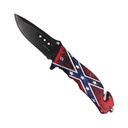
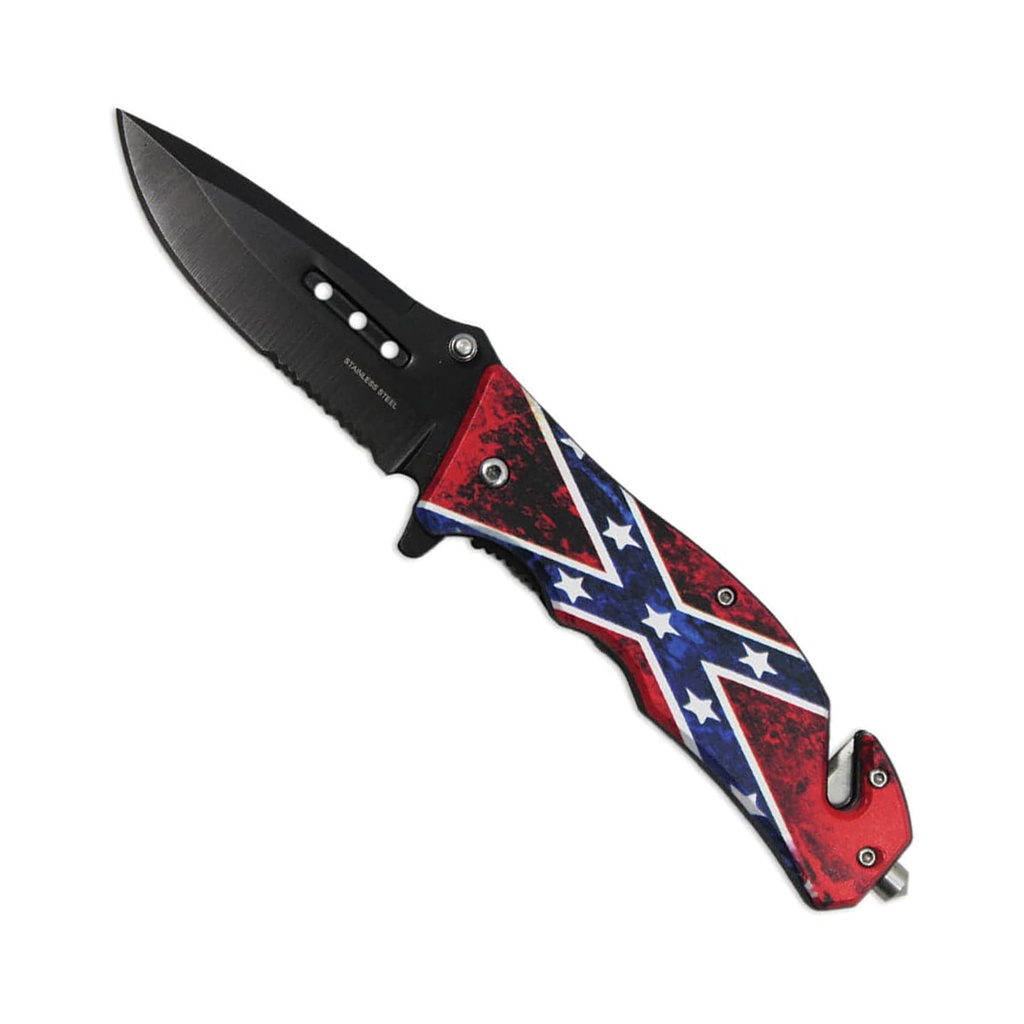
This is a spring-assisted rescue knife built for the moment everything goes sideways. The Rebel Signal’s 3.5-inch black 440 stainless blade snaps out with a decisive assist, with partial serrations tuned for rope, webbing, and stubborn fabric. A dedicated belt cutter and pointed glass breaker turn chaos into a checklist, while the liner lock holds firm under pressure. Flag-wrapped aluminum scales, finger grooves, and a pocket clip keep it ready to work, not just ride along.
Spring-Assisted Rescue Knife Built for the Seconds That Matter
This isn’t an automatic knife for sale, and that distinction matters. The Rebel Signal is a spring-assisted rescue knife: still fast, still decisive, but mechanically different from an automatic. You start the move with the flipper tab or thumb stud; the internal spring takes over and drives the blade home. That half-second of intentional input is the difference between casual curiosity and a tool chosen by someone who knows exactly what they’re carrying.
Why This Spring-Assisted Rescue Knife Earns Pocket Space
The profile is straightforward: 8 inches overall, 4.5 inches closed, and a 3.5-inch drop point blade. That puts it right in the sweet spot for EDC-sized rescue work—large enough to get real leverage, small enough that it doesn’t print like a boat anchor in the pocket.
The edge is a partial-serrated configuration, and that’s deliberate. A straight edge alone will eventually fight you when you’re cutting webbing, belt material, or thick nylon. Those serrations give you bite, especially under tension, while the plain section near the tip keeps you in control for push cuts, finer work, and precise entry when you don’t want the blade to skid.
440 Stainless Done for Real-World Rescue Use
440 stainless steel isn’t a bragging-rights super steel, and that’s exactly why it belongs on a budget-conscious rescue knife. It sharpens quickly in the field, shrugs off sweat and humidity, and handles the kind of edge abuse—glass dust, grit, dirty rope—that makes higher-end steels chip or become a chore to service. This is a blade you can tune with a basic stone or pocket sharpener in minutes, not a diva that demands a full bench setup.
Action You Can Actually Rely On
Spring-assisted deployment is a different animal from a true automatic or switchblade. With this mechanism, the blade is biased closed until you deliberately start it moving. Hit the flipper tab, roll off the thumb stud, and once you clear the detent, the assist spring takes over and snaps the blade to lockup. It’s fast enough to matter in an emergency, but still under your control, which many users prefer for both safety and legal reasons.
The liner lock engages with a positive, tactile stop. There’s enough lock face engagement to trust it under real grip pressure, but not so much that you need to fight it closed. This is the balance you look for on a working rescue folder: secure enough to lean on, easy enough to close one-handed when the other hand is busy doing something more important.
Flag-Themed Handle, Purpose-Built Rescue Tooling
The first thing you notice is the handle: aluminum scales fully wrapped in a Confederate flag graphic, with a distressed, hard-use look. Whether that hits you as Southern heritage, rebellion, or just bold visual attitude, the knife doesn’t pretend it’s subtle. But the real story is in the hardware tucked into that handle.
Belt Cutter and Glass Breaker: Panic Turned into Procedure
At the butt of the knife, you get a belt/strap cutter and a dedicated glass breaker. The cutter is designed to take a seatbelt or strap and feed it into the protected cutting edge without exposing a free blade to a flailing hand or a cramped vehicle interior. It’s about controlled damage: the belt goes, the passengers don’t.
The glass breaker is a hardened point intended for side and rear automotive glass. It’s meant to be driven with authority into a corner of the window, where the structure is weakest. If you’ve ever watched laminated versus tempered glass fail, you know why that point matters: it concentrates force into a single, decisive impact instead of a vague thud that does nothing.
Carry Geometry and Pocket Reality
The pocket clip rides on the reverse side, set up for tip-down carry. Is that the trendy configuration? No. Is it usable? Absolutely—especially on a rescue knife where you’re often drawing and indexing the handle in one motion. The 4.5-inch closed length pockets comfortably, and the curved handle profile with finger grooves gives you a natural, locked-in grip when adrenaline is up and fine motor skills are down.
Understanding Where This Sits Among Automatics, OTFs, and Switchblades
Browse any site with automatic knives for sale and you’ll see a lot of terms thrown around interchangeably. That’s how you lose serious buyers. This piece is not an automatic knife, not an OTF, and not a traditional switchblade—mechanically speaking.
Mechanism Breakdown for Enthusiasts
- Automatic knife: Blade is biased open by a spring and deploys fully with the press of a button or hidden actuator—no continued input from your hand once triggered.
- OTF (Out-The-Front) automatic: Blade travels forward out of the handle (single- or double-action) when you actuate a switch or slider. True OTFs are always automatics.
- Switchblade (traditional usage): Side-opening automatic knife—think button-actuated, spring-driven blade swinging out of the handle.
- Spring-assisted (this knife): You start opening the blade with a flipper or stud; once you overcome the detent, a spring helps complete the opening. It won’t move until you do.
Why the nuance matters: mechanism defines both how it feels in hand and how it’s treated legally in many jurisdictions. If you’re running a collection that spans OTF autos, side-opening automatics, and assisted folders, this one clearly belongs in the assisted category.
Legal Context: Where a Spring-Assisted Rescue Knife Fits
Any time you’re shopping automatic knives for sale, you should be thinking about laws first, not last. In the U.S., federal law (the Switchblade Act) primarily governs interstate commerce in true automatic knives and switchblades—not spring-assisted folders like this one. However, states and even cities stack their own rules on top of that.
Most jurisdictions treat spring-assisted knives differently from automatic knives, OTFs, and classic switchblades, because you must manually initiate opening. That said, some areas use broader language about “gravity knives,” “assisted opening,” or “one-hand opening” blades.
The only serious way to approach it is this: before you buy, check your state and local laws on assisted-opening knives, blade length, and carry style (open vs. concealed). Laws change, enforcement varies, and the responsibility is yours once the knife is in your pocket or duty bag.
What Buyers Ask Before Purchasing an Automatic Knife
Are automatic knives legal?
On the federal level in the U.S., automatic knives and switchblades are restricted mainly in terms of interstate commerce, import, and possession on federal property. Actual day-to-day carry rules are driven by state and local laws. Some states allow automatic knives with few limitations, others restrict blade length, opening mechanism, or how you carry (open vs. concealed), and a handful ban them outright for most civilians.
This knife is spring-assisted, not a true automatic, which often places it in a different legal category. But that isn’t a guarantee of legality. Always verify current statutes in your state, county, and city before treating any blade—automatic, OTF, switchblade, or assisted—as legal to carry.
What’s the difference between an automatic knife, OTF, and a switchblade?
Automatic knife: A broad term for any knife where a spring drives the blade open after you hit a button or actuator. The key is that once triggered, the blade opens without further hand input.
OTF (Out-The-Front): A specific type of automatic knife where the blade exits the front of the handle instead of pivoting from the side. Often double-action, meaning a single control both deploys and retracts the blade.
Switchblade (traditional sense): A side-opening automatic—push a button, the blade swings out from the side of the handle, driven by a spring.
This knife is none of those. It’s spring-assisted: you manually start it, the spring finishes. Enthusiasts and many statutes treat that mechanism differently.
What makes this automatic knife worth buying?
Strictly speaking, this isn’t an automatic knife—it’s an assisted rescue folder—but it belongs in the same conversation for buyers who care about fast deployment and real-world utility. What makes it worth buying is the combination of purposeful rescue features and no-nonsense materials: a 440 stainless partial-serrated blade that’s easy to service, a spring-assisted action that gets you to work fast without full-auto legal baggage, and integrated belt cutter and glass breaker that justify its space on your kit. Add the flag-wrapped aluminum handle for collectors who like bold themes, and you have a rescue knife that isn’t pretending to be anything other than what it is.
For the Collector Who Chooses Tools with Intent
If you’re the kind of buyer who can explain the mechanical difference between an OTF automatic, a side-opening switchblade, and a spring-assisted folder without reaching for a glossary, this knife was spec’d with you in mind. It’s not chasing the top end of the automatic knife for sale market; it’s delivering a fast-deploying, low-maintenance rescue tool with a loud visual signature and honest, work-ready internals.
Whether it ends up in your truck, your range bag, or your everyday rotation, it earns its keep the way any real knife should: by being exactly as capable as it looks, no more, no less.
| Blade Length (inches) | 3.5 |
| Overall Length (inches) | 8 |
| Closed Length (inches) | 4.5 |
| Blade Color | Black |
| Blade Style | Drop Point |
| Blade Edge | Partial-Serrated |
| Blade Material | 440 Stainless Steel |
| Theme | Confederate Flag |
| Pocket Clip | Yes |
| Deployment Method | Spring-assisted |