Ridgeback Tradition Fixed Hunting Knife - Brown Pakkawood
13 sold in last 24 hours
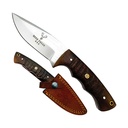
A fixed blade hunting knife that feels like it’s always been on your belt. The 3.75-inch satin clip point runs full tang through sculpted brown pakkawood with true finger grooves and a mosaic pin that locks in your grip. At 8 inches overall, it’s compact enough for all-day carry yet long enough to handle field dressing, camp prep, and general chores. It rides in a double-stitched leather belt sheath that looks as traditional as it works. Familiar, honest, and ready for real use.
Ridgeback Tradition Fixed Hunting Knife - Brown Pakkawood
The automatic crowd chases action and springs; the serious hunter chases control and predictability. The Ridgeback Tradition Fixed Hunting Knife - Brown Pakkawood isn’t an automatic knife for sale, and that’s exactly the point. This is the kind of compact full-tang field knife that lives on a leather belt all season, does the work cleanly, and never gives you a surprise you don’t want.
At 8 inches overall with a 3.75-inch satin clip point, it hits the sweet spot: long enough to field dress deer and handle camp chores, short enough to maneuver in tight work without feeling like a small machete. Stainless steel, full tang, pakkawood, leather sheath—classic ingredients, done with just enough refinement to earn a spot in a serious user’s rotation.
Why This Fixed Blade Earns a Spot Next to Your Automatic Knives
If you buy automatic knives for sale online, you already care about reliability and feel. A fixed blade like this coexists perfectly with your favorite automatic knife or OTF in the same kit. The deployment here is as simple as it gets: no spring, no button, no double-action mechanism, just draw from leather and you’re working. That mechanical simplicity is exactly why every automatic knife enthusiast should own at least one honest fixed blade hunting knife.
The full-tang construction means the steel runs uninterrupted from tip to butt, sandwiched by the brown pakkawood scales. No pivot to foul, no lock to fail, no timing to tune. You get the same consistent geometry and rigidity every time you cut—something even the best automatic or switchblade can’t quite duplicate when you’re torquing a blade through joint, cartilage, or wood.
Steel, Grind, and Tang: The Mechanics That Actually Matter
The blade is a 3.75-inch clip point in stainless steel with a satin finish. Is it a boutique powder steel? No. And that’s not what this knife is trying to be. For a hunting field knife that may see blood, moisture, and long days in a leather sheath, a sensible stainless is a rational choice. You trade a bit of edge-holding versus high-end tool steel for better corrosion resistance and easier touch-ups in camp with a simple stone or pocket sharpener.
Full-Tang Confidence in the Field
On a folding automatic knife, you always have at least one mechanical compromise point: the pivot and lock. On this Ridgeback Tradition fixed blade, the full tang is the backbone. Those pakkawood scales bolt to honest, continuous steel. Baton through kindling, leverage through bone, twist in stubborn cuts—you’re working against steel, not a hinge. That’s the kind of confidence you feel instantly when you transition from a folder or automatic to a well-built fixed blade.
Clip Point Geometry for Real Hunting Tasks
The clip point profile isn’t cosmetic. That swedge and fine tip let you do controlled work—starting your initial opening cut without punching through organs, tracing joints, and detail work around the neck and shoulders. The belly carries enough curve to make long skinning passes smoother. It’s the same logic that’s made clip points a hunting standard for generations.
Handle, Grip, and Sheath: Where This Knife Feels Like It’s Always Been Yours
Handle materials separate throwaway knives from the ones you keep. The polished brown pakkawood here hits a smart middle ground: the warmth and visual grain of traditional hardwood with the dimensional stability of a resin-impregnated laminate. Wet, cold, or bloody, it stays more predictable than bare wood and looks better, longer, than plastic.
Finger grooves sculpted into the scales give you indexing without being so aggressive that they dictate your grip. You can choke up for detail work or settle back for more power. A mosaic pin anchors the visual story—small detail, but it’s the sort of touch that collectors notice immediately. Brass rivets and hardware add that classic warm contrast against the darker wood and satin steel.
The knife rides in a double-stitched brown leather belt sheath with a snap closure and belt loop. This is what a traditional hunting knife should ship with: vertical carry, secure retention, and materials that age with you. Leather will mold to the knife over time and pick up the same stories your gear does—rain, mud, campfire smoke, and seasons of use.
Legal Context: Where a Fixed Blade Fits in the Knife Law Puzzle
Buyers who search for an automatic knife for sale are used to thinking about legality: button-activated blades, spring-assisted action, and switchblade definitions. This Ridgeback Tradition isn’t an automatic knife, isn’t an OTF, and isn’t a switchblade. It’s a fixed blade hunting knife—no spring, no button, no mechanical deployment at all.
In many jurisdictions, fixed blades are treated differently from automatic knives. That doesn’t mean anything goes; some states and cities regulate blade length, concealed carry of fixed blades, or specific environments like schools and government buildings. But the usual federal switchblade rules that apply when you buy automatic knife models across state lines don’t hit a knife like this the same way.
The short version: this is a traditional fixed blade. Many places that restrict automatic knives and OTFs are more tolerant of a hunting knife on a belt. As always, check your local and state laws before you carry—especially if you’re used to thinking exclusively in terms of automatic knife legal to carry rules.
What Buyers Ask Before Purchasing an Automatic Knife
Are automatic knives legal?
In the U.S., federal law (the Federal Switchblade Act) mainly regulates interstate commerce in automatic knives and switchblades—blades that open automatically by button, pressure, or similar mechanism. It doesn’t outright ban ownership for most individuals, but it limits how automatic knives can be shipped across state lines, especially to states that restrict them.
Actual legality to own and carry is driven almost entirely by state and sometimes local law. Some states allow automatic knives, OTF knives, and switchblades with few restrictions; others limit blade length, carry method (open vs. concealed), or reserve them for law enforcement and active military. A few still prohibit them outright. If you’re shopping automatic knives for sale, or trying to determine if an automatic knife is legal to carry where you live, you need to read your state and municipal codes—not just federal law.
What’s the difference between an automatic knife, OTF, and a switchblade?
Definitions matter:
- Automatic knife: A folding or telescoping knife that opens automatically when you activate a button, lever, or similar control in the handle. A side-opening automatic flips the blade out from the side like a traditional folder, powered by a spring.
- OTF (out-the-front) knife: A subtype of automatic where the blade travels linearly out the front of the handle. Many enthusiast OTFs are double-action, meaning the same control deploys and retracts the blade using internal springs.
- Switchblade: In legal language, this usually refers to any automatic knife that opens by pressing a button or similar device in the handle—both side-openers and many OTF designs fall under this umbrella.
The Ridgeback Tradition Fixed Hunting Knife - Brown Pakkawood is none of these. It’s a fixed blade: the steel is exposed, permanently extended, and doesn’t move. No spring, no button, no switchblade classification—just a traditional hunting tool.
What makes this automatic knife worth buying?
When someone asks that, they usually mean: what makes this knife worth buying next to my automatics, OTFs, and switchblades? The Ridgeback Tradition earns its place on your belt and in your kit by doing what an automatic knife can’t quite replicate: full-tang rigidity, no-moving-parts reliability, and classic hunting ergonomics that stay predictable when things get messy.
You’re getting a compact, 3.75-inch clip point in stainless that shrugs off blood and moisture, a pakkawood handle cut with real finger grooves and finished with a mosaic pin, and a leather belt sheath that belongs in deer camp, not just a display case. It’s the knife you pair with your favorite automatic for the jobs that demand absolute mechanical simplicity.
For the Enthusiast Who Owns Automatics but Trusts a Fixed Blade
If you’re the kind of buyer who knows the difference between a single-action OTF and a double-action automatic knife for sale, you also know where they tap out. When the work shifts from fidget-factor to field reality—blood, bone, wood, rope—a compact, honest fixed blade hunting knife is still the right answer.
The Ridgeback Tradition Fixed Hunting Knife - Brown Pakkawood is built for that role. It won’t replace your favorite automatic; it will complement it. One rides in your pocket for fast, one-handed access. The other waits on your belt for the moments where failure isn’t an option and the simplest mechanism—solid steel from tip to butt—is the one you can trust.
| Blade Length (inches) | 3.75 |
| Overall Length (inches) | 8 |
| Weight (oz.) | 9 |
| Blade Color | Silver |
| Blade Finish | Satin |
| Blade Style | Clip Point |
| Blade Edge | Plain |
| Blade Material | Stainless Steel |
| Handle Finish | Polished |
| Handle Material | Pakkawood |
| Theme | None |
| Handle Length (inches) | 4.25 |
| Tang Type | Full |
| Pommel/Butt Cap | None |
| Carry Method | Belt Loop |
| Sheath/Holster | Leather |