Ridgeback Saw Spine Survival Knife - Wood Handle
15 sold in last 24 hours
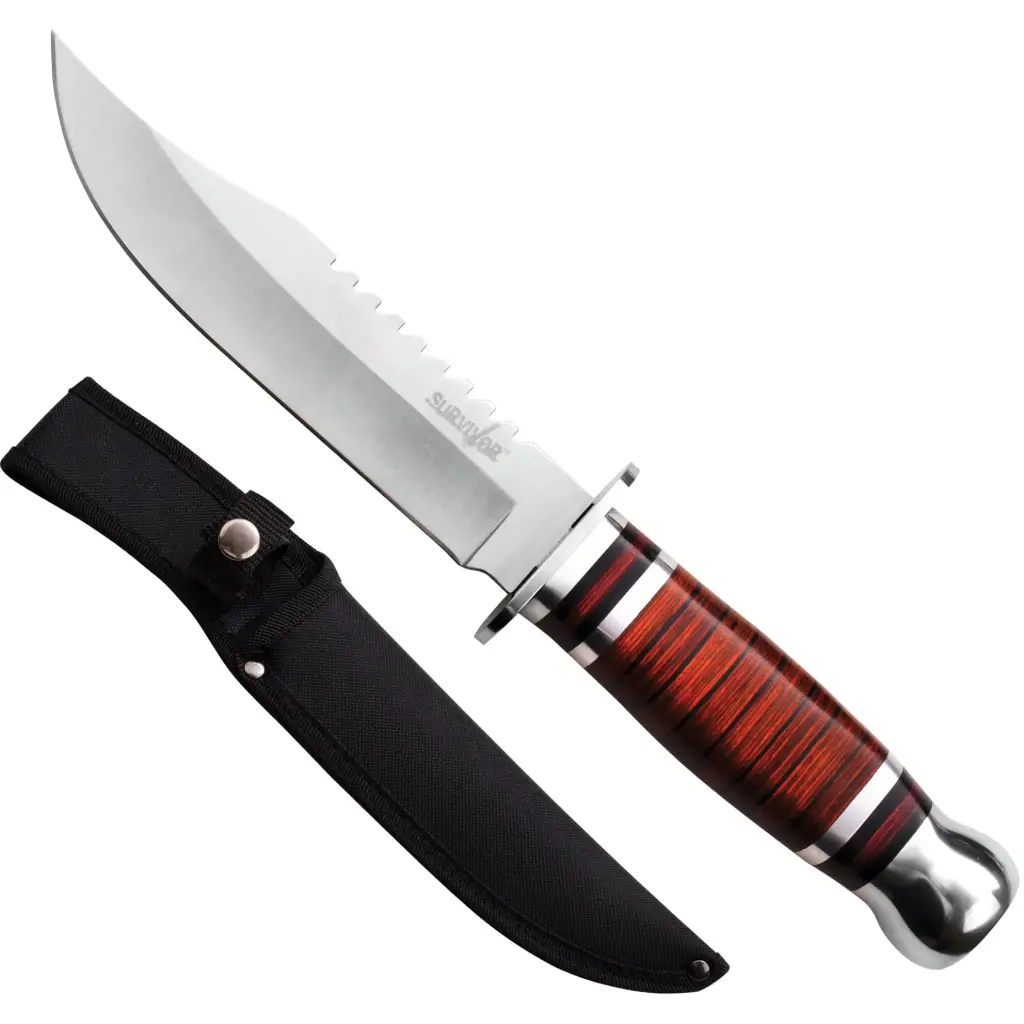
A fixed-blade survival knife that does real work, not just photo ops. The Ridgeback Saw Spine Survival Knife carries a 6-inch satin clip-point blade with sawback spine and partial serrations, full tang under a warm wood handle, and a belt-ready nylon sheath. Stainless steel, 10.5 inches overall, balanced for camp chores, light batoning, and general field abuse. If you want a straightforward survival knife that just cuts, saws, and keeps going, this is the kind of tool you strap on and forget—until you need it.
Field-Ready Fixed Blade for Buyers Who Actually Use Their Knives
The Ridgeback Saw Spine Survival Knife is the opposite of a glass-case collectible. This is a full-tang, fixed blade built for camp chores, bushline clearing, and the sort of improvised tasks you don't trust to a folder. At 10.5 inches overall with a 6-inch satin clip-point blade, it hits the classic survival sweet spot: long enough to chop and baton kindling, compact enough to ride on your belt all day without feeling like a short sword.
Why This Survival Knife Earns Its Place on Your Belt
Mechanically, this knife is simple by design: no springs, no automatic action, no OTF gimmicks—just a solid fixed blade with a full tang and hardware that can take a beating. The stainless steel clip point carries partial serrations near the ricasso for rope, webbing, and stubborn fibrous material, while the sawback spine gives you a functional edge for notching, light limb work, and quick field improvisation. The wood handle scales and metal guard lock your grip when you’re working hard, wet, or gloved.
Full-Tang Stability You Can Abuse
A proper survival knife doesn’t hinge, fold, or rely on a lock. The Ridgeback runs full tang from guard to pommel, with the steel visible all the way through the wood handle. That matters when you’re batoning through small logs, prying, or using the rounded pommel as an impact point. There’s no pivot to loosen, no liner to fail—just continuous steel taking the hit.
Sawback Spine and Partial Serrations for Real-World Tasks
The sawback isn’t ornamental. Combined with the partial-serrated edge section, you get three working zones on one knife: a clean plain edge for controlled slicing and food prep, aggressive serrations near the handle for rope and tough fibers, and a spine you can use to notch, score, and rough-cut when you don’t want to dull your primary edge. It’s a smart layout for a single-knife camp setup.
Steel, Edge, and Ergonomics: What You’re Actually Working With
The Ridgeback’s stainless steel is tuned for survival use, not lab specs or bragging rights hardness. It’s corrosion-resistant enough for wet environments, easy to touch up on a basic field stone, and tough enough not to chip if you’re splitting kindling or working against bark and grit. The satin finish reduces drag through material and sheds sap, dirt, and moisture better than a coarse bead blast.
Clip-Point Versatility in the Field
A clip point on a survival knife is about control. You get a fine enough tip for detail work—starting notches, piercing packaging, or careful camp prep—without sacrificing the belly you need for slicing and light chopping. Paired with the spine thickness, this blade walks the line between nimble and sturdy, which is exactly where a general-purpose field knife belongs.
Wood Handle Feel, Modern Carry Reality
The gloss-finished wood handle gives you that classic outdoors aesthetic, but it’s more than looks. The contour and warmth of wood reduce hand fatigue during extended cutting, and the straight guard keeps your fingers from sliding forward on hard thrusts. A rounded metal pommel closes the package, backing up light hammering and striking work without biting into your palm.
Carry and Deployment: Fixed-Blade Simplicity Over Fancy Mechanisms
If you’re here shopping automatic knives for sale, you already know the draw of fast deployment and mechanical precision. This Ridgeback isn’t an automatic knife, isn’t an OTF, and absolutely isn’t a switchblade—it’s the knife you strap on when you need something that doesn’t care about pocket lint or spring tension. You draw, you cut, that’s the entire deployment story.
The included black nylon sheath rides on your belt, light and low-profile. Nylon isn’t glamorous, but it’s forgiving, easy to clean, and won’t crack in cold or swell in the wet. The snap closure keeps the blade secured when you’re moving hard, climbing, or crawling through brush. For buyers used to flicking open an automatic, this is your mechanical reset: zero moving parts between you and a working edge.
Legal Reality: Fixed Blade vs. Automatic, OTF, and Switchblade Laws
One reason serious buyers look beyond every automatic knife for sale and add at least one solid fixed blade to their rotation is legal simplicity. In many jurisdictions, fixed-blade survival knives like this are treated differently from automatic knives, OTF designs, and switchblades. Where autos and OTFs often trigger specific statutes—spring-actuated opening, button or slider in the handle, blade projecting from the front—a straight fixed blade usually falls under length limits and carry-style rules instead.
In other words, this is a manually operated fixed survival knife. There’s no automatic deployment, no switchblade-style button, and no front-firing mechanism. That doesn’t mean it’s legal everywhere or in every carry configuration. Local and state laws can restrict blade length, concealment, and where you can carry any knife. But if you’ve ever wrestled with the patchwork of automatic knife legal to carry rules, you’ll appreciate how comparatively straightforward a belt-carried field knife can be.
As always, check your specific state and municipal regulations before you carry—especially if you’re used to navigating automatic and OTF laws. This knife gives you capability in the field without stepping into the grey areas reserved for spring-actuated automatic mechanisms and classic switchblade definitions.
What Buyers Ask Before Purchasing an Automatic Knife
Are automatic knives legal?
Under U.S. federal law, automatic knives—often called autos or switchblades—are restricted primarily in interstate commerce and importation, with specific carve-outs for military, law enforcement, and certain uses. The real complexity comes at the state level, where laws vary widely on owning, carrying, and selling autos, OTF models, and traditional side-opening switchblades. Some states largely allow them, some limit blade length or carry type, and a few heavily restrict or ban them.
The Ridgeback Saw Spine Survival Knife is not an automatic knife, not an OTF, and not a switchblade; it’s a fixed-blade survival knife with no spring mechanism at all. That typically places it under different statutes than automatic knives for sale in the same store. Still, you’re responsible for knowing and following your local laws—especially if you also carry an auto, OTF, or switchblade in your rotation.
What’s the difference between an automatic knife, OTF, and a switchblade?
Mechanism defines everything here:
- Automatic knife (auto): A folding knife that opens by pressing a button, lever, or similar control in the handle. A spring drives the blade open. Most side-opening autos fall in this category.
- OTF (out-the-front) knife: A subtype of automatic where the blade deploys linearly from the front of the handle, usually via a slider. Many are double action—push to deploy, pull to retract.
- Switchblade: In common U.S. legal language, this is essentially the same as an automatic knife: a spring-actuated blade that opens from the handle when a button or similar device is pressed.
The Ridgeback isn’t any of these. It’s a fixed survival blade—no button, no spring, no automatic action—built for field work alongside whatever automatic knife you choose to carry in your pocket.
What makes this survival knife worth buying?
For an enthusiast who already owns a good automatic knife for EDC, this is the missing piece: the hard-use survival knife that does the ugly work your auto shouldn’t. The sawback spine, partial serrations, and full-tang construction give you real leverage in camp and emergency scenarios. The stainless steel blade is easy to maintain and resists the kind of neglect that would kill a finer, more temperamental steel.
Add the classic wood handle, impact-ready pommel, and a simple belt sheath, and you get a field knife you won’t baby. It complements, rather than replaces, your automatic and OTF collection—because sometimes the right call is a straightforward fixed blade that’s always ready, no mechanism required.
For Enthusiasts Who Carry an Auto but Trust a Fixed Blade
If you’re the buyer who can tell a single-action from a double-action automatic knife in one click, you already understand why a solid survival fixed blade belongs in your kit. The Ridgeback Saw Spine Survival Knife isn’t pretending to be an automatic knife for sale; it’s the dependable partner that lets your auto stay sharp and clean while it takes the field abuse. For the serious enthusiast, that’s not redundancy—that’s a proper loadout.
| Blade Length (inches) | 6 |
| Overall Length (inches) | 10.5 |
| Blade Color | Silver |
| Blade Finish | Satin |
| Blade Style | Clip Point |
| Blade Edge | Partial-Serrated |
| Blade Material | Stainless Steel |
| Handle Finish | Gloss |
| Handle Material | Wood |
| Theme | None |
| Handle Length (inches) | 4.5 |
| Tang Type | Full Tang |
| Spine Thickness (inches) | 0.1375 |
| Pommel/Butt Cap | Rounded Pommel |
| Carry Method | Belt Carry |
| Sheath/Holster | Nylon Sheath |