Sevenfold Arc Balanced Throwing Star - Silver
9 sold in last 24 hours
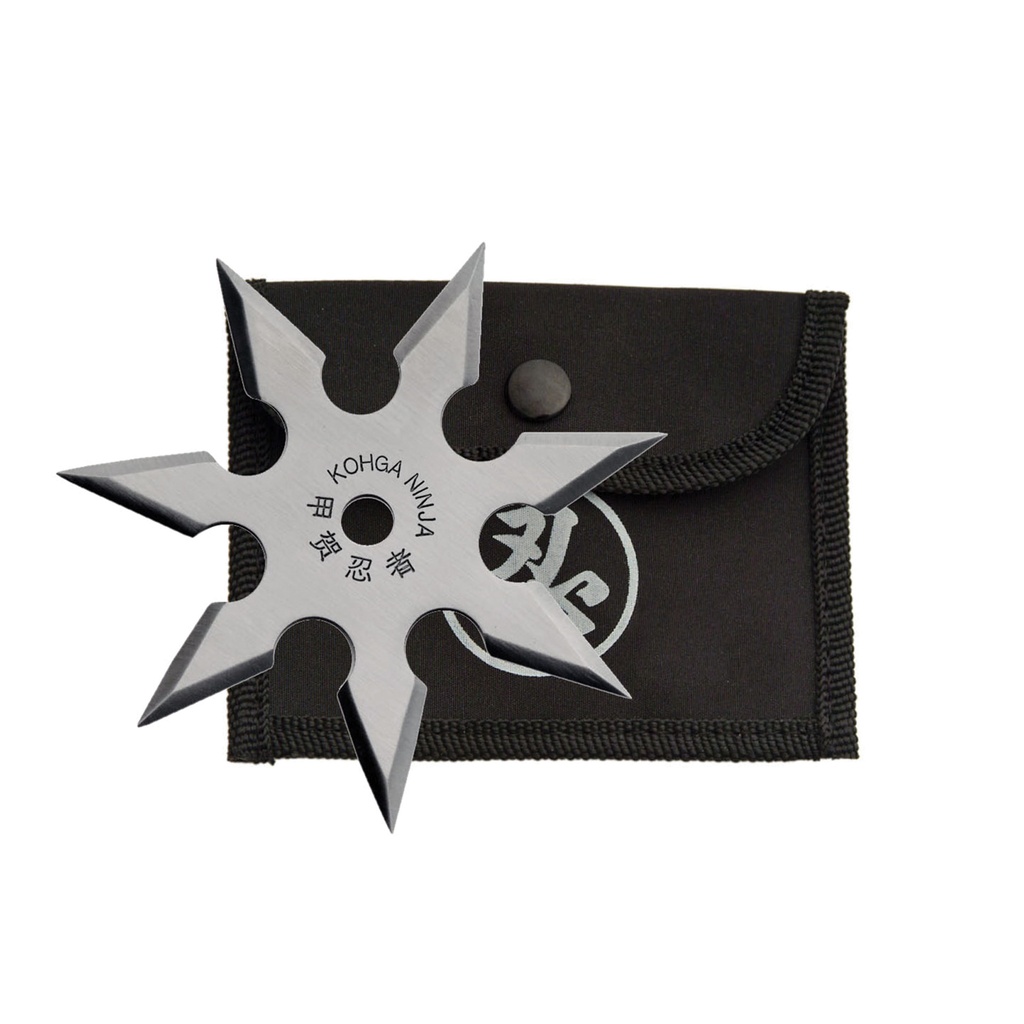
This seven-point throwing star is built for controlled flight, not wall-hanger cosplay. The brushed silver finish, centered hole, and evenly spaced cutouts work together to keep rotation predictable from release to impact. At 4 inches across, it sits in the sweet spot between easy carry and stable spin. The KOHGA NINJA engraving nods to its martial roots, while the included black pouch keeps it flat, protected, and ready for your next training session or display.
Sevenfold Arc Balanced Throwing Star - Silver
Some throwing stars are costume props. This one is a tool. The Sevenfold Arc Balanced Throwing Star - Silver is built around a simple idea: repeatable rotation. Seven points, true symmetry, centered mass, and a clean edge profile give you a throwing star that behaves the same way every time you let it go.
Precision Throwing Star Design for Real Practice
This is a classic ninja throwing star form refined for practical training. The overall diameter sits at approximately 4 inches, which is the proven middle ground between speed and stability. Too small and you get twitchy, over-rotating flight. Too large and you fight drag and bulky carry. Here, the disk size and thickness are tuned for a predictable, mid-speed spin that works for both underhand and overhand throwing styles.
The seven evenly spaced points matter. That odd number of arms creates a tight rotational rhythm where every point is effectively a repeat of the last. Miss the exact same grip by a few degrees and the throw still tracks the way you expect. For anyone working on consistency, that design choice is more important than ornamentation or wild blade shapes.
Symmetry, Center Hole, and Release Control
The central hole isn’t just there to look like traditional shuriken. It gives your fingers a clear reference point on every grip. Combine that with the smaller cutouts near each arm and you get multiple tactile cues that let you index your grip without staring down at your hand. That’s how you build muscle memory.
On release, the circular core and evenly weighted arms keep the rotation honest. There are no oversized spikes, no decorative blades throwing off balance. It’s a true circle of control designed for repeatable throws, not Instagram photos.
Why This Throwing Star Stands Out in a Market Full of Gimmicks
Most cheap throwing stars are either too thin, too flexy, or over-designed. They look aggressive in photos but fly like scrap metal. This star goes the other way: brushed silver finish, clean lines, and points that are sharpened where they need to be without turning the whole profile into a snag magnet.
The brushed silver finish isn’t cosmetic fluff. It gives a touch of texture for grip and cuts down on glare under strong lights, whether you’re throwing indoors at a dedicated target board or outside in practical training. The darker beveled edges visually define the strike points, which sounds like a small thing until you’re throwing in low light and want instant visual feedback on your rotation and alignment.
KOHGA NINJA Engraving and Martial Aesthetic
The "KOHGA NINJA" engraving and Japanese characters lean into traditional shuriken iconography without turning this into a caricature. It reads like functional martial gear, not a toy. That matters to collectors who want their display pieces to look like they could actually be used, and to practitioners who train with purpose and discipline.
The black pouch with white emblem reinforces that aesthetic. It’s not a hard case or overbuilt sheath — it’s exactly what you want for a flat profile: simple, fabric-style construction with a snap-button flap that keeps the star covered, discreet, and ready to deploy when you’re at the range or in the dojo.
Carry, Storage, and Real-World Use
Throwing stars live in a strange space between training tool, martial arts accessory, and display piece. This one checks all three boxes without pretending to be anything else. Flat profile, moderate diameter, and that fitted black pouch mean you can slide it into a bag, range kit, or drawer without it printing or snagging on everything it touches.
For training, the 4-inch diameter hits a usable weight and size that won’t punish slight form mistakes with wild, unpredictable flight. Beginners get a platform they can grow on, and experienced throwers get a star that won’t feel clumsy or “off” at distance. The sharpened points are tuned more for sticking into wood or target media than slicing, which is exactly what you want out of a dedicated throwing star.
Target Practice, Training, and Display Value
On the range, the balanced seven-point design lets you experiment with grip variations without completely rewriting your throw. It’s forgiving enough for repetition work but honest enough to show you when your release timing is sloppy. Over time, that’s the kind of feedback that actually improves your throws.
On display, the contrast between the brushed silver metal and the black pouch with its white emblem gives you a clean, martial look in a case or on a shelf. It reads as gear, not décor, which is exactly the line serious enthusiasts want to walk.
What Buyers Ask Before Purchasing an Automatic Knife
While this product is a throwing star, many buyers cross-shop automatic knives, OTF knives, and other edged tools in the same session. The questions below address the broader enthusiast context around automatic knives, switchblades, and related mechanisms.
Are automatic knives legal?
In the United States, automatic knives sit under a mix of federal and state rules. Federal law (the Switchblade Knife Act) restricts interstate commerce and mailing of automatic knives and switchblades in certain scenarios, but it does not by itself decide what you can carry day to day — that’s up to your state and sometimes your city. Some states allow automatic knives with few restrictions, others limit blade length, opening mechanism, or who can carry, and a few still prohibit them outright. Before you buy or carry an automatic knife, read your state and local statutes, and remember that throwing stars like this one are often regulated separately under their own weapons or "martial arts weapon" laws.
What’s the difference between an automatic knife, OTF, and a switchblade?
Mechanically, an automatic knife is any knife where a spring-driven blade deploys from a closed position when you press a button, push-bar, or hidden release — no manual thumb stud or flipper required. A switchblade is the traditional legal term used in many laws for that same class of automatic opening knives.
OTF (out-the-front) knives are a specific subset of automatic knives where the blade travels linearly out of the front of the handle rather than pivoting out from the side like a conventional folder. Many OTFs are double-action, meaning the same control both deploys and retracts the blade under spring tension. Side-opening automatics share the same spring-driven deployment but pivot on a hinge like a standard folding knife. Throwing stars like this Sevenfold Arc have no deployment mechanism at all — they’re fixed, single-piece projectiles designed to be thrown, not carried as folding or automatic knives.
What makes this automatic knife worth buying?
This specific product is a throwing star, not an automatic knife, but the same logic serious buyers use for automatic knives applies here: design, balance, and purpose-driven construction. Enthusiasts choose gear that is mechanically honest. In an automatic knife, that means crisp action, reliable lockup, and appropriate steel. In this throwing star, it means sevenfold symmetry, a centered hole and cutouts for consistent grip, a finish that favors control over flash, and a profile tuned for stable rotation instead of gimmicks. You’re buying a tool that behaves the way it looks like it should.
For Collectors and Practitioners Who Care About How Gear Performs
If you’re the kind of buyer who can feel bad balance the first time you pick up a throwing star, this piece is built for you. The Sevenfold Arc Balanced Throwing Star - Silver rewards proper technique with clean, predictable flight and offers enough visual discipline to hold its own in a serious collection. Whether it sits next to your favorite automatic knife, a double-action OTF, or a row of training shuriken, it belongs in a lineup chosen by someone who cares how their gear actually works, not just how it photographs.