Shadow Index Double-Action OTF Knife - Carbon Fiber Black
9 sold in last 24 hours
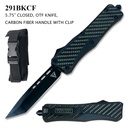
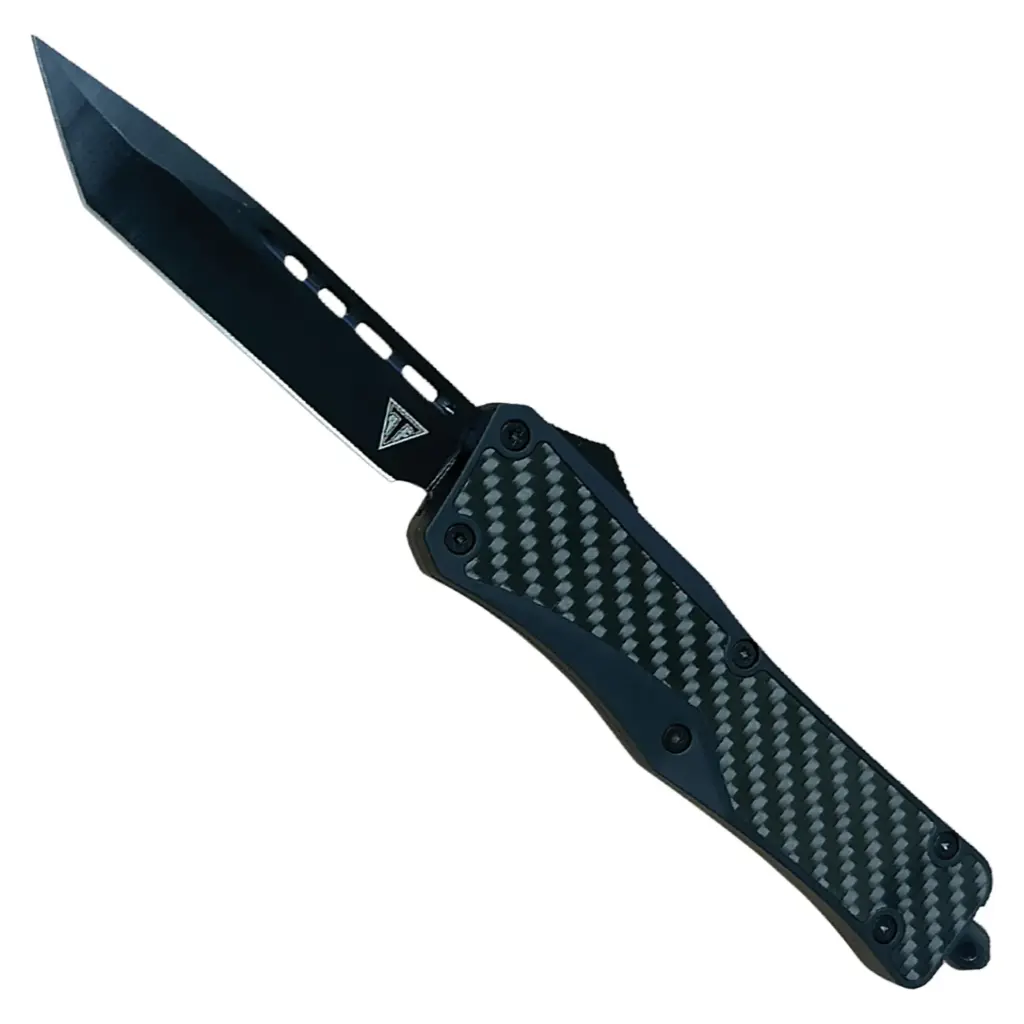
This automatic knife for sale is a straight-line problem solver: a double-action OTF with a blackout American tanto and carbon fiber panels that lock your grip. The side thumb slide gives positive, on-axis deployment and retraction with no grip change, so cuts start exactly where your eyes are. Deep-carry clip, glass breaker, and nylon sheath round out an EDC package that feels more like pro gear than novelty. You’re not buying a toy; you’re buying tuned hardware that earns pocket time.
Automatic knives for sale that actually earn pocket time
If you’re hunting for an automatic knife for sale that feels more duty-built than display-only, this double-action OTF is where that search stops. The Shadow Index concept is simple: put the slide where the thumb wants to live, give the blade an American tanto profile that can punch and cut without drama, and wrap it all in carbon fiber that grips like a proper tool, not a fashion accessory.
Automatic knife for sale with true on-axis OTF deployment
This is a double-action OTF automatic knife: thumb drives the side-mounted slide forward, the blade rockets straight out the front; pull the slide back, the blade retracts under control. No wrist flicks, no arc across your fingers, no changing grip positions mid-deployment. For anyone who’s worked in gloves, in a vehicle, or in tight spaces, that on-axis, repeatable motion is the whole point of an OTF over a folder.
At 3.75 inches, the matte black American tanto blade hits the EDC sweet spot: enough reach for real work, short enough that it doesn’t feel like you’re carrying a folding short sword. The 9.5-inch overall length gives you leverage; the 5.625-inch closed length keeps it pocketable. The 8.17-ounce weight isn’t trying to win a lightweight contest—it’s aiming for stability on tough cuts, the way a good framing hammer feels planted instead of floaty.
Slide tuning and action feel: where this OTF separates itself
The side thumb slide is where serious buyers notice the difference. Too light and it’s a liability; too heavy and it’s a chore. Here the spring tension and track geometry are tuned for a positive, mechanical feel—distinct detents at open and closed, with enough resistance that you can run it under stress without worrying about accidental activation. The straight-line travel also means your hand doesn’t have to re-learn the motion; once you’ve run it a few times, indexing becomes automatic.
American tanto geometry built for puncture-to-slice work
The American tanto tip gives you a reinforced point for punching through tougher materials—dense packaging, nylon webbing, stubborn zip ties—while the secondary edge transition provides a stable platform for controlled scoring and slicing. The matte blackout finish kills reflections and takes the edge off maintenance. Subtle fullers and a swedge shave a bit of weight and drag, keeping deployment snappy and cuts cleaner through dense mediums.
Carbon fiber control: why the handle matters as much as the blade
Anyone can bolt an OTF mechanism into a slab of metal and call it an automatic knife for sale. What separates this build is how the handle geometry and materials respect real-world grip. Carbon fiber panels in a proper weave pattern give tactile feedback and temperature neutrality; they don’t turn into an ice bar in the cold or a slip risk when wet. The black anodized frame anchors everything with Torx hardware, so you can service fasteners over time instead of treating the knife as disposable.
A deep-carry pocket clip tucks the OTF low in the pocket, minimizing print and keeping the knife where you left it. When the job or environment calls for off-body carry, the included nylon sheath handles belt or pack duty without trying to be fancy. At the base, a glass breaker pommel gives you a dedicated impact point—a last-resort tool that’s better to have and never use than to need once and come up empty.
Mechanics that serious buyers appreciate
The action is the heart of any OTF automatic. Here, the interplay between spring strength, internal track fit, and button geometry is what makes the knife feel predictable. There’s no vague mush at the end of the stroke; you get a crisp, mechanical confirmation that the blade is either locked out or buried back in the handle. That certainty is what separates a true working OTF from the flea-market switchblade crowd.
Automatic knife for sale with real EDC and duty potential
Plenty of automatic knives for sale look the part but fold under real use. This one was spec’d around actual tasks: opening and breaking down heavy cartons, cutting nylon straps, dealing with packaging tape and plastic banding, and serving as a controlled puncture tool when access matters more than aesthetics. The American tanto profile works particularly well in those puncture-to-slice transitions; you can drive the tip in, then ride the secondary edge through the material without needing a dramatic wrist change.
For EDC, the combination of carbon fiber inlays, deep-carry clip, and blackout hardware keeps the knife low-profile both visually and physically. You’re not advertising gear; you’re just carrying a tool that happens to deploy faster than almost anything else in your pocket.
Where automatic knives, OTFs, and "switchblades" actually differ
Serious buyers know the language matters. This is an OTF automatic knife, meaning it’s an automatic where the blade deploys out the front of the handle via a spring-driven mechanism. "Automatic knife" is the broader category: any knife where pressing a button, slide, or lever releases a spring that opens the blade for you. OTF is a type of automatic, just like side-opening autos are another type. "Switchblade" is the older, often legally loaded term—usually referring to side-opening automatics in statutes and pop culture. Enthusiasts will use all three terms in conversation, but mechanically, you’re looking at a double-action OTF automatic here, not a generic switchblade toy.
Automatic knife legal context: what responsible buyers should know
In the United States, federal law (the Switchblade Knife Act) mainly restricts interstate commerce and possession of automatic knives on certain federal properties and by specific categories (for example, in federal buildings or certain air travel contexts). However, the real deciding factor for carry is state and local law. Some states allow automatic knives and OTFs for everyday carry, some restrict blade length, some limit carry to one-handed opening but not autos, and a few still ban or heavily regulate switchblades and OTFs altogether.
Before you buy automatic knife models like this OTF for carry, you should check your state statutes and, ideally, municipal codes. Laws change regularly, and enforcement can vary. Owning an automatic knife in your collection is generally less problematic than carrying one concealed in a jurisdiction that still treats switchblades as contraband. When in doubt, consult up-to-date local resources or an attorney familiar with weapons law in your area.
What Buyers Ask Before Purchasing an Automatic Knife
Are automatic knives legal?
In short: it depends where you are and how you carry. Federally, automatic knives and OTFs are regulated by the Switchblade Knife Act, which primarily affects interstate shipment and federal jurisdictions, not day-to-day pocket carry. The real rules live at the state and local level. Some states now treat automatic knives like any other folding knife; others limit blade length, restrict concealed carry, or still classify switchblades and OTFs as prohibited weapons. Before you buy automatic knife models for EDC, verify current state and city laws—don’t rely on decade-old forum posts. Collecting at home is often less restricted than public carry, but you’re responsible for knowing your local framework.
What’s the difference between an automatic knife, OTF, and a switchblade?
“Automatic knife” is the big umbrella: any knife that opens by spring when you hit a button, slide, or lever. “OTF” (out-the-front) is a specific automatic where the blade travels straight out the front of the handle—like this one—with the thumb slide controlling both open and close (double-action). “Switchblade” is the older, legal-pop-culture term that usually refers to side-opening automatics, though many statutes use it to cover all autos, including OTFs. Enthusiasts prefer precise terms, so you’d call this a double-action OTF automatic knife, not just a switchblade.
What makes this automatic knife worth buying?
Three things: tuned action, functional geometry, and real materials. The double-action OTF mechanism gives you fast, on-axis deployment and retraction without changing grip. The blackout American tanto blade is built for actual work—puncture strength plus controlled slicing, not just aggressive looks. Carbon fiber grip panels, Torx-fastened construction, deep-carry clip, and a glass breaker pommel round out a package that feels like serious kit, not novelty. If you’ve handled enough automatic knives for sale to know most are forgettable, this one stands out in the hand, not just in the photos.
For the buyer who chooses tools on purpose
If your idea of the best automatic knife for EDC is a piece that can go from pocket to cut in one straight, practiced motion, this double-action OTF belongs in your rotation. It’s not trying to win a beauty contest; it’s engineered to work, to deploy predictably, and to disappear when the job’s done. That’s the mindset behind every serious automatic knife for sale on a proper enthusiast’s shelf—and this carbon fiber blackout earns its place there.
| Blade Length (inches) | 3.75 |
| Overall Length (inches) | 9.5 |
| Closed Length (inches) | 5.625 |
| Weight (oz.) | 8.17 |
| Blade Color | Black |
| Blade Finish | Matte |
| Blade Style | American Tanto |
| Blade Edge | Plain |
| Handle Finish | Glossy |
| Handle Material | Carbon Fiber |
| Button Type | Slide |
| Theme | Carbon Fiber |
| Pocket Clip | Yes |
| Sheath/Holster | Nylon Sheath |