Shadowline Covert Balance Shoulder Holster Rig - Black
4 sold in last 24 hours
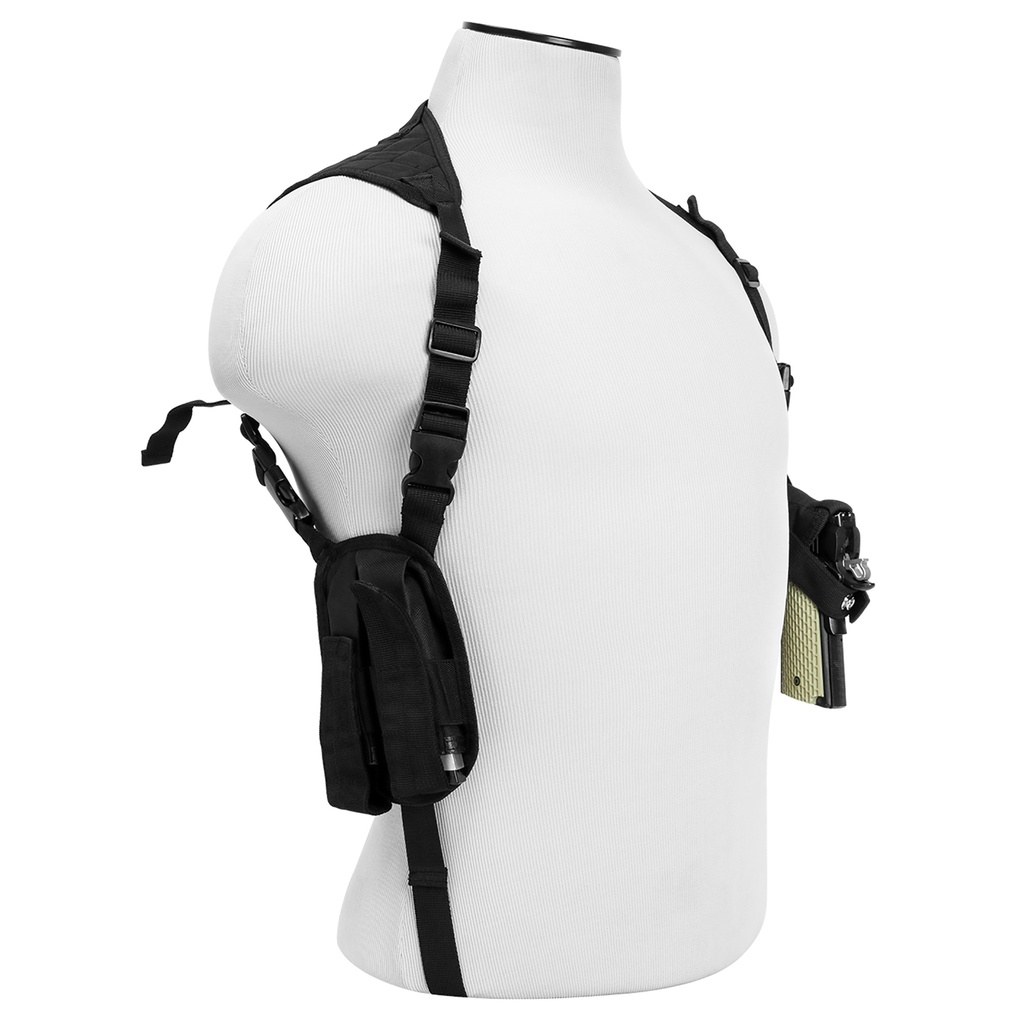
This isn’t a fashion prop; it’s a working rig. The Shadowline Covert Balance Shoulder Holster Rig rides flat under a jacket with a horizontal draw on one side and a double magazine pouch on the other for true weight balance. Padded shoulder panels spread the load, elastic-backed straps flex as you move, and belt tie‑downs keep the holster planted when you draw. For the carrier who cares more about stability, access, and all‑day comfort than looking “tactical” in the mirror.
Shadowline Balanced Shoulder Holster for Sale – Built for Real Concealed Carry
The Shadowline Balanced Shoulder Holster isn’t costume gear. It’s a purpose-built concealed carry rig for people who actually carry under a jacket all day and need the gun to be where they left it when it’s time to draw. A horizontal-draw pistol holster on one side, a double magazine pouch on the other, padded shoulders, and belt tie-downs—this is classic undercover ergonomics tuned for modern concealed carry.
Why This Shoulder Holster Disappears Into Your Day
Most shoulder holsters fail in the same three places: they dig into your shoulders, they sag when loaded, and they shift every time you sit, stand, or turn. The Shadowline balanced rig answers all three with specific design choices instead of marketing talk.
- Padded shoulder panels: Wide, stitched pads spread weight over more surface area, so the rig doesn’t cut into your traps after an hour in the car.
- Elastic-backed straps: Key sections of the harness flex as you move, which keeps the gun and mags in the same relative position instead of rocking with every step.
- Belt tie-downs: Lower straps connect holster and mag side to your belt line, killing swing and keeping your draw stroke consistent.
The result is a shoulder holster system that rides low-profile and steady under a jacket, moving with you instead of against you.
Mechanics of the Shadowline Rig – How the Carry System Actually Works
This isn’t an automatic knife for sale, but the same mechanical obsessiveness applies. Concealed carry gear lives and dies on how the system behaves under stress. The Shadowline is engineered around three pillars: orientation, balance, and retention.
Horizontal Draw Orientation for Faster Presentation
The pistol rides horizontally under the arm, muzzle pointed rearward. That orientation does two things: it shortens the movement path to the grip and keeps the holster footprint compact under a jacket. A horizontal draw shoulder holster lets you clear a cover garment with a shorter sweep and lock a full firing grip before the gun ever leaves leather (or in this case, synthetic). For seated carry—vehicle, desk, surveillance—horizontal wins every time.
Balanced Dual-Side Loadout
On the opposite side, the double magazine pouch counterbalances the pistol. When you load a full-size handgun and spare mags on a single belt holster, the weight always tries to drag that side down. Here, mass is mirrored left-right. The benefit isn’t abstract—you feel it after four hours on your feet. Less shoulder fatigue, more natural posture, and less printing because you’re not constantly tugging at one side of your jacket.
Retention You Can Trust Without Wrestling Your Gear
The pistol holster uses a thumb-break retention strap so you get positive mechanical retention that stays put during a sprint, bend, or scuffle, but releases cleanly with a practiced sweep of the thumb. The magazine pouches use flap closures backed by hook-and-loop, so your mags don’t walk out when you move, yet you can still rip a reload without fighting complicated hardware.
Shadowline Concealed Carry Shoulder Holster for Sale – Fit, Adjustability, and Real-World Comfort
Fit is everything with a shoulder holster. If the harness doesn’t dial in correctly, nothing else matters. The Shadowline system is built around broad adjustability so you can tune it to your body and your firearm choice.
- Ambidextrous setup: The harness can be configured for right- or left-handed shooters, so you’re not locked into a single orientation.
- Adjustable vertical straps: Slider hardware lets you fine-tune ride height of both the holster and mag side, so the gun sits where your hand naturally falls.
- Hook-and-loop adjustment points: Make micro-adjustments without having to re-thread every strap through buckles.
- Belt stabilization: Tie-down straps clip or loop to your belt, turning the shoulder rig into a full upper-body carry system instead of a loose harness.
All of this is wrapped in matte black webbing and fabric that reads as serious and low-profile, not loud or flashy. The hardware is a mix of metal and polymer chosen for durability without unnecessary weight.
Legal Context: Where a Shoulder Holster Fits in Your Carry Setup
Automatic knife legal to carry questions dominate knife forums; in the firearm world, the equivalent confusion often surrounds how you carry. The holster itself doesn’t change your legal status—it’s the firearm, your permit (where required), and your local concealed carry laws that matter. A shoulder holster like the Shadowline is simply one method of concealed carry.
In most jurisdictions where concealed carry is legal, a shoulder holster is treated the same as an inside-the-waistband or belt holster: the gun must remain concealed, and you must comply with permit and location restrictions. Always check your state and local laws on concealed carry methods, transport, and where you can legally carry. The Shadowline rig gives you a stable, discreet way to comply with those laws while keeping your firearm and spare magazines readily accessible.
What Buyers Ask Before Purchasing an Automatic Knife (and How This Holster Fits That Mindset)
If you’re the kind of buyer who reads every line of spec on an automatic knife for sale—action type, spring design, lock geometry—you tend to shop holsters the same way. You care about how the mechanism works, what can fail, and what happens under stress. These are the cross-over questions we hear all the time.
Are automatic knives legal?
Under U.S. federal law, automatic knives (often called switchblades) are regulated primarily under the Federal Switchblade Act. Federal restrictions target interstate commerce, importation, and possession on federal property—not simple ownership at home. The real deciding factor is state law. Some states broadly allow automatic knives; others restrict blade length, carry method (open vs. concealed), or ban them outright. Local ordinances can add another layer.
The takeaway: always check your specific state and municipal codes for terms like “automatic knife,” “switchblade,” and “spring-assisted” before you buy or carry. Online retailers can ship to many locations, but that doesn’t always mean carry is legal where you live.
What’s the difference between an automatic knife, OTF, and a switchblade?
Collectors and serious users draw sharp lines here:
- Automatic knife: A folding knife whose blade is deployed by pressing a button, lever, or similar control that releases spring tension and drives the blade open. Side-opening autos swing out from the handle like a conventional folder.
- OTF (out-the-front): A subset of automatic knives where the blade travels along the length of the handle and exits through the front. OTFs can be single-action (auto deploy, manual reset) or double-action (auto deploy and auto retract with the same control).
- Switchblade: In common language, this is a catch-all for automatic knives. Legally, many statutes use “switchblade” to describe any knife that opens automatically via a button or switch, whether side-opening or OTF.
A serious buyer doesn’t call every automatic a switchblade, just like they don’t call every holster “tactical.” Mechanism matters.
What makes this shoulder holster worth buying?
It comes down to three things: stability, balance, and real-world usability. The Shadowline isn’t a fashion shoulder rig; it’s a balanced system built for quiet, repeatable access.
- Stability: Belt tie-downs and elastic-backed straps keep everything locked in the same place, draw after draw.
- Balance: A full gun on one side, double mags on the other. Your spine—and your jacket—will thank you after a long day.
- Usability: Ambidextrous setup, quick adjustments, and straightforward thumb-break and flap closures mean you spend time training, not fighting your gear.
If you’re the kind of buyer who notices the difference between a gritty budget auto and a tuned double-action OTF, you’ll feel the same difference between commodity shoulder rigs and this balanced, thought-out carry system.
For the Enthusiast Who Chooses Gear on Purpose
The same mindset that pushes you to buy automatic knife models with clean action and proven mechanisms should drive your holster choice. The Shadowline Balanced Shoulder Holster is for carriers who want their setup tuned: horizontal draw, balanced load, padded support, and consistent access whether they’re seated, standing, or moving.
If you’re serious enough to look past gimmicks and dig into how your gear actually works, this is the shoulder holster that will earn its place in your rotation—and stay there.