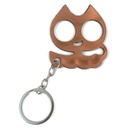
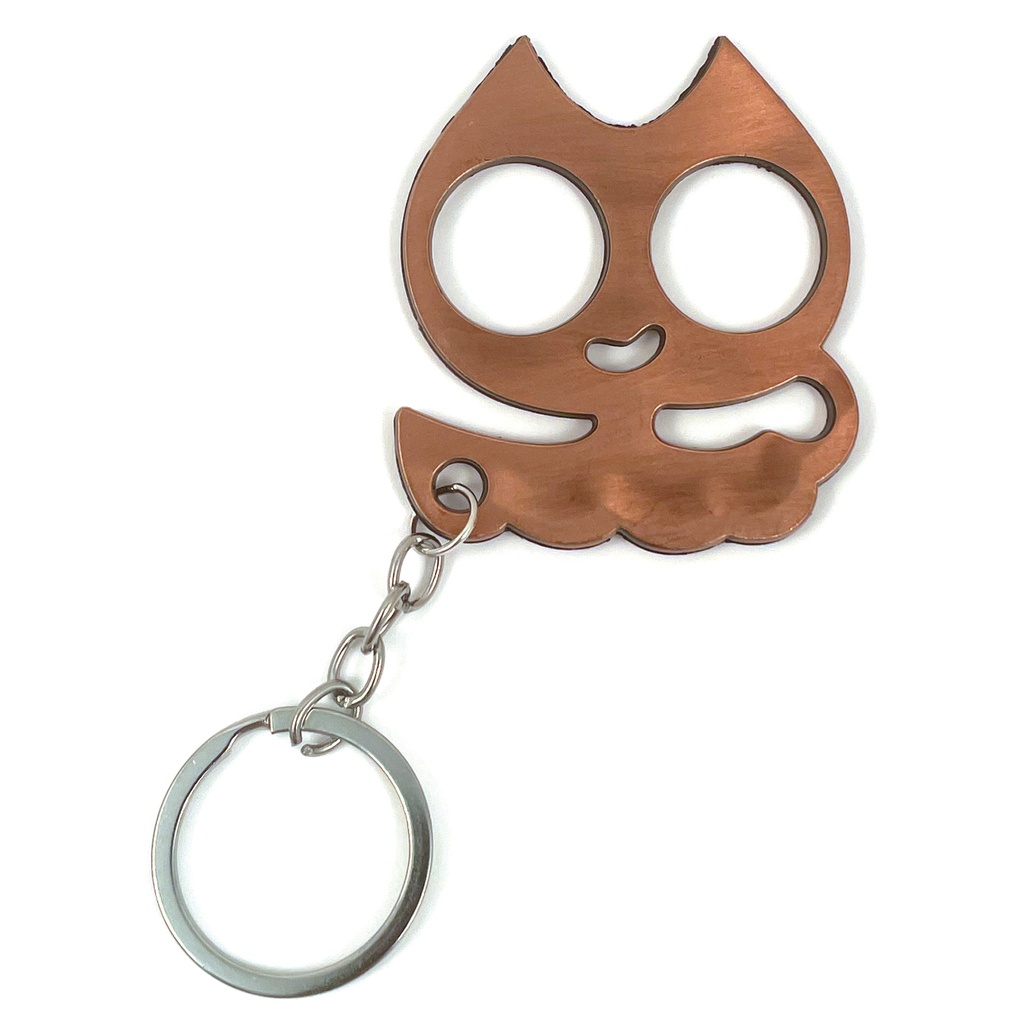
Sidewalk Sentinel Cat Self-Defense Keychain - Copper
14 sold in last 24 hours
This isn’t a toy cat; it’s a purpose-built self-defense keychain designed to disappear into your daily carry until it’s needed. The copper-toned body drops over two fingers for a locked-in grip, while the pointed ears focus force where it counts. Compact at roughly 2 x 2.5 inches, it rides on a standard split ring so your hand naturally finds it under stress. Cute at a glance, serious when required—this is quiet insurance that actually fits your life.
Sidewalk Sentinel Cat Self-Defense Keychain - Copper
Not every fight starts when you’re ready for it. That’s why serious everyday carry isn’t just about knives and flashlights—it’s about what’s already in your hand when trouble shows up. This copper cat self-defense keychain is built for that exact moment: small, flat, and unassuming until you slide your fingers through and those ears become focused points of impact.
Why This Self-Defense Keychain Works When Seconds Matter
Most people fumble when they’re scared. Digging in a bag for a bulky tool you never actually carry is a fantasy, not a plan. This keychain rides on a simple split ring and short chain, which means it lives where your hand already goes a dozen times a day. In a tight hallway, parking lot, or stairwell, you don’t need to deploy, unfold, or find a switch—you just lock your fingers through the eye holes and close your fist.
The flat copper-colored body gives you contact on both sides of the hand, improving control and keeping the tool indexed even under adrenaline. Those pointed cat ears aren’t cosmetic; they concentrate the force of your strike into a smaller surface area, which is exactly what you want from a last-resort impact tool.
Design Details That Separate It From Cheap Novelty Keychains
This category is flooded with cartoonish junk—pot-metal castings with rough edges, bad ergonomics, and designs that clearly came from a clip-art file, not real-world thinking. This piece does a few things better:
Finger Holes That Actually Fit Real Hands
Those two circular eye cutouts aren’t random. They’re sized so most adult fingers can slip through quickly without hunting for alignment. Once you’re in, the flat profile keeps the tool from twisting under pressure, and the lower scalloped edge gives your fingers a defined resting point instead of a vague, uncomfortable lump.
Point Geometry With Purpose
The cat ears form two forward-facing points. They’re not razor-sharp—that’s not the goal—but they are acute enough to focus impact without catching on pockets or clothing. It’s the same principle that makes a good kubotan or palm stick effective: precise, directed pressure in a compact form.
Carry Reality: How This Copper Cat Fits Into Your EDC
Every serious carrier eventually learns the same truth: if it’s annoying to carry, you’ll stop carrying it. This self-defense keychain earns its spot because it behaves like any other key fob until you need it.
- Form factor: Roughly 2 x 2.5 inches, flat, and low bulk
- Attachment: Standard split key ring with short chain for easy indexing
- Profile: Smooth, brushed copper-colored finish that won’t shred pockets
The warm copper tone reads as an accessory, not a weapon. That matters in public spaces, classrooms, and workplaces where overtly tactical gear draws eyes. This blends in with lanyards, charms, and regular house keys while still being solid enough to make a difference if you’re forced to use it.
Material & Build: Why the Copper Finish Matters
The copper-colored metal body isn’t just for aesthetics. Metal gives you three critical advantages over plastic self-defense keychains:
- Rigidity under stress: Less flex means better energy transfer on impact.
- Durability: It tolerates daily knocks, drops, and keyring abuse without deforming.
- Weight balance: Enough heft to matter, not so much that it turns your keyring into an anchor.
The brushed finish keeps edges comfortable in the hand while avoiding the slick, glossy feel that can slide when your palms are sweaty. It’s subtle, but in a fight subtle is usually what decides whether you keep your grip or lose it.
Legal & Practical Context for Self-Defense Keychains
Unlike an automatic knife, OTF, or traditional switchblade, this cat self-defense keychain is a blunt-force impact tool with no moving parts and no edged blade. That typically puts it into a different legal bucket than knives, but that doesn’t mean it’s automatically legal everywhere.
Some jurisdictions regulate or restrict "knuckle"-type weapons, keychain impact tools, or any object designed primarily for self-defense. In others, items like this occupy a gray area: not explicitly banned, but potentially subject to an officer’s discretion if carried in sensitive locations like schools, courthouses, or airports.
The smart approach is simple: check your local and state laws on self-defense keychains, impact tools, and knuckle-style devices before carrying. Avoid restricted areas, and understand that intent and context matter. This is a tool, not a toy—carry it with the same responsibility you’d bring to any defensive option.
What Buyers Ask Before Purchasing an Automatic Knife
Even though this product is a self-defense keychain and not an automatic knife, most serious EDC buyers cross-shop it with folders, OTF options, and other tools. These are the questions that come up every time.
Are automatic knives legal?
In the United States, automatic knife legality is a mix of federal and state rules. Federal law (the Switchblade Knife Act) mainly restricts interstate commerce and mailing of switchblades and automatic knives, especially across state lines and into certain jurisdictions. Day-to-day carry is governed by state and sometimes local law. Some states allow automatic knives and OTFs with few restrictions, others limit blade length or carry method, and a few still ban them outright. Before you buy or carry an automatic knife, OTF, or traditional switchblade, you should verify the current laws where you live and where you travel—statutes change, and enforcement can vary by city or county.
What’s the difference between an automatic knife, OTF, and a switchblade?
Mechanically, an automatic knife is any knife whose blade opens under spring tension when you hit a button, lever, or switch—no wrist flick required. A side-opening automatic looks like a standard folding knife but fires out from the side. An OTF (out-the-front) knife is a specific type of automatic where the blade travels straight out the front of the handle, either single-action (auto deployment, manual retraction) or double-action (auto both ways). The term switchblade is the older legal and cultural name that usually refers to automatic knives in general, especially in statutes. All three share one core trait: you actuate a control and the blade deploys under its own spring power.
What makes this self-defense keychain worth buying?
This copper cat keychain earns its spot in your rotation because it respects the same principles that make a good automatic knife or OTF worth owning: reliable deployment, ergonomic control, and real-world carryability. It lives where your hand already goes, requires no fine-motor deployment under stress, and gives you a defined, controllable striking surface in a compact footprint. Add the discreet, non-tactical look and solid metal construction, and you’ve got a defensive option that fits your life on the days you can’t—or choose not to—carry a blade.
For Carriers Who Take Everyday Preparedness Seriously
If you’re the person who thinks about how gear actually works under pressure, this self-defense keychain makes sense. It’s not a replacement for an automatic knife, OTF, or fixed blade, and it doesn’t pretend to be. It’s the layer that’s always there when everything else is buried in a bag or left at home.
In a market full of gimmicks, this copper cat is simple, direct, and built around the way real people actually move through the world—keys in hand, eyes up, and a quiet plan if something goes wrong.