Signal Core 5-Tool Survival Whistle - Red
12 sold in last 24 hours
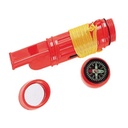
Built for the moments you don’t plan, the Signal Core 5-Tool Survival Whistle keeps your critical signaling tools on a single neck cord. A loud whistle, integrated compass, separate signal mirror, flint striker, and waterproof compartment give you sound, direction, fire, and dry storage in one compact pod. Lightweight, high-visibility red and yellow housing makes it easy to find when conditions turn sideways, so your backup plan is literally hanging within reach.
Signal Core 5-Tool Survival Whistle - Red: Small Pod, Full-Scale Signal Kit
Serious backcountry travel isn’t just about blades and firesteel. A compact survival whistle that actually does more than make noise is one of those pieces that earns its spot on your neck cord or in your kit. The Signal Core 5-Tool Survival Whistle - Red takes the classic emergency whistle and pushes it into real survival tool territory with five genuinely useful functions packed into a bright, high-vis pod.
Why This Survival Whistle Earns a Permanent Place in Your Kit
This isn’t a novelty keychain. The Signal Core is built around a loud, high-pitch whistle body in safety red, then layers on tools you actually reach for when things go off-script: a working compass in the end cap, a dedicated signal mirror, a flint striker for ignition, and a waterproof compartment for critical micro-gear. It’s neck-ready out of the box with a yellow cord that’s easy to spot in snow, brush, or the bottom of a dark pack.
Mechanics of a Real Survival Whistle, Not a Toy
Good survival gear is about redundancy and reliability, not gimmicks. The Signal Core 5-Tool Survival Whistle leans on simple, mechanical solutions that work when batteries, screens, and apps don’t.
Whistle Body: High-Visibility, High-Volume Design
The glossy red cylindrical body isn’t an aesthetic decision; it’s about being found. The rectangular mouthpiece and dual-tone style opening are designed to move air hard and fast, creating a sharp, attention-cutting blast that carries over wind, trail noise, and tree cover. Molded grip ridges give your fingers purchase when your hands are cold, wet, or shaking, so you can get a full breath behind the signal without fumbling the tool.
Compass, Mirror, and Waterproof Core: Simple Systems That Work
The removable end cap houses an integrated compass with cardinal directions and degree markings. Is it a full orienteering baseplate? No. Is it exactly what you need to keep your general heading when you’re fogged in or turned around off-trail? Yes. The compass sits in the cap, so when the pod hangs around your neck, it’s protected but ready the second you need to check bearing.
The threaded section reveals a compact waterproof compartment, sealed with a black O-ring. This is where you stash the tiny, must-not-fail items: storm matches, water purification tablets, a rolled-up note with emergency contacts, even a small tinder bundle. The separate red-framed signal mirror gives you another signaling axis—visual flash—when sound alone isn’t enough, or when you’re trying to flag aircraft, boats, or distant teams across a valley.
Built for Real-World Carry and Emergency Reality
Survival gear you leave in a bin doesn’t help. The Signal Core survival whistle is compact and neck-ready by design. The yellow woven cord wraps the midsection and runs as a lanyard so the whistle rides where it should: on your chest, outside your jacket or pack straps, not buried three zippers deep. The high-vis red and yellow color pairing is intentional—easy to find in low light, snow, or leaf litter.
The cylindrical form factor and smooth surfaces keep it from snagging on clothing or pack straps, while the cord gives you enough length to bring the whistle to your mouth or the compass and mirror up to eye level without unclipping anything. It’s light enough that you forget it’s there—right up until you need it.
Automatic Knife Buyer, Meet the Other Piece of Your Kit
If you’re the kind of buyer who cares about the difference between a single-action and double-action automatic, you already think in terms of systems: primary, backup, last-ditch. This survival whistle sits firmly in that last category. Your automatic knife handles cutting, prying, and emergency first-response work. The Signal Core whistle covers sound signaling, basic navigation, fire-starting, and micro-storage in a single, failure-resistant pod.
No moving parts beyond a threaded cap. No springs to fatigue, no batteries to die, nothing to update. When your phone is dead and your GPS is frozen, this is the analog signal stack that still works.
What Buyers Ask Before Purchasing an Automatic Knife
Automatic knife buyers are usually the same people who build serious kits—so the questions they ask about knives spill over into their survival tools too.
Are automatic knives legal?
In the United States, automatic knife legality is a mix of federal shipping rules and state carry laws. Federally, automatic knives (often called switchblades in statutes) are restricted in interstate commerce with some exemptions for military, law enforcement, and specific uses. Day to day, what matters is your state and local law: some states allow automatic knives for everyday carry, some limit blade length or restrict concealed carry, and a few ban them outright. If you’re planning to buy an automatic knife for EDC, check current state and local codes—don’t rely on decade-old forum posts. Your survival whistle, by contrast, is universally legal to carry.
What’s the difference between an automatic knife, OTF, and a switchblade?
In enthusiast terms, an automatic knife is any knife where the blade deploys under spring tension with a press of a button, lever, or similar control. Most side-opening automatics pivot from the handle spine like a traditional folder, just powered. An OTF knife—out-the-front—is a subtype where the blade travels linearly out of the handle’s front slot. Double-action OTF knives both deploy and retract under spring power; single-action OTFs deploy automatically but require manual retraction.
“Switchblade” is the legal term most statutes use to lump all automatics and many OTF knives together. Collectors tend to use “automatic” for the mechanism, “OTF” for the specific out-the-front configuration, and “switchblade” when talking about laws or older traditional designs. Knowing those distinctions matters when you shop, compare mechanisms, or read legal language.
What makes this survival whistle worth buying?
From a serious-gear perspective, this survival whistle earns its spot because it replaces several separate items in your kit without becoming a gimmick. You get a loud, easy-to-grip whistle; a real, readable compass in the cap; a dedicated signal mirror; a functional flint striker; and a small waterproof compartment for must-stay-dry micro gear. All of it rides on a bright neck cord in a compact, high-vis pod.
If you already care enough to choose the right automatic knife for sale based on mechanism and steel, you’ll recognize the value here: purposeful functions, simple mechanics, and redundancy where it counts—signal, direction, fire, and storage.
Round Out Your Kit Like a Serious Enthusiast
Collectors and experienced outdoorspeople don’t stop at the blade. They think in layers of capability. Pairing a well-chosen automatic knife for sale with a compact, multi-function survival whistle like the Signal Core 5-Tool Survival Whistle - Red is how you quietly elevate your loadout from "good enough" to "actually prepared." This is the kind of small, overlooked piece that separates a casual weekend kit from a system built by someone who’s thought through worst case and still plans to walk out on their own terms.